As a continuation of 5G Advanced, Release 19 will focus on performance improvements and on meeting key requirements for commercial 5G deployments. Ericsson expects 5G Advanced to continue evolving within 3GPP during this decade, and anticipates that standardization activities for 6G will accelerate in Release 20 and Release 21, with initial work starting around 2025.
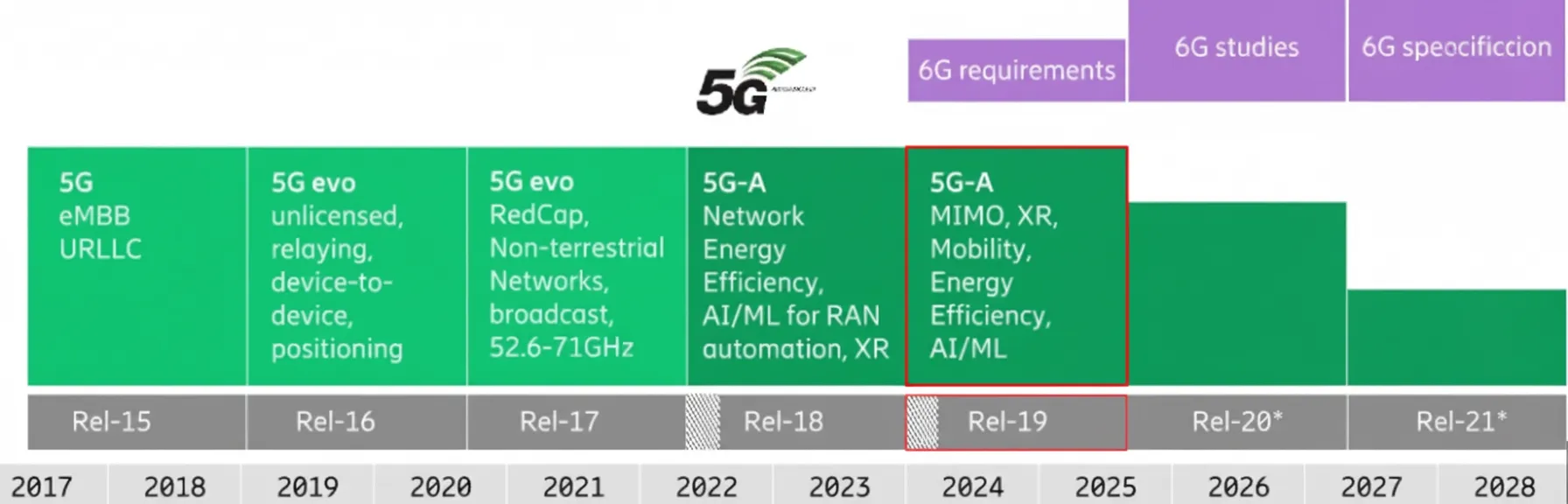
Figure 1: Ericsson view of the 3GPP 5G Advanced and 6G timeline (dates after 2025 are indicative)
1. High-performance 5G network MIMO
In Release 19, massive MIMO will support very large antenna arrays to deliver higher gain and more flexible beamforming. This is important for new bands in the 6–7 GHz range. Release 19 will also introduce enhancements to enable cost-effective distributed transmitters, a step toward large-scale distributed MIMO (D-MIMO) deployments.
Finally, Release 19 will permit UE-initiated measurement reporting to accelerate 5G beam management procedures. This feature enables faster beam selection, which is especially relevant for mobile users.
2. Mobility
The L1/L2-triggered mobility (LTM) framework will be extended in Release 19 to support handovers between serving cells on different gNBs. LTM will add support for NR-NR dual connectivity across FR1 and FR2. Ericsson experts note that Release 19 will also explore the use of artificial intelligence and machine learning (AI/ML) to improve mobility, for example by predicting the best serving cell. 3GPP research will balance AI/ML performance and complexity, and findings will inform mobility performance specifications in Release 20.
3. Dynamic Spectrum Sharing
Dynamic spectrum sharing (DSS) is a key deployment feature that lets 4G and 5G carriers share the same frequencies, facilitating migration from 4G to 5G. With DSS, a single base station can serve both 4G and 5G devices on the same spectrum.
DSS was introduced in early 5G releases and has been improved across several releases. Release 18 added handling for strong interference from neighboring 4G cells and improved the capacity and coverage of downlink control channels. After continuous improvements from Release 15 through Release 18, DSS is now mature and Release 19 does not plan further DSS enhancements.
4. Extended Reality
Release 18 introduced RAN and core enhancements for XR. To meet strict latency requirements, a low-latency low-loss scalable throughput mechanism (L4S) was introduced. L4S reduces queuing in the network by adjusting application data rates. Release 18 also defined the abstraction of media units, groups of packets that correspond to elements such as video frame rendering, enabling the access network to perform active queue management (AQM) that minimizes perceived quality impact when packets are dropped. Power-saving features specifically for XR devices were also added. The access network was made XR-aware via new signaling so XR application information, such as packet periodicity and QoS requirements, can be conveyed from the 5G core to the access network.
This work will continue in Release 19. Packet delay information can be used to improve uplink and downlink scheduling and thereby increase XR capacity. Release 19 will also enable data transmission during unused measurement gaps to reduce the impact of measurement gaps on throughput.
5. Indoor Positioning
AI and ML open new possibilities to improve positioning performance in specific scenarios. Release 18 studied AI/ML methods to improve 5G-based positioning accuracy, which is particularly valuable indoors where GNSS signals like GPS may not be available, for example in factories or offices. The 3GPP study focused on using AI to identify line-of-sight links between gNBs and UEs, since LOS conditions enable higher positioning accuracy.
Based on the Release 18 study, 3GPP will standardize AI/ML-driven positioning in Release 19 to improve accuracy.
6. Internet of Things
Release 17 introduced low-complexity NR RedCap terminals, reducing device cost and supporting industrial wireless sensor networks, wearables, and wireless cameras. RedCap devices can be equipped with a single receive chain to enable smaller wearable form factors.
Release 18 specified positioning and reduced peak data rates to 10 Mbps, further lowering RedCap complexity. Ericsson experts indicate that remaining RedCap topics will be discussed in Release 19, including support for satellite communication to enable truly ubiquitous NR IoT coverage.
Power-saving features are critical for IoT devices. In Release 18, 3GPP studied low-power wake-up signals (LP-WUS). Low-cost, low-power wake-up receivers (WURs) detect LP-WUS; their sole purpose is to wake the main receiver when an LP-WUS is present. Release 19 will standardize LP-WUS and WUR support.
7. Non-Terrestrial Networks
In Release 17, NR was adapted to support satellite communication in non-terrestrial networks (NTN). Release 18 included uplink coverage enhancements for NR NTN to facilitate stable, reliable voice and messaging. Mobility procedures between terrestrial and non-terrestrial topologies were strengthened to enable closer integration between these network types.
NR NTN evolution will continue in Release 19. One target is to improve downlink satellite coverage. 3GPP will study whether architectural changes are needed to deploy full gNBs on satellites. High-output-power terminals will be introduced. As noted earlier, RedCap terminal support for NTN is also planned.
8. Network Energy Efficiency
5G was designed to meet growing traffic demand while limiting mobile network power consumption. With the advent of 5G Advanced, network energy efficiency has gained increased attention. Release 18 defined a network energy consumption model to identify when energy efficiency improvements are possible and specified methods for gNBs to dynamically adjust antenna activation and transmit power.
Building on Release 18, Release 19 will add energy-saving features such as on-demand auxiliary cell SSB transmissions and on-demand SIB1 transmissions for idle-mode UEs. Both techniques will rely on a new trigger mechanism for on-demand transmissions.
Release 18 also included AI/ML-related work for network energy savings.
AI and ML for Next-Generation RAN Enhancements
Release 18 AI/ML work focused on three use cases: AI-driven network energy savings, load balancing, and mobility optimization. Signaling enhancements on NR interfaces (for example, UE-to-gNB and Xn between gNBs) enable AI applications for these use cases. 3GPP has agreed not to standardize AI models themselves to preserve vendor competition, incentives, and innovation.
Research into new use cases will continue in Release 19. A new use case is AI-assisted dynamic cell shaping, or AI-assisted coverage and capacity optimization.
9. AI and ML for Physical Layer Enhancements
Release 18 studied how AI/ML can improve radio interface functionality and performance, driven by three use cases: positioning, beam management, and channel state information reporting. The study also covered aspects of AI lifecycle management, including performance monitoring and testing.
Based on Release 18 conclusions, Release 19 will define a comprehensive framework for AI/ML applied to the air interface and will standardize AI/ML applications for use cases such as positioning and beam management. 3GPP will also continue exploring AI/ML applicability to other use cases like mobility.
10. A Bridge Toward 6G
Within the Release 19 timeframe, research on 6G use cases and service requirements is expected to begin in Service and System Aspects working group 1 (SA1). In-depth technical studies covering 6G radio access design are expected in Release 20, with Release 21 targeting 6G radio access standardization to prepare for potential commercial 6G releases around 2030. Ericsson states that many Release 19 projects will provide a bridge from 5G Advanced to 6G.
XR is expected to evolve into immersive human-machine communication and will drive new 6G requirements to improve user experience. AI and ML are expected to play an important role in 6G from day one. Network energy efficiency improvements in 5G Advanced will provide benchmarks for sustainable network design in the 6G era. D-MIMO solutions introduced in Release 18 and Release 19 will lead toward D-MIMO in 6G.
Release 19 will include two study items focused on channel modeling to lay groundwork for future work: integrated sensing and communication (ISAC) channel modeling, which enables networks to support both communication and environment sensing, and validation of 3GPP channel models in the 7–24 GHz range, particularly investigating new centimeter-wave spectrum for 6G.
11. Conclusion
The completion of Release 18 marked the introduction of 5G Advanced. Building on Releases 15 through 17, 5G Advanced reflects the cumulative progress in 5G evolution since 2018 and is expected to further enhance 5G commercial value.
As a continuation of 5G Advanced, Release 19 will focus on solutions that sustain commercial 5G investment by improving performance and meeting critical requirements. At the same time, Release 19 will serve as a bridge toward 6G, with many solutions providing baselines for future 6G systems.