Introduction
IEEE Transactions on Communications recently published a paper from researchers at Tsinghua University's Department of Electronic Engineering, the Microwave and Antenna Research Institute, and the Communications Research Institute titled "Transmissive RIS for B5G Communications: Design, Prototyping, and Experimental Demonstrations." Reconfigurable intelligent surface (RIS) technology can shape wireless channels and has been identified as a potential key technique for 6G networks.
Background
Most existing RIS research focuses on reflective RIS, which creates an additional communication link between a base station and a user via reflected beamforming to improve system performance. Reflective RIS requires the base station and the user to be on the same side of the RIS, a topology constraint that limits application scenarios. For example, a reflective RIS mounted on a window is ineffective for enhancing outdoor base station coverage for indoor users.
Transmissive RIS addresses this limitation by allowing signals to pass through the surface while controlling phase or amplitude during transmission. This enables transmissive beamforming to fill coverage blind spots left by reflective RIS, which is valuable for achieving seamless coverage in 6G deployments.
Prototype Design
The authors developed a 256-element millimeter-wave transmissive RIS with 2-bit phase control. Each RIS element consists of three parts: a receiving dipole, a 90° digital phase shifter, and a transmitting dipole. Two PIN diodes load the transmitting dipole to control current direction; by reversing the current, a stable 180° phase difference is obtained across the operating band, achieving 1-bit phase control. The 90° digital phase shifter is loaded with two PIN diodes to select 0° or 90°. Combined, each element can select 0°, 90°, 180°, or 270°, realizing 2-bit phase control.
Experimental System
Based on the RIS prototype, a transmissive RIS-assisted millimeter-wave communication system was implemented. The system components included a transmitter PC, a transmit horn antenna, an obstruction slab, the transmissive RIS, a receive horn antenna, and a receiver PC. The transmit horn was aimed at the RIS. The RIS applied 2-bit phase shift beamforming to the received signal and re-radiated the through-RIS signal to the receive horn. A slab of marble was placed between the RIS and the transmitter to test obstruction resilience. The system operated at 28 GHz with 800 MHz bandwidth, using CP-OFDM modulation and 16-QAM constellation mapping.
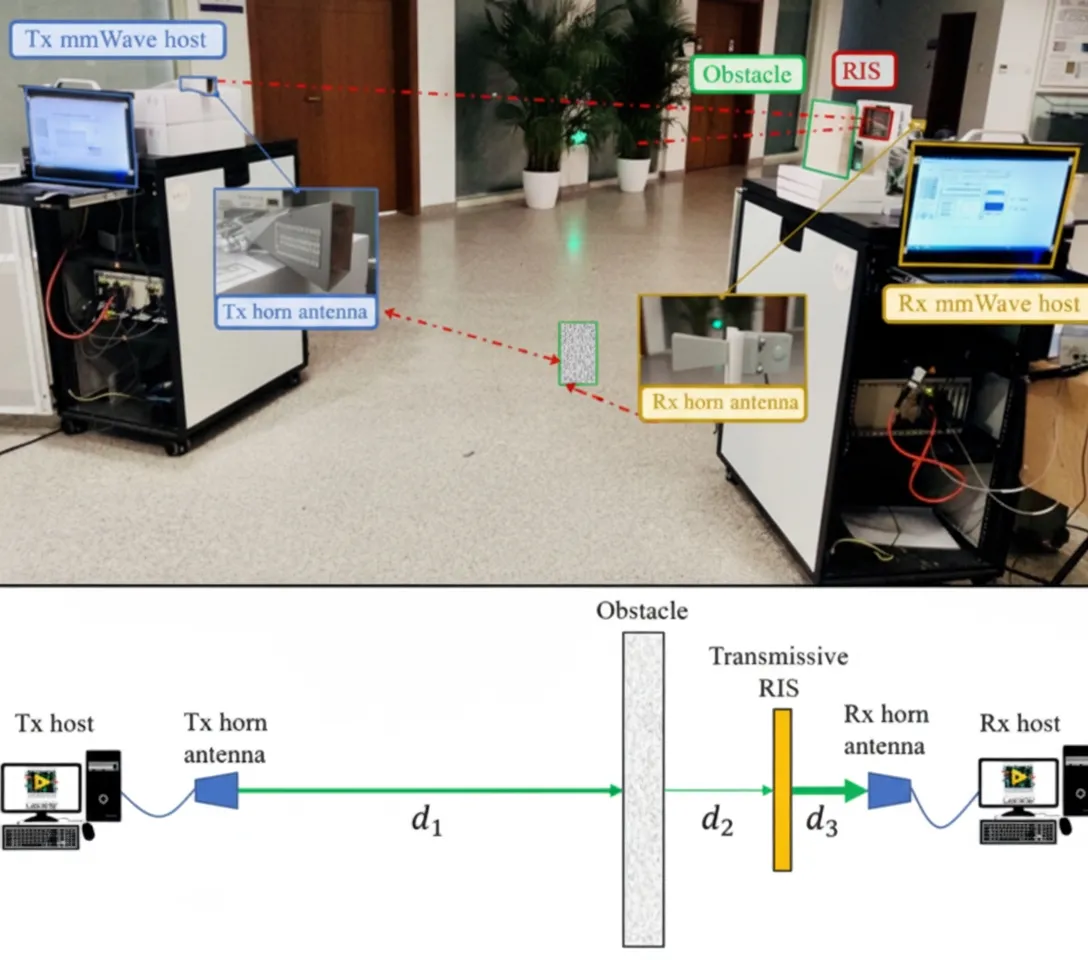
Figure 1: Transmissive RIS-assisted millimeter-wave communication system
Measured Results
Array gain: With no marble slab placed in front of the transmit antenna, experiments compared scenarios with and without the transmissive RIS to measure beamforming gain. Without the RIS, a transmit power of 13.6 dBm was required to achieve 1024 Mbps. With the RIS deployed, only 5.4 dBm was required to reach 1121 Mbps. Under approximately equal data-rate conditions, the transmissive RIS provided an 8.2 dB transmissive beamforming gain.
Obstacle resilience: The study also evaluated the effect of an obstruction and the RIS deployment on throughput. With no obstruction and no RIS, throughput was about 1024 Mbps. With an obstruction and no RIS, throughput dropped to 0 Mbps and the link was blocked. With an obstruction and the RIS deployed, throughput reached 1683 Mbps and the link was restored. These results indicate that the transmissive RIS beamforming gain exceeds the attenuation introduced by the obstruction, enabling effective mitigation of blockage and improved coverage.
Conclusion
This work demonstrates a 256-element, 2-bit phase-controlled millimeter-wave transmissive RIS and a transmissive RIS-assisted mmWave communication prototype. Experimental validation shows that transmissive RIS can significantly improve blockage resilience and enhance wireless signal coverage, indicating practical application potential in 6G wireless systems. The work was carried out by Junwen Tang, Associate Researcher Shenheng Xu, Professor Fan Yang, Associate Professor Maokun Li, master's student Mingyao Cui, and Professor Linglong Dai from the Department of Electronic Engineering's Microwave and Antenna Research Institute and the Communications Research Institute at Tsinghua University.