Background
Recent increases in algal blooms have made monitoring algal toxins and their metabolites important for water quality assessment. Microcystins are cyclic peptide hepatotoxins with strong tumor-promoting activity and are among the most harmful cyanotoxins. Their pathogenic mechanism involves inhibition of protein phosphatases in hepatocytes, inducing hyperphosphorylation of cytokeratins, disruption and rupture of microfilaments, and hemorrhage. Microcystins can also affect other organs such as kidneys, causing physiological damage. Existing methods for detecting microcystins are often complex and costly. Advanced fluorescent nanosenors have shown potential for sensitive detection of these toxins.
Study and publication
According to a report by Maims Consulting, researchers at the Yantai Institute of Coastal Zone Research, Chinese Academy of Sciences, including Li Bowei and Qi Ji in the group led by Chen Lingxin, have advanced methods for detecting trace non-fluorescent environmental compounds. The results were published in Nature Communications under the title "Molecular imprinting-based indirect fluorescence detection strategy implemented on paper chip for non-fluorescent microcystin".
Detection approach
Fluorescent nanosenors are attractive for chemical and biological assays because of their convenience, sensitivity, and high throughput. Microcystins are nonfluorescent and cannot directly enhance or quench quantum dot emission, which complicates direct fluorescence detection. To address this, the team developed a general indirect fluorescence sensing approach that combines charge transfer effects with molecular imprinting for high-sensitivity, high-selectivity, and rapid microcystin detection.
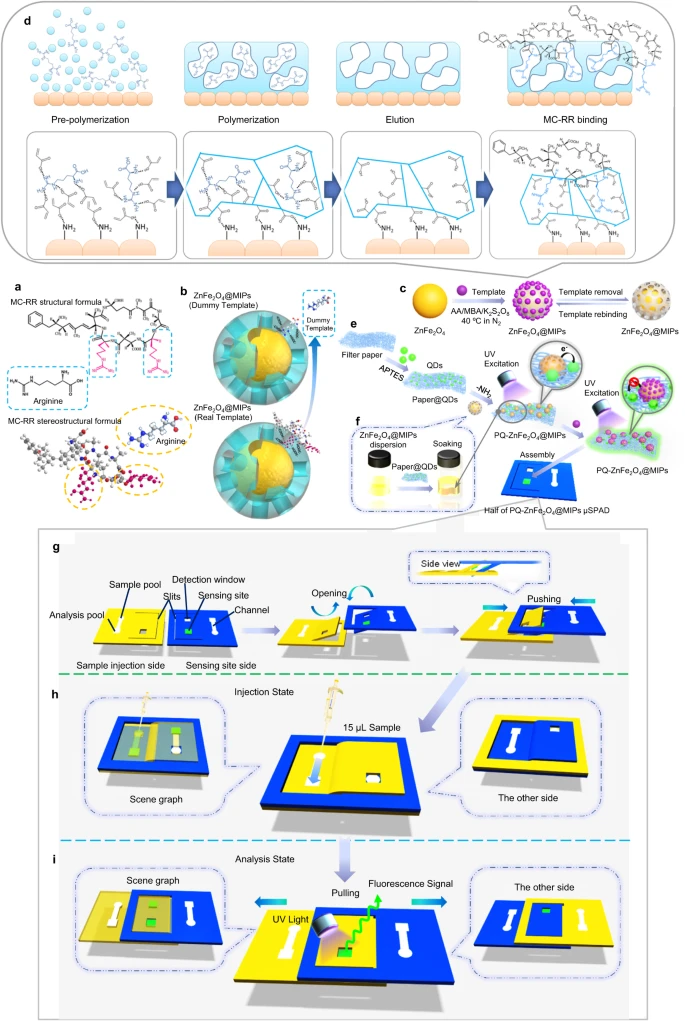
The sensing mechanism uses molecularly imprinted polymer (MIP) films to encapsulate zinc ferrite nanoparticles (ZnFe2O4@MIPs), which act as biomimetic quenchers, and couples them with fluorescent quantum dots on a paper-based chip. During recognition, the imprinted cavities in the MIP serve both as binding sites for microcystin molecules and as the only electron-transfer pathway linking the ZnFe2O4 nanoparticles and the quantum dots. When microcystin occupies the imprint cavities, it blocks electron transfer between the nanoparticles and the quantum dots, leading to recovery of the quantum dot fluorescence.
Platform design and performance
The researchers designed a "slidable clip" type paper-based chip that operates without sample pretreatment, enabling trace and efficient detection of microcystin in complex matrices. The platform was applied to real water samples from Taihu Lake (Wuxi) and achieved rapid, sensitive detection with a limit of detection of 0.43 μg/L and an assay time of 20 minutes. This indirect fluorescence approach provides a notable route for sensitive detection of fluorescence-inert targets.