Introduction
Automotive electronics form the backbone of modern vehicles, powering everything from engine control units to advanced driver-assistance systems. These components operate in harsh environments characterized by extreme temperatures, constant vibrations, and rapid thermal cycling. Ensuring automotive PCB reliability is paramount to prevent failures that could compromise safety and performance. Among the key factors influencing this reliability, the choice of copper thickness in printed circuit boards stands out. Specifically, 2oz copper PCBs, with their 70-micrometer-thick copper layers, offer superior performance compared to standard 1oz options. This article explores why 2oz copper PCB automotive applications are essential for achieving the durability demanded by the industry.
Understanding 2oz Copper PCBs and Their Role in Automotive Applications
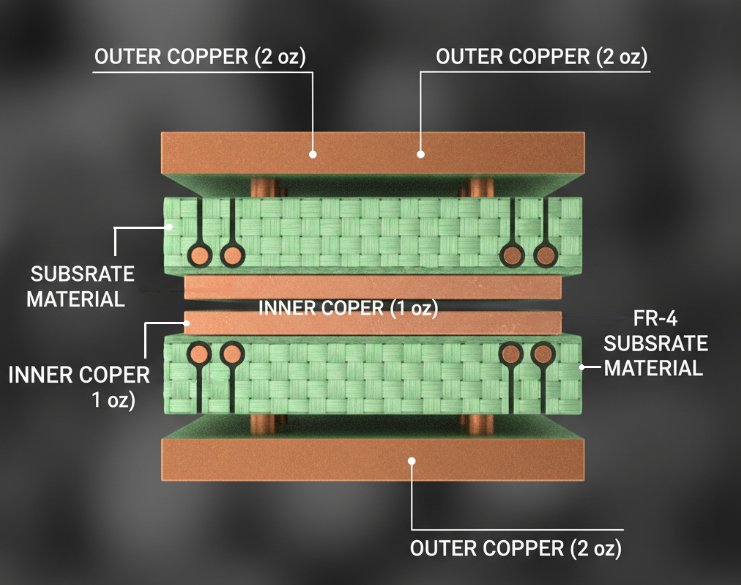
A 2oz copper PCB refers to a board where each square foot of copper foil weighs 2 ounces, translating to a nominal thickness of 70 micrometers per layer. This is double the thickness of the ubiquitous 1oz copper at 35 micrometers, providing a robust foundation for demanding circuits. In automotive contexts, where power distribution and signal integrity must withstand prolonged stress, thicker copper enhances overall board integrity. Electrical engineers specify 2oz copper for high-current paths in power modules and control systems to minimize resistance and heat buildup. The increased mass also contributes to better mechanical stability during manufacturing and assembly processes. As automotive systems evolve toward electrification, the need for such heavy copper constructions becomes even more critical for long-term reliability.
Automotive PCB reliability hinges on the board's ability to endure environmental stressors without degradation. Standard 1oz PCBs suffice for consumer electronics but falter under automotive conditions, where junction temperatures can exceed 125 degrees Celsius. 2oz copper mitigates these risks by offering improved thermal pathways and structural reinforcement. Engineers designing for vehicles prioritize this thickness to align with performance specifications that ensure zero-defect operation over the vehicle's lifespan. Vibration resistant PCB designs benefit particularly, as the extra copper reduces fatigue in traces and vias. Ultimately, opting for 2oz copper PCB automotive solutions translates to fewer field failures and extended service life.
Technical Mechanisms Behind Enhanced Reliability
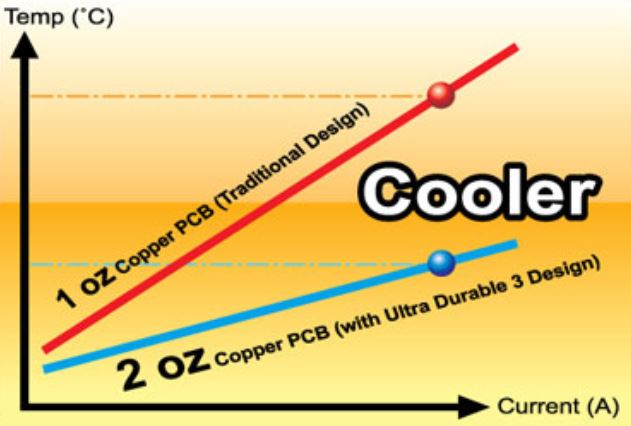
The primary advantage of 2oz copper lies in its superior current-carrying capacity, governed by principles outlined in IPC-2221. Thicker copper reduces electrical resistance, allowing higher amperage without excessive heating, which is vital for automotive power electronics. For the same trace width, a 2oz layer handles roughly twice the current of a 1oz layer, minimizing voltage drops and I-squared-R losses. This capability prevents hotspots that could accelerate material degradation in high-power applications like inverters and battery management systems. Electrical engineers model these effects using thermal simulation tools to verify performance under load.
Thermal management represents another cornerstone of automotive PCB reliability. Copper's high thermal conductivity, around 400 W/m-K, enables efficient heat spreading when layers are thicker. In high temperature PCB environments, such as under-hood modules, 2oz copper acts as a heat sink, lowering peak temperatures in adjacent components. This reduces the risk of delamination or solder joint fatigue during thermal cycling. Compared to thinner foils, the added volume in 2oz designs provides a larger thermal mass, stabilizing temperature fluctuations. Compliance with IPC-9701 performance test methods confirms these benefits through accelerated life testing.
Vibration resistance emerges as a critical factor in automotive settings, where engines and road conditions induce constant mechanical stress. Thicker 2oz copper foils exhibit greater resistance to cracking and microcracking at trace-plating interfaces. The enhanced rigidity minimizes warpage and bowing, preserving via integrity over millions of cycles. Studies show that heavy copper constructions improve shock resistance significantly, making them ideal for vibration resistant PCB requirements. Electrical engineers consider coefficient of thermal expansion mismatches between copper and substrates, where 2oz layers distribute stresses more evenly. This durability aligns with IPC-6012DS qualification standards tailored for automotive rigid boards.
Practical Best Practices for Implementing 2oz Copper PCBs
Selecting 2oz copper requires careful design adjustments to leverage its strengths fully. Engineers should widen traces proportionally to maintain impedance control while capitalizing on the higher current density allowance per IPC-2221 guidelines. During layout, allocate power planes with 2oz thickness to high-dissipation areas, ensuring adequate annular ring sizes around vias to prevent plating voids. Fabrication tolerances for heavier copper demand precise etching control to avoid undercuts, which could compromise reliability. High temperature PCB materials like high-Tg FR-4 laminates pair well with 2oz copper for synergistic performance.
Manufacturing processes for 2oz copper PCB automotive boards emphasize panel plating or direct metallization to achieve uniform thickness. Post-etch inspection verifies minimum copper weights as per IPC-6012 specifications, preventing reliability issues from thin spots. Solder mask application must account for the increased topography, using liquid photoimageable masks for better step coverage. Assembly teams benefit from the mechanical robustness, reducing handling damage during wave or reflow soldering. Vibration testing protocols simulate real-world conditions to validate the design.
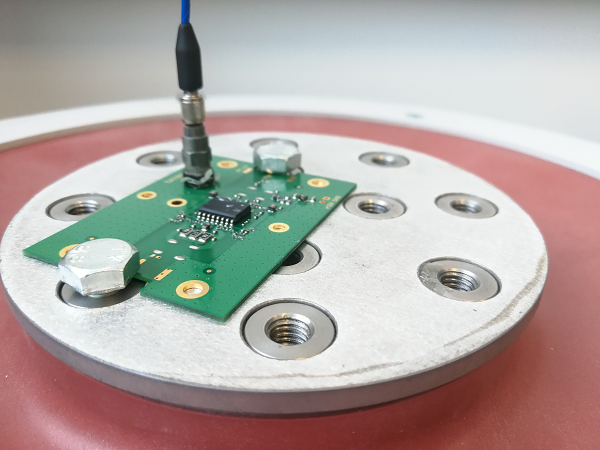
For troubleshooting common issues, engineers monitor for excessive heating or intermittent failures pointing to insufficient copper thickness. Upgrading to 2oz resolves these by enhancing dissipation and strength. In multilayer stacks, hybrid constructions with 2oz on outer layers and 1oz internals balance cost and performance. Always correlate designs with qualification tests under IPC-9701 to predict field behavior accurately.
Key Insights from Automotive PCB Deployments
In power electronics for electric vehicles, 2oz copper enables compact layouts without thermal throttling. Designers report improved margins in harsh environments, attributing this to the foil's inherent toughness. Vibration resistant PCB attributes shine in transmission controls, where thinner alternatives show premature wear. High temperature PCB demands in exhaust monitoring systems further underscore the necessity. These insights guide procurement toward 2oz specifications for mission-critical modules.
Conclusion
2oz copper PCBs stand as a cornerstone for automotive electronics reliability, addressing thermal, electrical, and mechanical challenges head-on. Their thicker foils deliver unmatched current handling, heat dissipation, and vibration resistance essential for modern vehicles. Electrical engineers gain confidence through adherence to standards like IPC-2221 and IPC-6012DS, ensuring designs meet rigorous demands. As automotive systems push boundaries, prioritizing 2oz copper PCB automotive solutions safeguards performance and safety. Integrating these boards optimizes the entire ecosystem from design to deployment.
FAQs
Q1: What makes 2oz copper PCB automotive designs superior for reliability?
A1: 2oz copper provides double the thickness of standard foils, enhancing current capacity and thermal spreading per IPC-2221. It resists vibration-induced fatigue better, crucial for automotive PCB reliability in engines and suspensions. High temperature PCB performance improves as thicker copper lowers resistance at elevated temperatures. Factory insights confirm longer lifespans under IPC-9701 cycling tests.
Q2: How does 2oz copper contribute to high temperature PCB applications?
A2: The 70-micrometer thickness acts as an effective heat sink, distributing thermal loads evenly across the board. This prevents hotspots in power circuits exposed to over 125 degrees Celsius. Automotive modules benefit from reduced CTE mismatches, minimizing warpage. Engineers specify it for compliance with qualification standards.
Q3: Why choose vibration resistant PCB with 2oz copper for vehicles?
A3: Thicker copper reinforces traces against mechanical stress from road vibrations and engine pulses. It reduces microcracking risks in vias and pads during prolonged exposure. This aligns with automotive durability needs, offering superior fatigue life compared to 1oz options. Practical testing validates its edge in harsh conditions.
Q4: When should electrical engineers specify 2oz copper in automotive PCBs?
A4: Opt for 2oz in high-current paths, power planes, or environments with extreme temps and vibes. It ensures automotive PCB reliability without oversized traces. Balance with cost by using hybrids in multilayers. Reference IPC-6012DS for qualification criteria.
References
IPC-2221B — Generic Standard on Printed Board Design. IPC, 2012
IPC-6012DS — Qualification and Performance Specification for Rigid Printed Boards for Automotive Applications. IPC, 2015
IPC-9701 — Performance Test Methods and Qualification Requirements for Via Reliability. IPC, 2017