Introduction
In the PCB manufacturing process, bare board testing serves as a critical gatekeeper before components are populated. This stage verifies the electrical integrity of unpopulated printed circuit boards, identifying defects such as opens, shorts, and improper connections that could lead to assembly failures or field returns. Electric engineers rely on these tests to ensure that the foundational wiring matches the design netlist precisely, minimizing risks in high-density, multilayer boards. Common bare board test methods include PCB continuity testing and PCB isolation testing, which form the backbone of quality control in factories. By catching issues early, manufacturers avoid the exponential costs associated with rework after soldering. Ultimately, robust bare board testing aligns production with reliability demands in demanding applications like aerospace and telecommunications.
What Is Bare Board PCB Testing and Why It Matters
Bare board PCB testing involves systematic electrical verification of printed boards without components, focusing on the copper traces, vias, and planes. Factory processes generate a test program from the design netlist, which maps all electrical networks, allowing automated equipment to probe points and confirm connectivity. This testing confirms that manufacturing steps like etching, plating, and drilling have produced a board true to specifications. Without it, subtle defects propagate to assembly, causing yield losses that strain production timelines.
The relevance stems from the complexity of modern PCBs, where multilayer stacks and fine-pitch features amplify defect risks. A single open in a power net or short between signal lines can render an entire assembly nonfunctional, leading to scrapped materials and delayed shipments. In high-volume factories, bare board testing achieves test coverage exceeding 90-100% for accessible nets, directly impacting overall equipment effectiveness. For electric engineers specifying boards, insisting on this step ensures compliance with performance expectations under operational stresses like thermal cycling.
Core Principles of Bare Board Test Methods
Bare board test methods primarily revolve around verifying electrical paths through resistance, capacitance, or vector-based measurements. PCB continuity testing applies a low-voltage stimulus to each net, measuring resistance to detect opens where paths exceed thresholds, typically in the megaohm range or higher indicating failure. Conversely, PCB isolation testing stresses adjacent nets with voltage differentials, checking for leakage currents or shorts below minimum resistance values. These methods use the netlist to sequence probes across thousands of points, ensuring comprehensive coverage.
Open short test PCB combines these into a single program, first charging nets capacitively to flag anomalies quickly, then refining with DC resistance for precision. Capacitance testing excels for high-speed detection on dense boards, as it induces charges without physical contact wear. Engineers appreciate how these principles scale from prototypes to production, adapting to board sizes up to 24x24 inches.
As outlined in IPC-9252, continuity must register below 10 ohms for Class 3 boards, providing a standardized benchmark for factory acceptance.
Resistance-based approaches dominate for accuracy, applying currents from microamps to milliamps while monitoring voltage drops per Ohm's law. Isolation often employs guarded measurements to eliminate stray capacitance influences, crucial for high-impedance nets. Vectorless testing supplements where probe access limits, using time-domain reflectometry for via integrity.
Bare Board Testing Equipment Overview
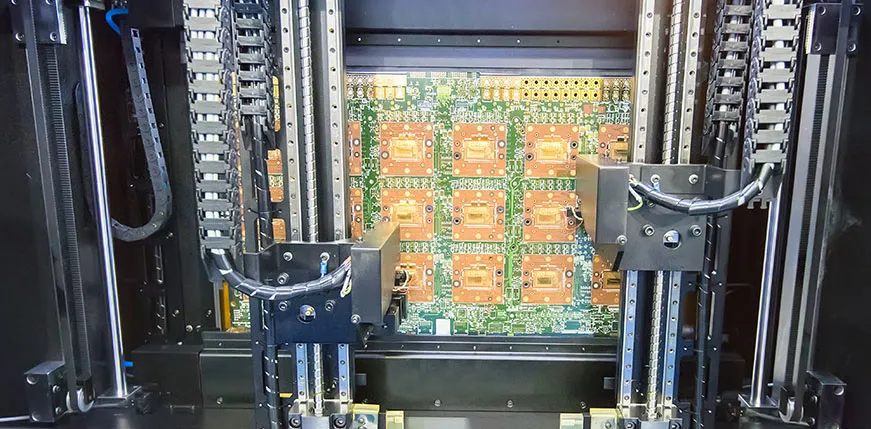
Factories deploy specialized bare board testing equipment tailored to volume and complexity. Flying probe systems use 2-8 independent probes that move via linear motors, contacting pads at speeds up to 150 points per second without custom fixtures. This flexibility suits low-to-medium volumes and double-sided boards, enabling quick program generation from netlists.
Bed-of-nails fixtures, or dedicated clamshell testers, press hundreds of spring-loaded pins against test points simultaneously, achieving throughputs over 100 boards per hour for high-volume runs. Universal grid systems offer a compromise, using interchangeable receiver fixtures on a common bed for faster changeovers. Selection hinges on net count, pitch down to 0.15mm, and multilayer depth.
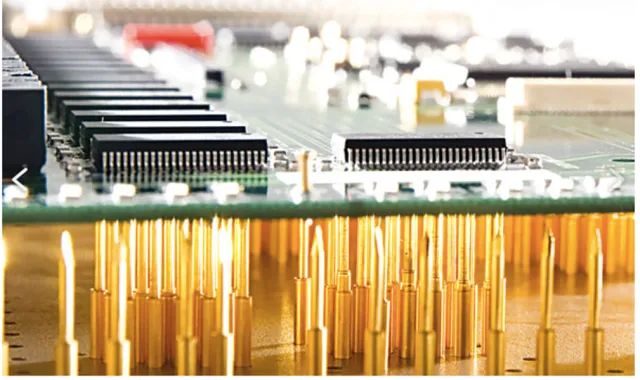
Advanced equipment integrates software for fault diagnosis, highlighting defect locations on Gerber overlays for repair routing. Probe force calibration to 50-150 grams prevents board damage, while vacuum hold-down ensures planarity during testing. Electric engineers value equipment logging test data for traceability, supporting failure mode analysis.
Practical Best Practices in Factory Implementation
Implement bare board testing post-final fabrication, after solder mask and silkscreen, to capture all process-induced defects. Verify netlist integrity against CAM data before programming, resolving discrepancies to avoid false calls. Aim for 100% net coverage, prioritizing high-speed signals and power planes first in test sequences.
Calibrate equipment daily per manufacturer guidelines, monitoring probe tip wear and fixture alignment. Segregate boards by class, applying IPC-6012 performance criteria for qualification lots. Document reject rates, targeting under 1% for mature processes, and feed data back to upstream etching controls.
Incorporate environmental controls, testing at 23°C and 50% RH to mimic assembly conditions. For HDI boards, combine flying probe with boundary scan prep for hybrid coverage.
Troubleshooting Common Bare Board Test Failures
Open failures often trace to drill breakout or plating voids, inspect vias microscopically for barrel integrity.Shorts arise from etch residue or mask misalignment, requiring plasma cleaning validation.False opens from probe misalignment demand fixture redesign with taller pins.Capacitance anomalies signal delamination; cross-section suspect nets.High continuity resistance flags thin plating; measure coupon resistances from panels.
Conclusion
Bare board PCB testing fortifies PCB reliability through meticulous continuity and isolation checks using proven equipment and methods. Adhering to standards like IPC-9252 ensures factory outputs meet engineering demands. Prioritizing these practices yields defect-free foundations for assembly success.
FAQs
Q1: What are the primary bare board test methods used in PCB manufacturing?
A1: Bare board test methods focus on electrical verification, including PCB continuity testing for opens and PCB isolation testing for shorts. Factories use capacitance for rapid screening and resistance for precise measurements against netlists. Flying probe or fixture-based systems execute these, achieving high coverage. Compliance with IPC standards guides thresholds, ensuring production quality.
Q2: How does PCB continuity testing detect defects in bare boards?
A2: PCB continuity testing sends low DC current through nets, measuring resistance to identify opens exceeding limits like 10 ohms per IPC-9252 Class 3. It sequences probes per netlist, logging failures for repair. This prevents assembly issues from manufacturing flaws such as via discontinuities. Engineers use it post-plating for early feedback.
Q3: What role does open short test PCB play in quality control?
A3: Open short test PCB verifies all nets for connectivity and isolation in one program, combining continuity and shorts detection. Essential for multilayer boards, it uses equipment like bed-of-nails for volume testing. Factories achieve near-100% coverage, reducing downstream yield losses significantly.
Q4: Which bare board testing equipment is best for high-volume production?
A4: Bed-of-nails fixtures excel for high-volume due to parallel probing and speed, contrasting flying probe's flexibility for prototypes. Both support open short test PCB via netlist programs. Select based on pitch and net count, ensuring calibration for accuracy.
References
IPC-9252A — Guidelines and Requirements for Electrical Testing of Unpopulated Printed Boards. IPC
IPC-6012E — Qualification and Performance Specification for Rigid Printed Boards. IPC, 2017
IPC-A-600K — Acceptability of Printed Boards. IPC, 2020