Introduction
Even advanced classical networks such as the Internet remain vulnerable to evolving cyberattacks. Quantum networks can mitigate some of these vulnerabilities by protecting data using quantum properties. A key challenge is that diverse quantum implementations currently lack cohesion, preventing systems from interoperating. Could the benefits of classical and quantum communication be combined to create a scalable, more secure network infrastructure? On June 13, 2023, DARPA announced the Quantum-Enhanced Network (QuANET) program to pursue this question.
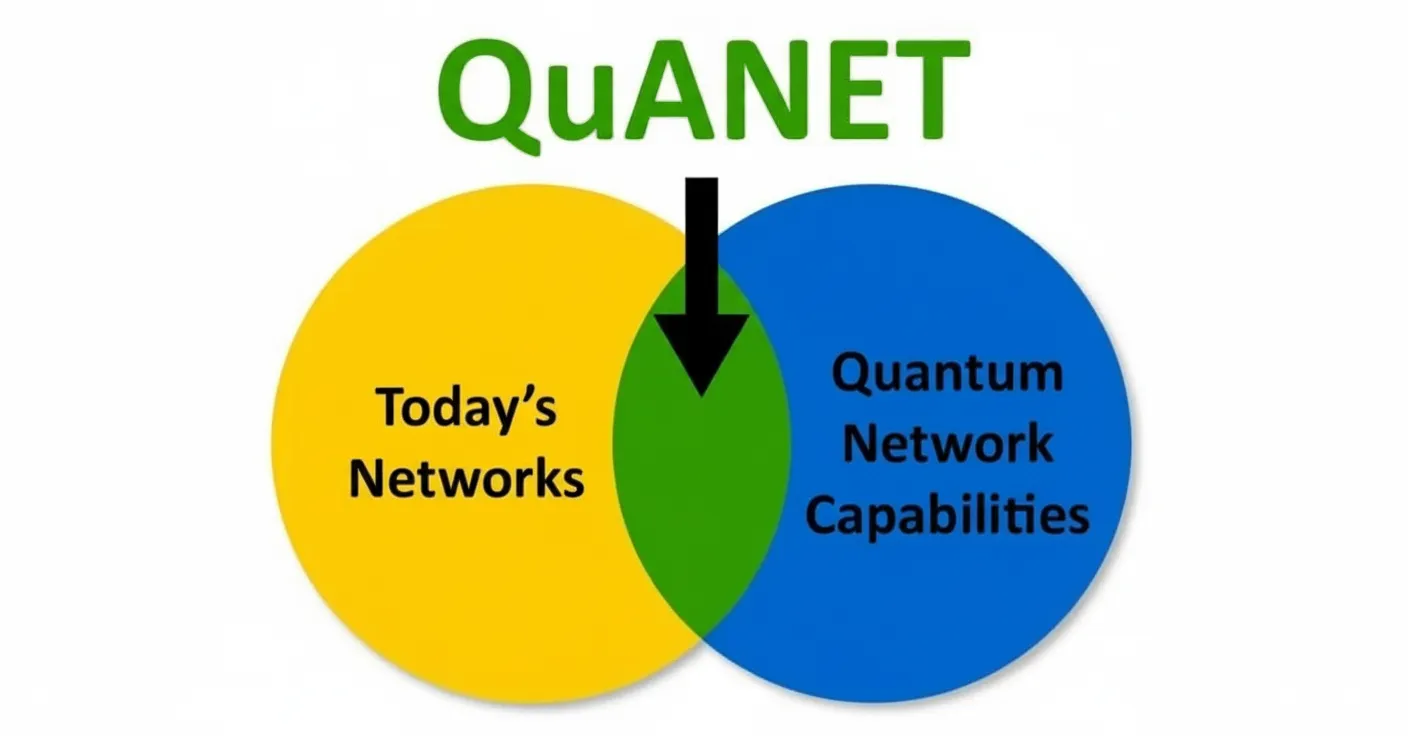
DARPA states that QuANET will explore how to integrate quantum and classical approaches into networks to provide quantum-physics-based security capabilities for critical network infrastructure. QuANET researchers will focus on combining current and future quantum network infrastructure, including hardware and protocols, with classical infrastructure to deliver security capabilities relevant to national security. DARPA anticipates combining quantum networks' secure and covert properties with the ubiquity of classical networks.
Allyson O'Brien, QuANET program manager in DARPA's Information Innovation Office, noted that a major challenge is connecting quantum optical links to today's computers in a secure, configurable way. The program aims to increase mutual understanding between the networking and optical-communications communities and the quantum community, potentially creating a new network paradigm. QuANET seeks to enable network infrastructure to use quantum systems in various ways and is not focused on quantum key distribution (QKD) as a primary objective. Quantum repeaters, switches, and routers are also out of scope for the initial program. The target scale is metropolitan-area networks.
Project Overview
DARPA's Information Innovation Office is soliciting research proposals to develop a hybrid quantum-classical communication network architecture that enhances the security and covertness of today's classical networks. Contemporary digital communication uses a layered software protocol stack. Upper layers are closer to applications on computers and servers (nodes), while lower layers are closer to physical media. Many advanced networks rely on security at the top of the stack, assuming it mitigates attacks at lower layers. However, advanced persistent threats (APT) are defeating many current defenses, increasing defensive costs for commercial and government entities.
QuANET aims to augment existing software infrastructure and network protocols with quantum properties to mitigate these attack vectors. The program plans to combine existing "best" quantum communication capabilities with networks used in military and critical infrastructure. Quantum information will coexist with classical information (quantum-classical interoperability), including:
- Quantum time synchronization to enhance clock synchronization tasks and time-of-flight measurements
- Quantum sensing and metrology within communication patterns to improve situational awareness of information flows
- Embedding classical information into quantum systems to mitigate information theft and data corruption
QuANET seeks hardware progress in the form of an environment-hardened, configurable network interface card that directly connects quantum links and classical computing nodes. This hardware should extend existing classical network capabilities.
Many quantum communications efforts focus on QKD. QuANET seeks to develop network infrastructure that supports broader uses of quantum communication beyond QKD. The hybrid quantum-classical infrastructure will enable network and communications experts to develop applications that are not limited to QKD. Proposals focused primarily on QKD are strongly discouraged.
The initial design and development will emphasize integrating current quantum capabilities into classical infrastructure. Quantum interconnects such as repeaters, switches, and routers are out of scope; proposals should describe modular approaches that consider future interconnects. The desired solutions should scale to metropolitan-area network (MAN) size.
QuANET Architecture
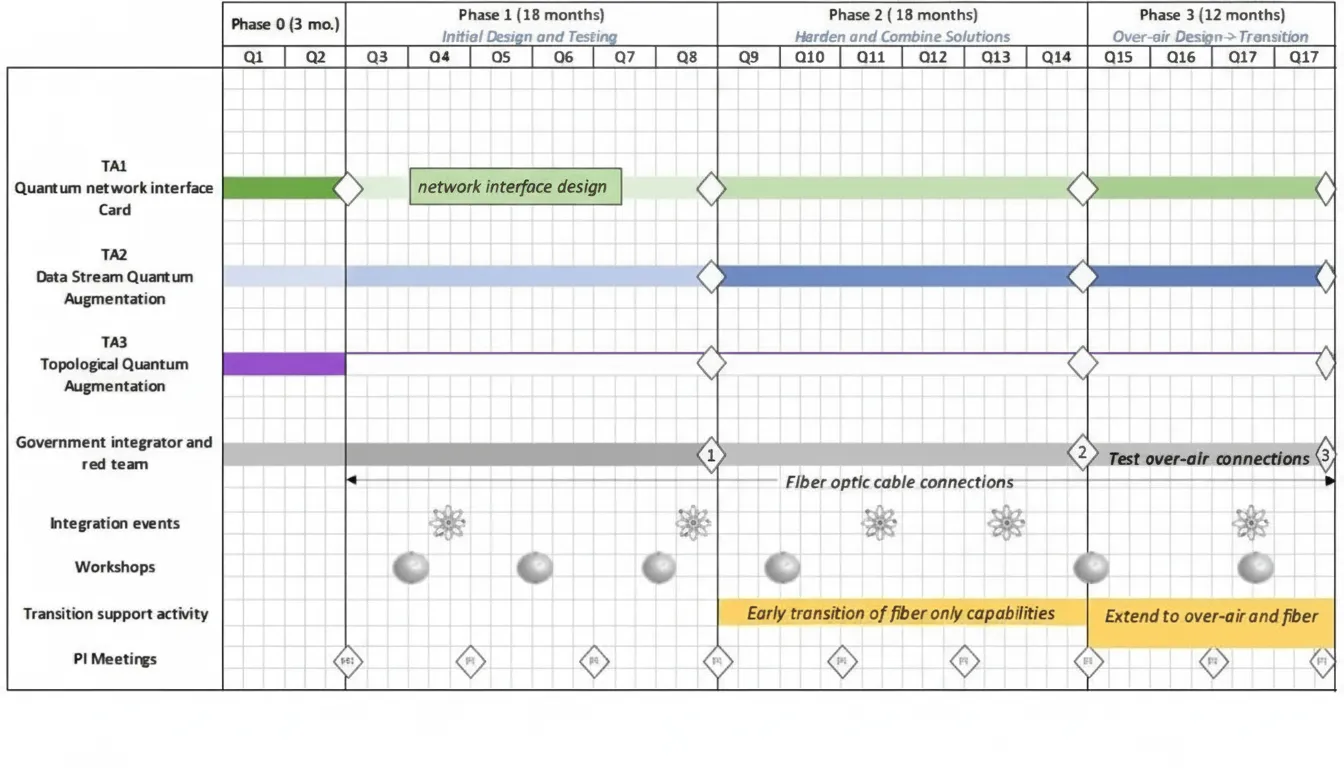
QuANET is a 51-month, four-phase program. Phase 0 (3 months) focuses on qNIC design. Phase 1 (18 months) concentrates on qNIC fabrication and prototype data flows and topologies. Phase 2 (18 months) emphasizes integrating the qNICs with fiber networks to enhance data flows and topologies. Phase 3 (12 months) focuses on scalability for fiber quantum-enhanced networks and preliminary designs for aerial links. Phases 2 and 3 should be proposed as separately priced options. The government may exercise options based on metrics and milestones in the BAA and on available funding.
Selected performers are expected to collaborate. The government will require a Joint Contractor Agreement (ACA) to facilitate open information exchange. The ACA will help ensure compatibility among software components, system architectures, devices, data, and other project elements to prevent duplicate work and maximize integration. All selected performers must complete the ACA before the project kickoff.
Technical Areas
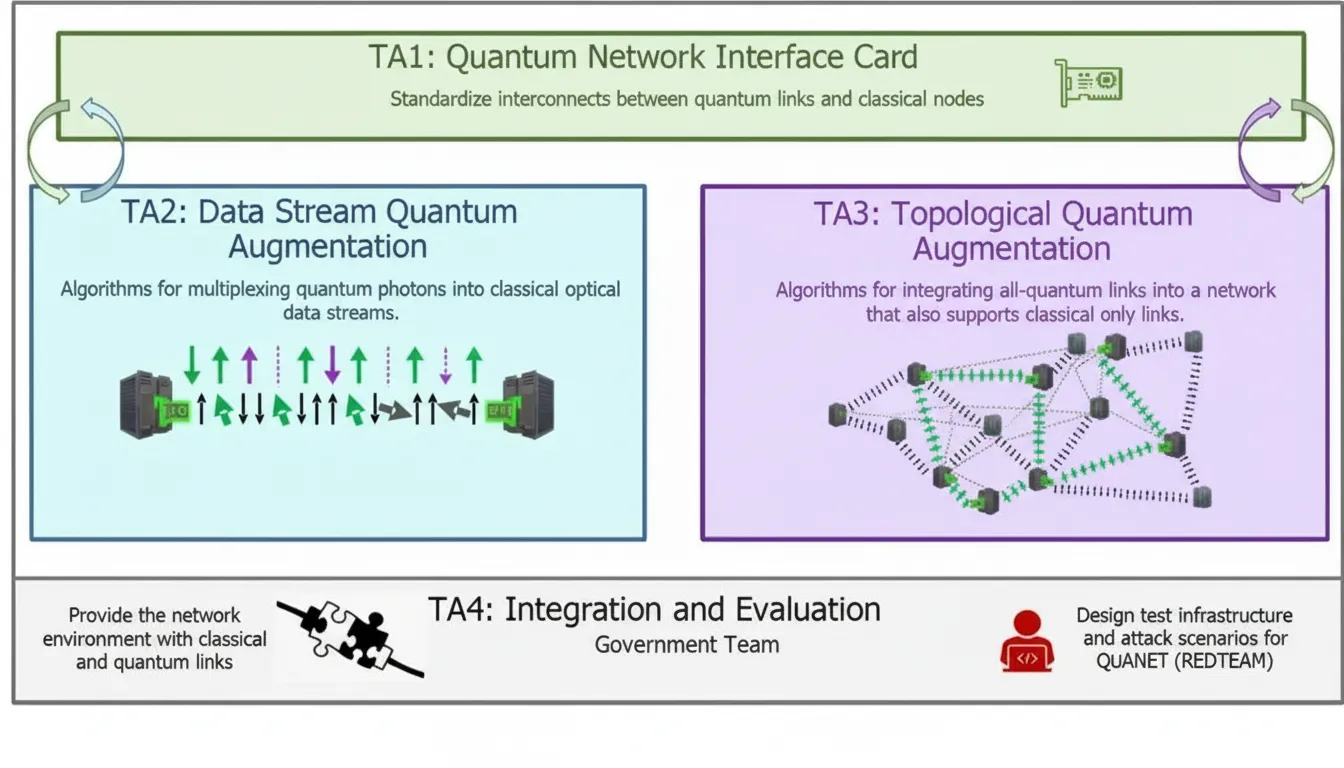
QuANET will develop technologies that give classical networks quantum-enhanced characteristics. The program focuses on three technical areas (TAs), with TA4 serving as a government integration and evaluation team (TA4 is not solicited under this BAA).
- TA1: Develop, ruggedize, and miniaturize a quantum network interface card (qNIC) that directly connects quantum links and classical compute nodes. The qNIC must send and receive quantum information alongside classical information and handle quantum timing and sensing data. Embedded qNIC software is expected to begin integration with TA2 and TA3 solutions in Phase 2.
- TA2: Build algorithms, protocols, and software infrastructure that use quantum timing and sensing data to enhance classical communication. These software tools are expected to integrate into the TCP/IP network stack.
- TA3: Build algorithms, protocols, and software infrastructure that integrate quantum-secure direct-communication links into TCP/IP-based classical network infrastructure.
TA3 capabilities are expected to run on TA1 qNICs beginning in Phase 2. TA4, to be staffed by government partners, will provide an integrated testbed and an independent test and evaluation team. The integration team will provide a classical network infrastructure (nodes, twisted pair, and fiber) and quantum links to support TA1–TA3 integration.
The government expects to award one or more contracts for TA1, TA2, and TA3. Each proposal may address any combination of these TAs. Proposals addressing multiple TAs should separate them clearly so the government can review and potentially award individual TAs. A proposer addressing multiple TAs may be selected to perform any combination of the proposed TAs.
TA1: Quantum Network Interface Card
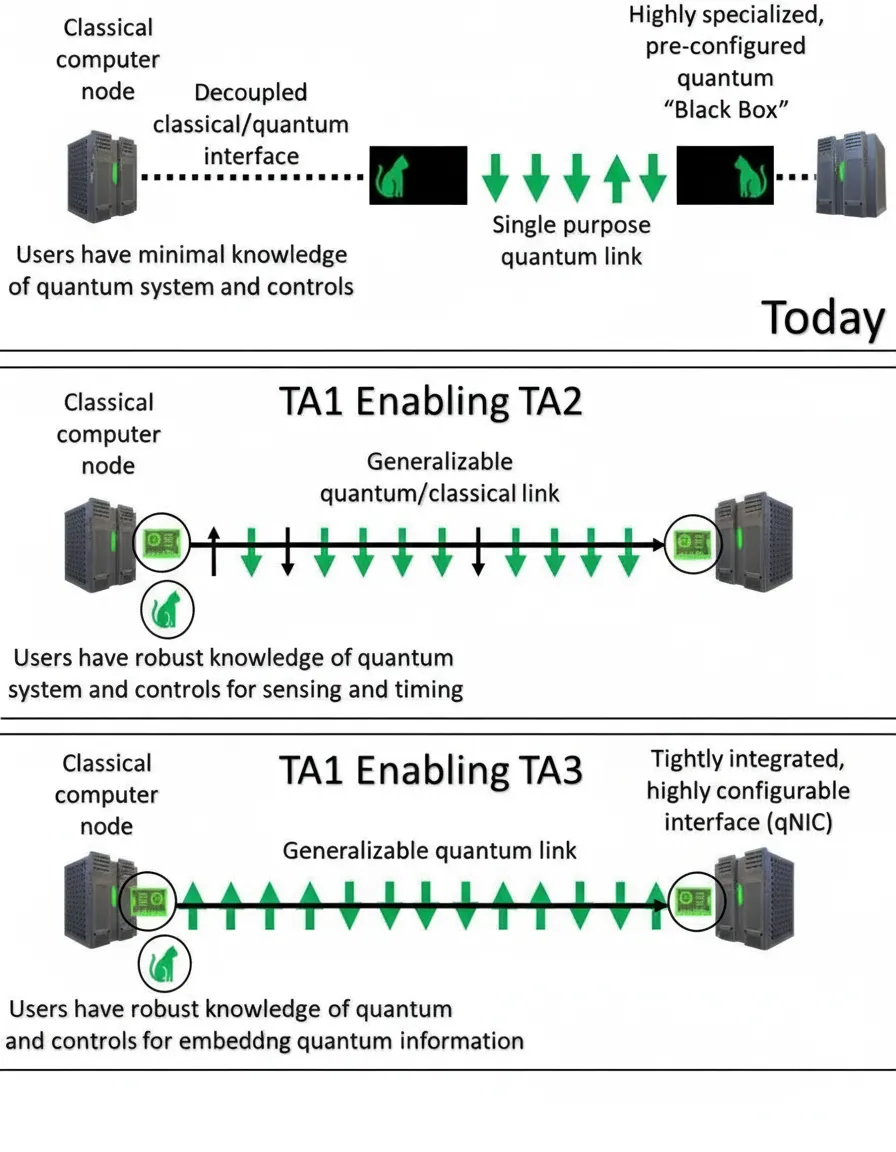
TA1 aims to standardize the interconnect between quantum links and classical nodes by developing a quantum network interface card (qNIC). TA1 focuses on photonic quantumization, implementing qNIC as an extension of optical NICs with entanglement generators and receivers sensitive enough to receive quantum information. The device must send and receive quantum information based on classical information and handle quantum timing and sensing data. Strong proposals will describe coordination with TA2 and TA3.
Strong proposals should address:
- Hardware and packaging:
- Interoperability with quantum hardware such as photon sources, entanglement generators, transmitters, and receivers
- Packaging considerations for integration with typical classical compute equipment, including environmental hardening (vibration, temperature) and reductions in size, weight, and power (SWaP) over the project lifetime
- Embedded software: qNIC embedded software must process quantum data and pass it to TA2 and TA3 algorithms in the host operating system network stack. The application programming interface (API) should describe:
- Types of quantum information that can be captured and delivered to higher network layers
- How those quantum information types map to existing classical protocol data units (e.g., bits, packets, Ethernet frames)
TA1 hardware proposals should describe integration between classical NIC hardware and quantum hardware, including sources, entanglement generators, transmitters, and receivers with time-synchronization hardware. Modules such as short-term quantum memories (buffered memory) and frequency converters must be described and experimentally validated where included.
TA1 performers should address preventing significant signal loss while achieving quantum-classical multiplexing required by TA2 applications. Recent work in time-division multiplexing (TDM) and wavelength-division multiplexing (WDM) indicates such coexistence is possible. Strong TA1 proposals will explain the coexistence approach and how it mitigates major losses inside the qNIC. Note that later metrics refer to expected source emission throughput.
TA1 proposals should emphasize hardware configurability and environmental hardening. SWaP improvements are expected but should not come at the expense of other project metrics.
Software and capability architecture: TA1 proposals should describe any preprocessing on the qNIC before data is passed to the host operating system TCP/IP stack. Describe how embedded preprocessing enables different TA2 and TA3 use cases. qNIC solutions should be compatible with one or more open-source operating systems, such as Linux or BSD variants. Strong TA1 proposals may describe new protocols or extensions to existing TCP/IP protocol data units (for example, Ethernet frames) to encapsulate measured quantum information and explain how these extensions coexist with classical network protocols.
Performers for TA1 should have experience in quantum communications hardware, custom network hardware fabrication, and embedded software development for NICs, as well as a deep understanding of host network interfaces and APIs. Strong proposals should explain how qNIC design and fabrication will adapt to TA2 and TA3 feedback and emerging requirements, and how schedule and supply-chain risks will be managed.
TA2: Quantum-Enhanced Data Flows
TA2 will develop algorithms, protocols, and software infrastructure to multiplex quantum photons into classical optical flows so quantum timing and sensing information can be used above the classical information layer. Integrating quantum photons into classical optical data flows enables event detection, node authentication, and high-fidelity timing mechanisms in existing classical networks. Strong proposals should describe how these mechanisms help prevent rogue or spoofed nodes, routing injection, and timing attacks, including how the proposed solutions would extend or replace current protocols such as ARP or secure neighbor discovery. Proposals should leverage the long-standing resilience of the TCP/IP stack.
Several approaches to clock synchronization and optical quantum sensing in network architectures have been proposed and experimentally validated. TA2 teams must coordinate closely with TA1 to ensure the enabling quantum technologies and low-level functions required by their protocols are available. Strong TA2 proposals will describe required enabling quantum technologies and include metrics that demonstrate advantages relative to other methods. TA2 proposers should consult the metrics in Figure 5 for the three use cases and explain how their methods meet those requirements. Proposals are not limited to the listed use cases and may include use cases that do not require new quantum hardware.
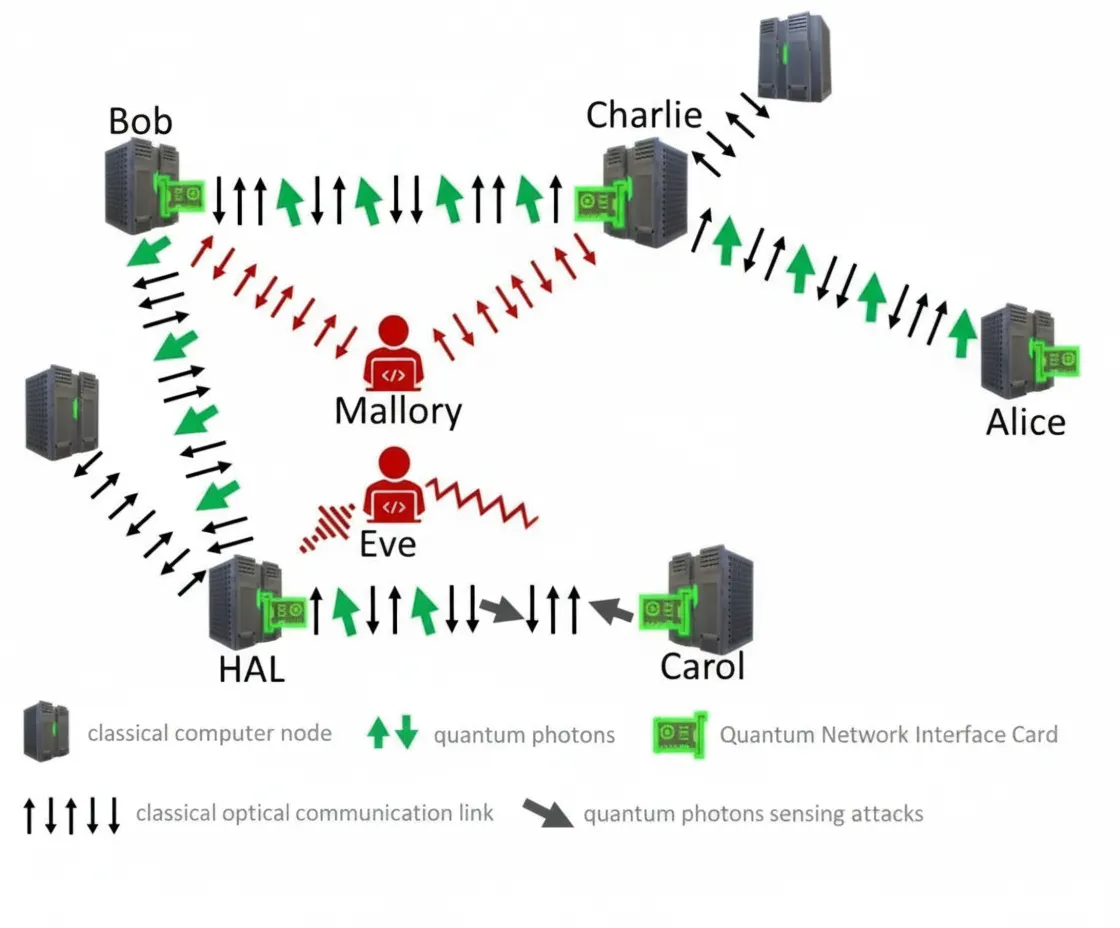
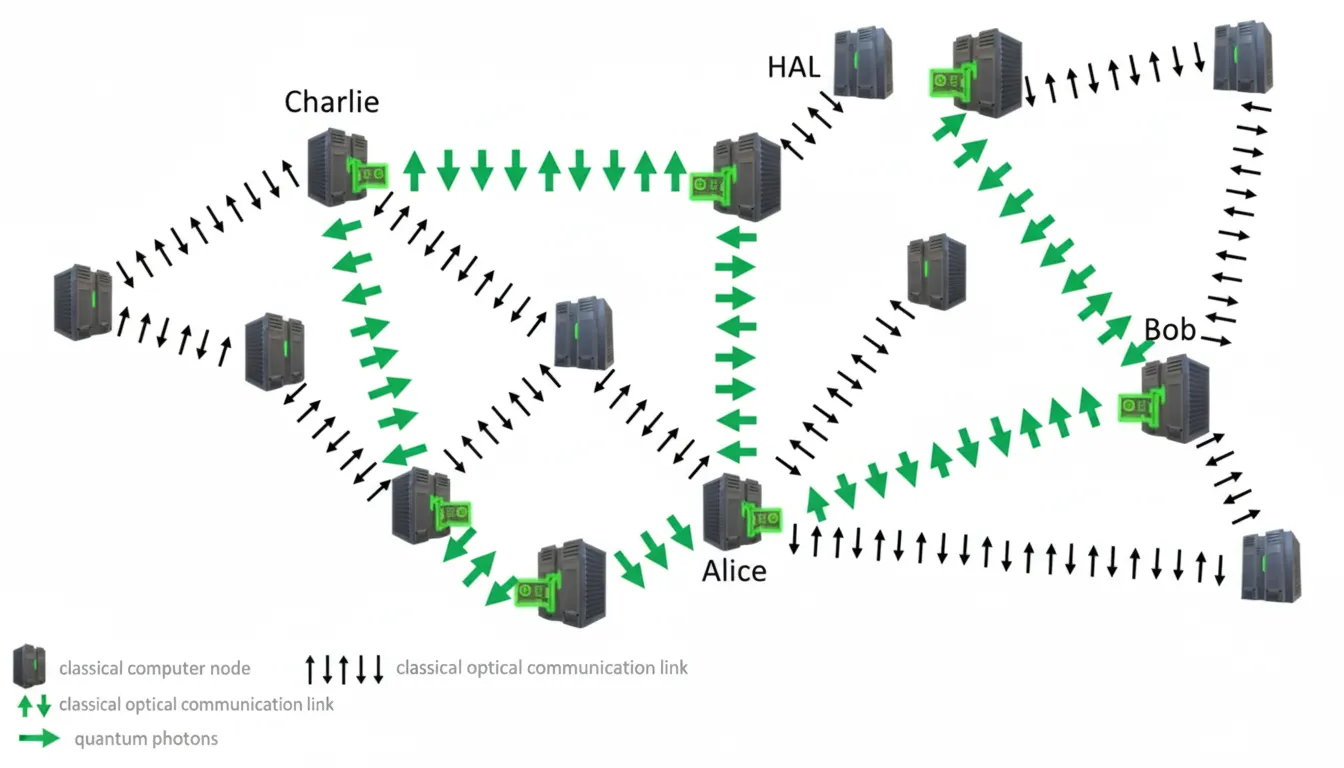
Figure 3 illustrates TA2 use cases. In the first use case, Bob intends to send a message to Alice along Bob -> Charlie -> Alice. Mallory hijacks the route so the path becomes Bob -> Mallory -> Charlie -> Alice. When Alice receives the message, a TA2 protocol alerts her that the message did not traverse the expected quantum/classical link. This attack could also be mitigated earlier with TA2 node authentication protocols to prevent Mallory from joining the network as a valid node. In a second use case, Eve tries to eavesdrop on a fiber link between HAL and Carol. When Carol receives a message from HAL, TA2 event detection immediately alerts Carol that the link has been intercepted.
In TA2 applications, quantum information is measured and generated at each node in the chain (point-to-point sensing and timing information propagation). Strong proposals will define how data from quantum measurements propagates through the network stack so quantum measurements are available in defined scenarios. Proposals should balance quantum sensing and metrology capabilities while mitigating computational bottlenecks in the network.
TA2 teams will need to test and evaluate their methods as TA1 qNICs enter production. Strong proposals will include test and evaluation plans across the project, including simulators, emulators, and external testbeds. QuANET will not fund proposals to build new quantum communications infrastructure but will consider use of existing facilities such as academic testbeds and national laboratories. Strong TA2 proposals will show expertise in classical network algorithms and protocols combined with quantum communications, sensing, and metrology capabilities.
TA3: Topological Quantum-Enhanced Techniques
TA3 aims to develop algorithms that integrate quantum links into networks that also support pure classical links. Whereas TA2 focuses on quantum-classical integration at the optical-flow level, TA3 examines mixing pure-quantum and pure-classical links at the topology level. Availability of pure-quantum links enables additional security mechanisms across the QuANET network. TA3 work will ensure that data transported in embedded quantum systems is secure when transmitted over classical network infrastructure.
Various quantum algorithms and protocols for quantum-secure direct communication have been developed. While validated approaches are increasing, there remains a range of options that depend on specialized quantum hardware and architectures. Strong TA3 proposals will abstract quantum algorithms so they operate across a broader set of enabling technologies and will coordinate with TA1 to ensure required low-level functions are available.
Many quantum communication protocols focus on point-to-point physical-layer protocols. To integrate fully with classical infrastructure, TA3 proposers must also incorporate standard network traffic into higher layers of the stack, addressing routing, message authentication schemes, and loss mitigation for quantum links. Strong proposals will describe how these standard network concerns integrate into TCP/IP infrastructure.
TA3 is expected to address classical flow loss recovery mechanisms, such as retransmission, and to describe mechanisms for decoherence recovery essential to robust communication.
TA3 performers must test and evaluate their approaches as TA1 qNICs become available. Test methods may include simulators, emulators, and existing commercial, academic, or national-lab testbeds. QuANET will not accept proposals to establish new quantum communications infrastructure.
TA3 performers will be initially evaluated for their ability to detect network attacks and successfully route quantum links across increasing nodes and hops. Proposers may include additional metrics to emphasize strengths. Strong TA3 proposals will show expertise in classical network infrastructure and security combined with current quantum communication algorithms to enable quantum-secure information transport over classical infrastructure.
Phases and Metrics
The government will use the following project metrics to assess whether proposed solutions are making satisfactory progress before authorizing continued funding. Although the metrics are specific, proposers should note that the government intends these targets to bound scope while allowing flexibility and creativity in solution approaches. Proposals should list quantitative and qualitative success criteria for each phase.
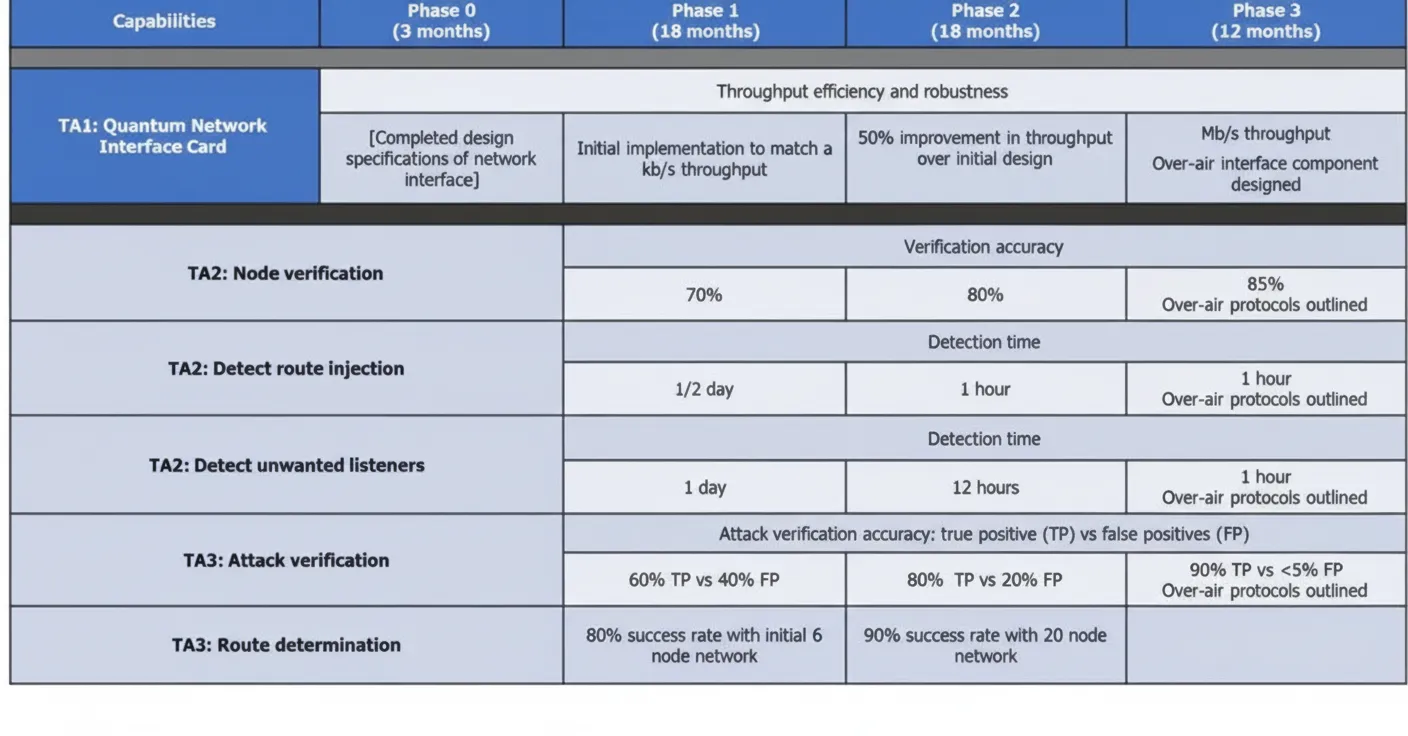
Phase 0 is limited to TA1 and focuses on initial qNIC design. At the end of Phase 0, TA1 performers must deliver qNIC design specifications validated by the government integration team and provide a Phase 1 schedule for manufacturing and testing.
Phase 1 and Phase 2 emphasize fiber-link capabilities. At the end of Phase 1, TA1 performers must design, fabricate, and test a qNIC capable of kb/s-level throughput. TA2 performers must achieve at least 70% verification accuracy, detect routing injection attacks within half a day, and detect unwanted eavesdroppers within one day. TA3 performers must achieve 60% attack verification accuracy and at least 80% routing determination success in a six-node network.
At the end of Phase 2, compared to Phase 1 results, TA1 should produce a qNIC with 50% increased throughput. TA2 should raise verification accuracy to 80%, reduce routing injection detection time to one hour, and reduce unwanted-eavesdropper detection time to 12 hours. TA3 should reach at least 80% attack verification accuracy and at least 90% routing determination success in a 20-node network.
Phase 3 focuses on aerial links. TA1 fiber qNICs should achieve Mb/s throughput and include a design for an aerial interface component. TA2 and TA3 must implement algorithmic changes required for aerial communications.
Schedule and Milestones
QuANET aims to produce the first deployable quantum-enhanced network. The program will engage potential technology transition partners early and throughout the effort to ensure QuANET capabilities support transition needs and to maintain awareness of the evolving quantum communications state. Integration activities will occur annually, with workshops and PI meetings alternating quarterly.
The government will designate locations for project activities such as kickoff, PI meetings, integration events, and workshops for in-person attendance. For budgeting, locations are assumed to alternate between Washington, D.C., and San Diego, starting in Washington, D.C. A project schedule summary with activities is provided in Figure 6.