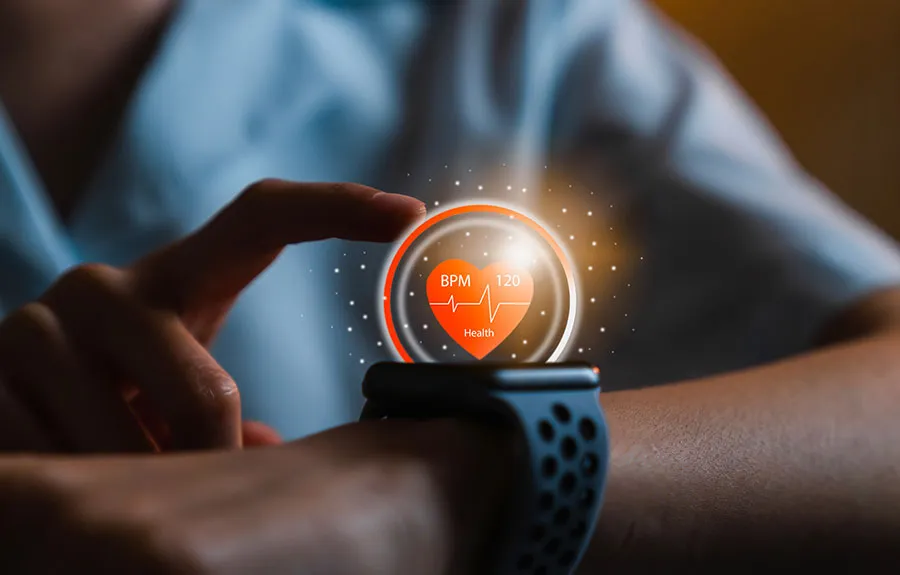
Wearable devices are portable computing devices designed to be worn on the body, characterized by miniaturization, portability, small size, and strong mobility. Human–computer interaction for wearables is different from that of general computing or smart devices: it aims for seamless, tightly coupled interaction with the user. Typical interaction characteristics include single- or dual-hand release, voice interaction, enhanced perception, haptic interaction, and consciousness-based interaction. The main interaction methods and technologies fall into the following seven categories.
1. Bone Conduction Interaction
Bone conduction interaction is an audio-related technique that transmits sound signals via vibration of the skull, bypassing the outer and middle ear and delivering vibrations directly to the inner ear. Bone conduction vibrations do not directly stimulate the auditory nerve, but the vibrations they induce in the basilar membrane of the cochlea function in the same way as air-conducted sound, although with lower sensitivity.
Under normal conditions, sound enters the inner ear via both air conduction and bone conduction. The inner ear fluids vibrate, the organ of Corti converts mechanical vibrations into neural signals, and the auditory nerve sends impulses to the auditory centers for cortical processing. A simple example of bone conduction is covering both ears and speaking; even small sounds of one’s own voice remain audible due to bone conduction.
Bone conduction systems generally include two parts: bone-conduction input devices and bone-conduction output devices. Input devices capture bone vibration signals generated when a speaker talks and forward them to remote or recording equipment. Output devices convert incoming audio electrical signals into bone vibration and transmit them through the skull to the user’s inner ear.
Bone conduction is commonly used in smart glasses and headphones. For example, Google Glass used bone conduction for voice interaction between the device and the user.
2. Eye-Tracking Interaction
Eye-tracking, also called gaze tracking or eye movement measurement, is a mature scientific technique. Typical tracking approaches include: tracking based on features around the eyeball, tracking based on changes in iris angle, and actively projecting infrared beams onto the iris to extract features. Eye-tracking has long been applied in experimental psychology, applied psychology, engineering psychology, and cognitive neuroscience. With the rise of wearable devices, especially smart glasses, eye-tracking is increasingly used for human–computer interaction.
The basic principle is that the eyes exhibit subtle, extractable changes when looking in different directions. Computers capture or scan images to extract these features, enabling real-time tracking of eye movements, prediction of user state and intent, and gaze-based control of devices.
Eye-tracking typically involves three steps: hardware detection, data extraction, and data fusion. Hardware captures raw eye movement data as images or electromagnetic signals. Digital image processing converts these into coordinate-based eye movement values. In the data fusion stage, those values are combined with eye movement priors, user interface attributes, head-tracking data, and user pointing information to implement gaze-tracking functionality.
3. AR/MR Interaction
Augmented reality (AR) overlays informational or entertainment content on the real environment, such as graphics, text, audio, and hyperlinks, to provide additional cues, labels, annotations, or explanations. Mixed reality (MR) refers to computer-processed representations of real-world scenes. AR and MR create virtual screens between the user and the environment, enabling scene-based interaction.
AR/MR are widely applied in smart glasses, immersive devices, and motion-controlled games, providing new application modes for wearable devices by enabling interaction with virtual overlays on the real world.
4. Voice Interaction
Voice interaction is one of the most direct and widely used interaction methods for wearable devices. The emergence of wearables and the maturity of voice recognition and big data techniques have created new opportunities for voice-driven interaction. The recent rise of voice interaction is not just due to recognition breakthroughs but to the effective integration of voice with intelligent terminals and cloud backends. This integration allows voice input to communicate with software systems and understand user intent by combining front-end voice capture with backend web search, knowledge computation, databases, and question-and-answer or recommendation systems, compensating for the limitations of purely front-end command-based approaches.
Voice interaction has developed along two directions: large-vocabulary continuous speech recognition, used for dictation systems, and compact, portable voice products, such as dial-by-voice on mobile phones and voice-enabled toys. A remaining challenge is improving noise rejection and multi-context recognition robustness.
5. Motion-Sensing Interaction
Motion-sensing interaction uses techniques such as computer vision to recognize body language and convert it into commands that a computer can execute. As a successor to the mouse, keyboard, and touch screen, motion-sensing has emerged as an important interaction mode driven by wearable trends.
Body gestures are innate means of communication that precede language; gesture-based interaction has been researched for decades. Earlier work focused on hand gestures, with less emphasis on full-body or head postures. With the development of smart clothing and motion-sensing industries, motion-sensing interaction is becoming indispensable for wearables.
Hand-gesture recognition is the most representative example. It relies on various sensors to continuously capture hand or handheld tool shape and displacement, periodically build models to form a sequence of model frames, and translate those sequences into commands. As sensors and supporting technologies mature, gesture recognition has reached usable levels and diverse products and solutions are appearing.
6. Haptic Interaction
Haptic interaction is a relatively recent human–computer interaction field within wearable technology and is likely to have a lasting impact on information exchange. Touch is a fundamental human sense and a critical channel for perceiving the external world: properties such as softness, temperature, texture, and shape are all detected through touch. Complex emotional communication can also be conveyed via touch.
Haptic research focuses on using tactile information to augment interaction between humans, computers, and robots. Application areas include surgical simulation training, entertainment, remote robotic operation, product and industrial design. Haptics has seen exploratory use in immersive smart products and is expected to be a key technology for realistic perception in virtual reality.
7. Brainwave Interaction
Brainwave interaction, also called consciousness-control technology, has been explored but is not yet widely adopted. Brainwave interfaces could become a definitive interaction mode for wearable devices, providing new communication channels both between people and between people and devices. In the future, brainwave interaction could allow highly synchronized human-to-human communication and create novel human–computer interaction paradigms for the wearable era.