Inside the Modern PCB Factory: From Design to High-Volume Production
Key Moment
- 0:00 Introduction – Why PCBs Matter
- 0:24 DFM Check & Material Cutting
- 1:04 Inner Layer Circuit Patterning
- 1:54 Lamination & Pressing
- 2:52 Drilling & Plating Through Holes
- 3:42 Outer Layer Circuit Patterning
- 4:26 Solder Mask & Silkscreen
- 5:01 Surface Finish & Electrical Testing
- 5:37 Profiling, Final Inspection & Packaging
What This Video Coevrs
This video provides a clear, step-by-step tour inside a real high-volume PCB factory, showing the complete manufacturing journey from digital design files to fully functional boards ready for assembly. Viewers see every major fabrication stage with practical explanations, including material preparation, layer stack-up, drilling, plating, and final processing that ensure precision and consistency at scale.
The content highlights how modern factories support complex multilayer and high-reliability designs used in demanding environments. It is especially valuable for engineering and procurement teams working on automotive electronics, aerospace systems, electric vehicles, and industrial control applications where quality and volume are critical.
For immediate project support, request a PCB mass production quote or explore our automotive PCB capabilities.
Key Highlights
- Complete PCB fabrication workflow from Gerber files to finished boards in a single high-volume facility
- Scalable manufacturing processes supporting multilayer, high-reliability designs for automotive and aerospace use
- Direct transition from prototype validation to mass production with consistent quality control
Complete Fabrication Workflow from Gerber Files to Finished Boards
Modern high-volume PCB factories convert verified Gerber, ODB++, or IPC-2581 data into finished boards through a tightly sequenced set of processes. After incoming design-rule checks, copper-clad laminates are cut and cleaned. Inner-layer imaging uses laser direct imaging or high-resolution phototools to define circuitry, followed by etching and automated optical inspection.
Layer stack-up is performed under controlled temperature and pressure in multi-day press cycles. Mechanical or laser drilling creates vias and through-holes; desmear and electroless copper deposition prepare the holes for electrolytic plating. Outer-layer patterning, etching, solder-mask application, surface finish (typically ENIG or HASL), legend printing, and final electrical testing complete the sequence.
Every stage incorporates statistical process control and in-line inspection so that dimensional accuracy, impedance, and plating thickness remain within specification across thousands of panels. This integrated flow is what allows a modern PCB factory to deliver consistent quality at production volumes.
Scalable Processes Supporting Multilayer and High-Reliability Designs
High-volume facilities maintain dedicated lines for 4- to 20-plus-layer constructions. Impedance control is achieved through tight dielectric-thickness management and real-time etch compensation. Via structures—including through-hole, blind, and buried—are plated with uniform copper distribution to meet thermal and current-carrying requirements of automotive and aerospace applications.
Panelization strategies maximize material utilization while preserving registration accuracy. Automated optical inspection, flying-probe or fixture-based electrical testing, and X-ray verification of internal layers are applied at defined sampling rates or 100 % depending on the reliability class. These process controls enable the same factory to support both complex high-layer-count boards and high-volume simpler designs without compromising yield.
Transition from Prototype Validation to Consistent Mass Production
Prototype runs typically rely on flexible tooling and rapid-turn processes that prioritize speed over unit cost. Once design validation is complete, the transition to high-volume production introduces fixed tooling, optimized panel layouts, and dedicated process recipes.
Lead times shift from a few days to two-to-five weeks, but unit cost drops significantly and process capability indices improve. Material lots are locked, plating chemistry is maintained within tighter windows, and statistical process control limits are tightened. This disciplined hand-off is essential for programs that must scale from a few dozen boards to tens of thousands while retaining the electrical and mechanical performance demonstrated in prototypes.
Critical DFM Controls That Determine Yield in High-Volume Runs
Design-for-manufacturability decisions made early determine final yield more than any single process step. Minimum trace/space, annular-ring size, via aspect ratio, and copper-to-edge clearance must be set according to the factory's demonstrated capability rather than theoretical minimums.
Insufficient annular ring or excessive aspect ratio leads to plating voids or drill breakout under thermal stress. Inadequate copper balancing produces warpage that exceeds flatness specifications after reflow. Solder-mask defined pads that are too small increase the risk of solder bridging or incomplete coverage.
Factories running high-volume production apply automated DFM analysis against their specific process windows before releasing jobs to the floor. Designs that pass these checks achieve higher first-pass yield and fewer engineering change orders during ramp-up.
Material Preparation, Stack-Up, and Process Stability at Scale
Base materials are received with certified dielectric constant, loss tangent, and glass-transition temperature data. Moisture control and bake cycles prevent delamination during subsequent thermal exposures. Stack-up construction accounts for copper weight, prepreg flow, and resin content so that final thickness and impedance remain within tolerance after pressing.
In high-volume environments, material lots are segregated and process parameters are locked once a stack-up is qualified. Any change in resin system or glass style requires requalification because even small shifts in dielectric thickness can move impedance outside the required window for high-speed or RF circuits.
Consistent material handling and press-cycle control are among the primary reasons modern PCB factories can sustain yields above 95 % on complex multilayer constructions.
Common Failure Modes Observed During High-Volume PCB Fabrication
Typical production issues include incomplete desmear leading to poor plating adhesion, etch undercut that reduces trace width below specification, and registration drift between layers that compromises annular rings. Solder-mask misalignment or insufficient thickness can cause solder bridging or copper exposure.
Surface-finish defects—such as nickel corrosion under ENIG or uneven HASL coating—appear more frequently when chemistry baths drift outside control limits. Final electrical opens or shorts often trace back to debris trapped during lamination or incomplete hole plating.
Modern factories mitigate these risks through real-time bath analysis, automated optical inspection at multiple stages, and statistical process control charts that trigger corrective action before defects accumulate. Understanding these failure modes allows design teams to apply appropriate design rules and inspection criteria from the outset.
Comparison of Prototype vs High-Volume PCB Production Parameters
| Parameter | Prototype Focus | High-Volume Focus |
|---|---|---|
| Lead Time | 3–10 days | 2–5 weeks |
| Tooling | Soft tooling, flexible | Dedicated hard tooling |
| Panel Utilization | Secondary | Optimized for cost and yield |
| Process Control | Batch-level checks | Statistical process control + SPC |
| Material Lot Control | Flexible | Locked lots after qualification |
| Typical Layer Capability | 2–12 layers | 4–20+ layers with impedance control |
| Cost Driver | Speed and flexibility | Unit cost and sustained yield |
FAQ
Q1: How many layers can modern high-volume PCB factories reliably produce?
A1: Modern high-volume PCB factories routinely produce boards with 4 to 20+ layers while maintaining tight impedance control, high yield rates, and consistent quality across large production runs.
Q2: What are the critical steps shown in a real PCB manufacturing process from design to finished board?
A2: The complete process includes design file preparation, inner layer imaging, lamination, mechanical drilling, copper plating, outer layer etching, solder mask application, surface finish (ENIG or HASL), and final electrical testing.
Q3: How does high-volume PCB production differ from prototyping in terms of process and lead time?
A3: High-volume production uses optimized panelization, dedicated tooling, and automated lines for cost efficiency, typically achieving 2–5 week lead times compared to 3–10 days for prototype quantities.
Q4: What DFM parameters most strongly affect yield when moving a design into a modern PCB factory?
A4: Annular-ring size, via aspect ratio, copper balance, minimum trace/space relative to the factory's process capability, and solder-mask clearance are the parameters that most frequently determine first-pass yield. Designs that stay inside the factory's demonstrated windows avoid plating voids, registration failures, and warpage.
Q5: How is impedance controlled across large production volumes?
A5: Impedance is maintained through locked material lots, controlled dielectric thickness after lamination, real-time etch compensation, and coupon verification on every panel or production lot. Statistical process control ensures that dielectric and copper thickness remain within the tolerances required for the specified impedance targets.
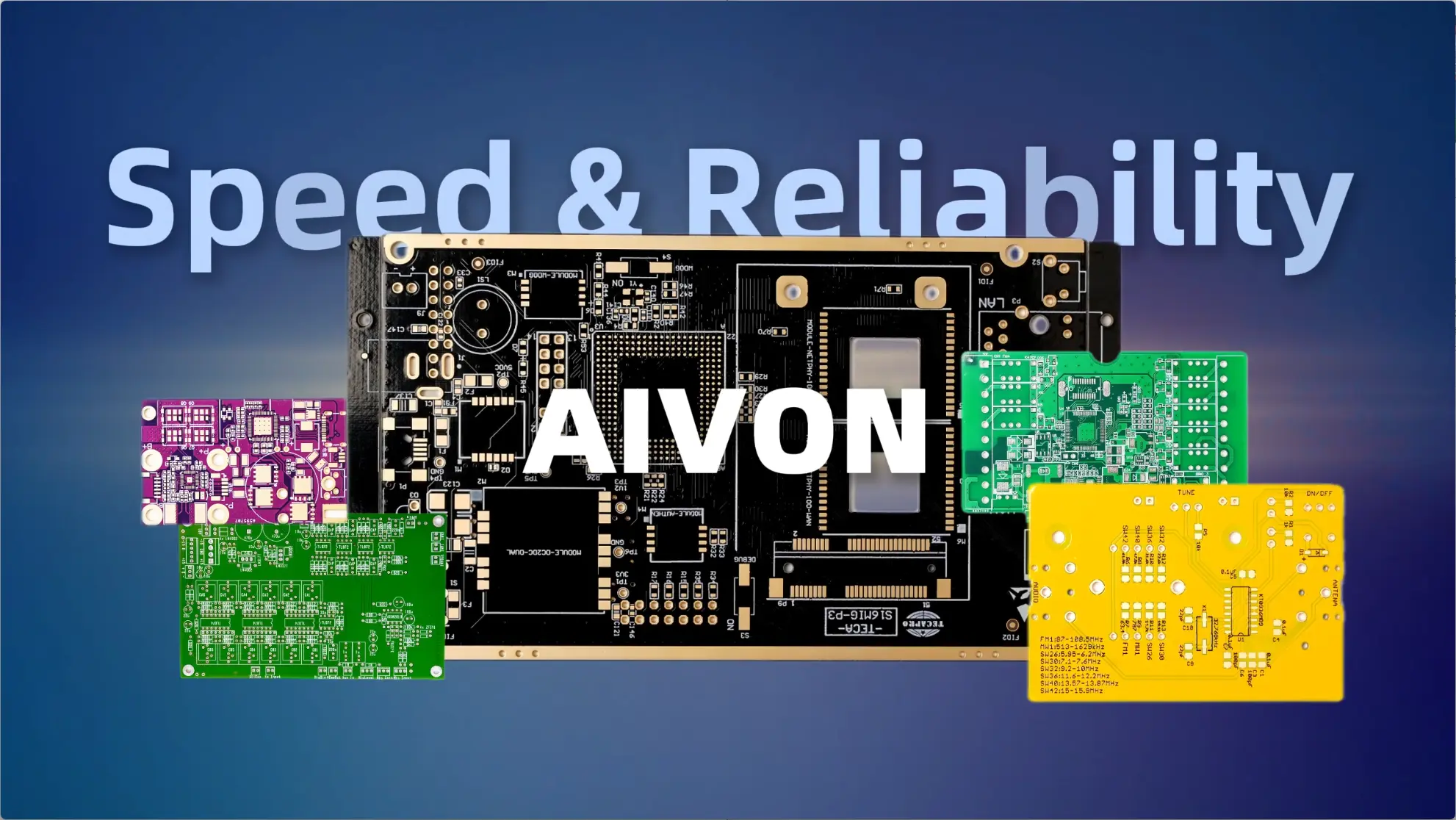
Printed Circuit Boards, or PCBs, are the foundation of nearly every electronic device we use today — from your smartphone and laptop to electric vehicles and satellites. In this video, we're going to walk you through the complete PCB manufacturing process in under 7 minutes. From digital design files to a fully functional board ready for assembly, you'll see every major step in a real high-volume factory.
Step 1 DFM&Material Cutting
It all starts in the Engineering department. The factory receives your Gerber files, drill files, and BOM. Engineers run a Design for Manufacturability (DFM) check to verify trace widths, clearances, drill sizes, and layer stack-up are within the factory's capabilities.
Once approved, raw material preparation begins. Standard panels of FR-4 epoxy glass-fiber laminate (usually 1.6 mm thick with 1 oz or 2 oz copper foil) are cut into production-sized panels.Any rough edges are deburred to prevent defects downstream.
Step 2: Inner Layer Circuit Patterning
For multi layer boards — which make up most modern PCBs — inner layers are created first. The copper surface is cleaned and a thin photosensitive dry film is laminated on both sides. Using Laser Direct Imaging or UV exposure, the circuit pattern from your Gerber file is transferred onto the film. After development, the unwanted copper is chemically etched away in an alkaline solution, leaving only the protected circuit traces. The dry film is then stripped off. Finally, Automated Optical Inspection (AOI) scans every micron of the layer for shorts, opens, or defects. This step ensures the inner circuitry is flawless before layers are bonded together.
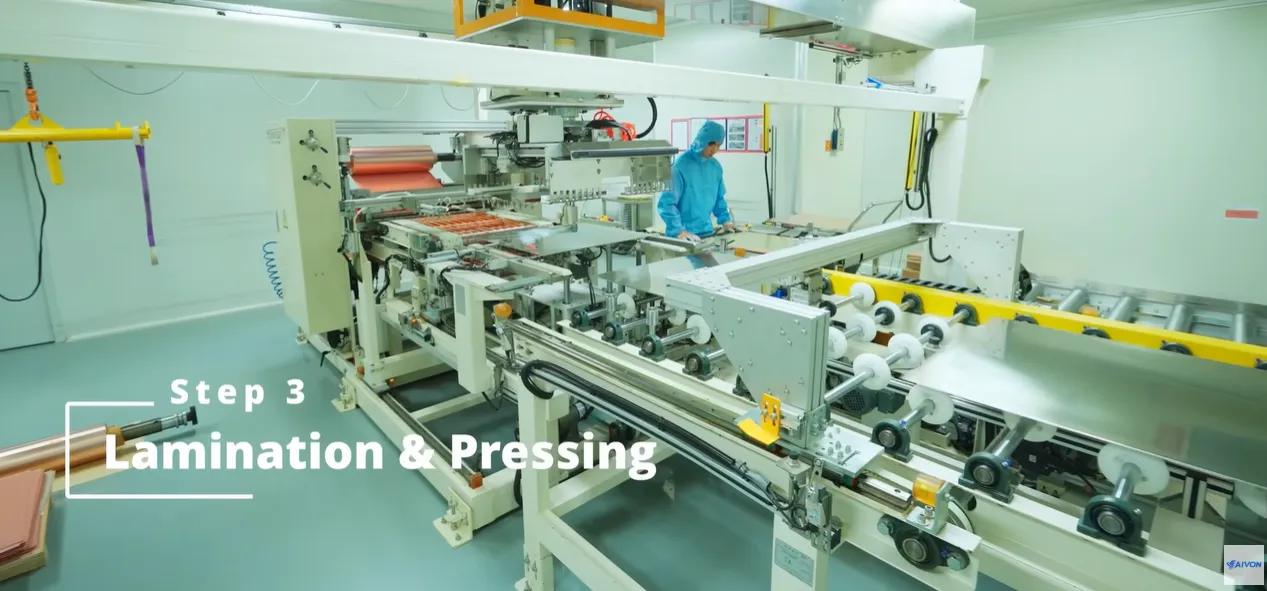
Step 3: Lamination & Pressing
Now the layers are fused into one solid board. First, the inner layers undergo brown oxide treatment to roughen the copper surface and improve adhesion. Then, in a cleanroom, Prepreg sheets are manually pre-stacked between the inner cores.After that, the panels enter a emi-automated stacking system, where copper foils are added on both sides to complete the full structure.Once assembled, the stack is transferred via conveyor directly into the lamination press.Inside, heat and pressure do the real work — typically around 180 to 200°C and over 300 psi.
The prepreg melts and flows, bonding everything into a single solid structure.What comes out is a rigid multilayer board — with each layer electrically isolated, but perfectly connected where it needs to be.
Step 4: Drilling & Plating Through Holes
Holes are next. Using ultra-precise CNC drills, thousands of vias are drilled exactly where needed for interlayer connections. After drilling, the panel goes through deburring and plasma desmear to clean the hole walls.
Then comes the critical electroless copper deposition — a chemical process that deposits a thin 0.5 to 1 micron layer of copper on the non-conductive hole walls. Finally, electrolytic plating thickens this copper to 15 to 25 microns, creating reliable conductive pathways between every layer. Without this step, multilayer boards simply wouldn't work.
Step 5: Outer Layer Circuit Patterning
Outer layers follow almost the same process as inner layers, but with one important difference. Dry film is applied again, the outer circuit pattern is imaged and developed, and then we do pattern plating: additional copper is electroplated only where needed, followed by a thin tin layer that acts as an etch resist. The unwanted copper is etched away, and the tin is later stripped off. This leaves clean, raised copper traces on the outer surfaces, protected and ready for soldering. AOI checks the outer layers just like the inner ones.
Step 6: Solder Mask & Silkscreen
To protect the copper and prevent solder bridges during assembly, a liquid photo-imageable solder mask (usually green epoxy) is applied over the entire board. It's exposed and developed to open up only the pads and vias that need to be soldered. After curing under UV light, the board gets its professional look. Next, white legend or silkscreen ink is printed to add component designators, polarity marks, logos, and assembly notes. A final cure hardens everything. This step not only protects the board but makes it easy for technicians to assemble.
Step 7: Surface Finish & Electrical Testing
Surface finish is crucial for solderability and oxidation protection. Options like ENIG, HASL, or OSP are applied only to the exposed copper pads. Immediately following this, every board undergoes 100% electrical testing. We use flying probes for prototypes or dedicated test fixtures for volume production to verify continuity and isolation on every net. This ensures the board is electrically perfect before it moves to final shaping.
Step 8: Profiling, Final Inspection & Packaging
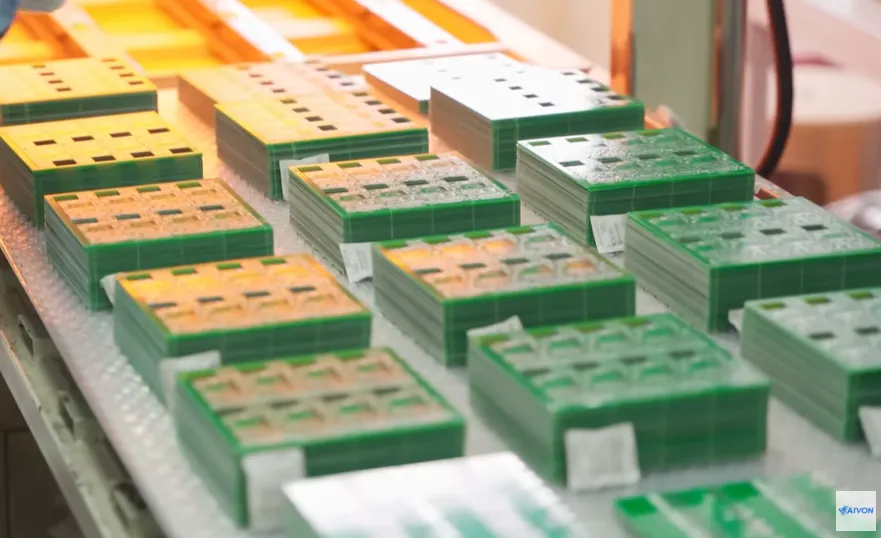
Once electrical integrity is confirmed, the panel is profiled. CNC routers or V-scoring machines cut the large panel into individual boards, adding any required slots or bevels. Finally, our team performs a manual final inspection alongside AOI to catch any cosmetic or dimensional issues. Only flawless boards are vacuum-packed with desiccant, labeled, and shipped to customers worldwide.
That's the complete journey — over 200 highly automated steps, extreme precision down to 50 microns, and strict environmental controls for wastewater and chemicals. AivonPCB factories produce hundreds of thousands of boards every day with incredible reliability.
If you're designing your next project or just love tech, drop a comment: which step surprised you the most? Like, subscribe, and hit the bell for more deep-dive electronics videos — next up, we'll cover SMT assembly!