Introduction
With the widespread use of smartphones, laptops, tablets and other wireless devices, wireless internet access has become a primary need. A technology has emerged that enables internet access using LED lighting rather than traditional WiFi signals.
Background
The radio-frequency spectrum used by WiFi is limited and increasingly congested, making it difficult to meet growing data-communication demands. Wireless data security concerns also pose challenges for WiFi. Visible light communication, commonly called LiFi, offers an alternative approach that can provide secure, high-speed, and stable data transmission.
What is LiFi
LiFi (Light Fidelity) is a wireless communication technology based on light rather than radio waves. It combines data transmission with lighting functionality. Because visible light is harmless to humans and already widely used for illumination, LiFi is also known as visible light communication (VLC). VLC is an emerging wireless optical communication technique based on white LED illumination.
Visible light communication modulates signals onto LED light sources while the LEDs provide illumination. For example, an LED on can represent 1 and off can represent 0; rapid switching transmits information without the human eye noticing the flicker. LiFi shares many advantages with fiber-optic communication, such as high bandwidth and high speed, but instead uses light propagating through the surrounding environment. Any location reached by natural or artificial light can carry a LiFi signal. By embedding a small electronic chip in existing lamps, an LED can function like an access point so devices can connect to the network.
Compared with WiFi, LiFi can offer higher efficiency, larger bandwidth, and secure high-speed connectivity in many scenarios.
How LiFi Works
Light and radio waves are both electromagnetic waves, and the basic principles for transmitting network signals are similar. A microchip attached to an LED can control its flicker rate at millions of times per second; these rapid changes are imperceptible to the human eye but detectable by photodetectors. Binary data are encoded into the light signal and transmitted. A receiving device under the light uses a specialized receiver to decode the light "Morse code."
The transmitter consists mainly of a white LED light source and signal-processing circuitry. The receiver includes an optical system optimized to collect the signal, a photodetector (PD) and front-end amplifier to convert light into electrical signals, and subsequent signal processing and output circuits to deliver data to the terminal.
In the basic architecture, baseband data are conveyed over power lines to the ceiling-mounted LED transmitters. The LED emits modulated light that radiates over a wide angle. The PD at the receiver converts the optical signal back into an electrical signal for demodulation and recovery of the original baseband data. The optical receiver's performance, including noise and distortion behavior, reflects the system's overall VLC performance.
Practically, the transmission signal is superimposed on the AC mains sine waveform and carried to the ceiling LED units. Before the AC enters the LED driver, it is split: one path is rectified to provide DC for illumination, and the other passes through a band-pass filter to extract the communication signal, which modulates the LED intensity. Because the modulation frequency is high, the human eye does not perceive intensity changes, so illumination is unaffected. The modulated optical carrier then propagates through the optical wireless channel and is received by the PD of the mobile terminal, where the signal is demodulated and restored to the original data.
Technology Development Overview
1. Japan
In 2000, researchers at Keio University and the Sony research institute proposed using LED lighting as communication base stations for indoor wireless information transmission. Tanaka and Komine formally proposed in 2002 a data transmission system that integrates power-line carrier communication with LED visible light communication. In 2003, a visible light communication consortium was advocated, with participation from NEC, Sony, and other research organizations and companies. In 2008, a prototype LED optical-communication product was first demonstrated at an international electronics exhibition in Tokyo.
2. Europe and North America
In 2009, the University of California and national laboratories established a research effort called UCLight to develop LED-based high-speed communication and positioning systems. In 2010, a research team at the Fraunhofer Institute in Germany increased communication speed to 513 Mbit/s, setting a record at the time. In 2011, Harald Haas at the University of Edinburgh demonstrated LED-based transmission of high-definition video using signal-processing techniques and used the term "LiFi." In 2013, his team demonstrated a commercial prototype and showcased live streaming. That year, several UK research groups achieved offline rates up to 10 Gbit/s.
3. China
In 2006, Peking University proposed an ultra-wide-angle visible light reception scheme using wide-angle lenses and explored physical, link, and transport layer integration of VLC with passive optical networks. In 2008, Jinan University developed the first domestic white-light LED communication prototype with a transmission range exceeding 2.5 m. In 2011, China's National 863 Program funded research on visible light communication, yielding important results in modulation-bandwidth expansion, real-time transmission rates, and network integration over two years of research. In 2012, the PLA Information Engineering University developed VLC-based video-on-demand, near-field communication, and novel wireless broadcasting, with potential applications for underground communication and positioning. In 2013, Fudan University demonstrated an offline data rate of 3.75 Gbit/s and achieved a real-time VLC system operating at 150 Mbit/s; by 2015 real-time rates reached 450 Mbit/s.
Technical Advantages of LiFi
LiFi's main technical advantages include:
(1) Easy deployment.
Lamps are ubiquitous and have evolved technologically over a century. Existing electrical infrastructure can be leveraged by embedding a chip in lamps at locations requiring network access. For example, roadlights along highways can broadcast signals that moving vehicles can receive.
(2) High bandwidth and high speed.
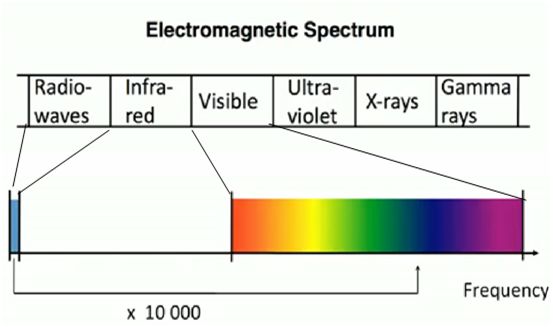
The visible light spectrum offers much larger bandwidth than radio frequencies. Laboratory demonstrations have reported speeds up to 1 Gbit/s under test conditions, enabling high-speed experiences in many scenarios.
(3) Energy efficiency and environmental friendliness.
Visible light is non-ionizing and considered safe for humans. Using light as the communication medium can be a more health-conscious approach and can reduce additional energy consumption compared with deploying separate radio base stations. During daytime, LED brightness for data hotspots can be reduced below perceptible levels, while at night LEDs serve both illumination and data transmission roles.
(4) Security.
Radio waves can penetrate walls and may be intercepted, whereas visible light propagates in straight lines and does not pass through opaque barriers. Data transmission is therefore confined to physically lit areas, which can improve information security.
Comparison with WiFi
WiFi is widely used by handheld devices. However, the explosive growth of mobile data traffic has strained the available radio spectrum, contributing to complaints about unstable signals, slow speeds, and frequent disconnections. LiFi proposes using light emitted by lamps to transmit data by modulating intensity. While promising, LiFi has limitations: visible light cannot penetrate obstacles, so if the receiver is blocked the signal is lost. That raises practical questions about how mobile devices use visible light for uplink and how to maintain connectivity when line-of-sight is interrupted.
One pragmatic approach is seamless switching between visible light and radio frequency when light signals are blocked. LiFi is therefore viewed as a complementary technology to WiFi that can help relieve radio-spectrum congestion rather than a direct one-to-one replacement.
Technical Challenges
1) Light-source selection and indoor layout
Indoor VLC systems typically require multiple LEDs or LED arrays to meet illumination, increase transmit and receive power, and mitigate shadowing effects. Proper placement of light sources is critical for both lighting quality and system performance.
2) Implementing the uplink
Indoor duplex VLC systems include downlink and uplink channels. Downlink signals are emitted from ceiling LEDs and must provide diffuse illumination. Uplink transmission from terminals does not need to provide illumination and can use quasi-collimated beams aimed at ceiling receivers. Techniques such as polarization separation and parallel-channel approaches have been proposed to separate transmit and receive optical paths for duplex communication.
3) High-sensitivity optical reception
Optical diversity reception can improve the signal-to-noise ratio and mitigate intersymbol interference caused by multipath, changes in receiver position, and shadowing from moving people or objects. When detecting optical signals, white-LED transmissions are susceptible to ambient light interference, so receiver front-end design must account for circuit noise and background illumination noise.
4) High-performance modulation, coding, and demodulation
LEDs combine fast response and moderate modulation bandwidth. VLC systems can choose between baseband (no-carrier) schemes and carrier-based schemes. No-carrier schemes transmit nanosecond-level baseband pulses directly and are simple to implement; the typical method is IM/DD (intensity modulation with direct detection). Carrier-based schemes modulate baseband pulses onto one or more optical carriers for transmission.
5) Channel multiplexing
To allow multiple terminals to share a high-speed channel, multiplexing techniques are required. Optical-domain approaches include wavelength-division multiple access (WDMA), time-division multiple access (TDMA), and optical code-division multiple access (OCDMA). OCDMA is a spread-spectrum technique in the optical domain that can dynamically allocate bandwidth, enabling direct multiplexing and switching of optical signals. OCDMA offers good confidentiality and interference resistance and is a promising multiple-access method for LED-based VLC, where noncoherent OCDMA systems can be used.
Applications and Future Development
As incandescent and fluorescent lamps are increasingly replaced by LEDs, any location with lighting can become a potential LiFi data source.
Possible application scenarios include downloading media from streetlights, downloading music by switching on a bedside lamp, posting to social networks while seated under restaurant lighting, and underwater internet access in illuminated environments. LiFi is also advantageous in environments sensitive to radio frequencies, such as aircraft cabins and operating rooms.
The visible light communication industry involves many sectors and could scale significantly. Conservative estimates suggested substantial market growth by 2020, with indoor green-communication networks as a major market opportunity that can complement or partially replace WiFi and Bluetooth in certain contexts.
Indoor precise-positioning systems can complement outdoor GPS and may replace existing indoor WiFi positioning techniques in some applications. Tour-guide systems at attractions could replace traditional radio-based tour systems. LiFi-based mobile payment networks offer a potentially more secure payment channel. LiFi-enabled media and advertising networks could create new distribution and business models by using TV screens, outdoor LED displays, traffic lights, streetlights, and commercial lighting fixtures as content-delivery platforms.
With advances in digital technology, LiFi's advantages—high bandwidth, high speed, energy efficiency, and improved security—make it a promising solution to some of the current wireless-communication challenges and a complementary technology to WiFi.