Overview
Compared with traditional display panels, OLED panels are self-emissive, offer wide viewing angles, fast response, small size, light weight, and flexibility. They are mainly used in smartphones, smartwatches, laptop computers, automotive displays, and televisions.
Evaporated OLED materials are the core functional materials that enable OLED panels to emit light and determine display quality. They require high purity and consistency, and their quality directly affects panel performance, yield, and stability. These materials are used in the vacuum evaporation step of the OLED panel manufacturing process: in a vacuum chamber, evaporative OLED materials are heated to sublimate into molecular vapor and then uniformly deposit on the substrate according to the device structure. Panel manufacturers therefore demand high purity and consistent impurity profiles; typical product purity reaches 4N (99.99%).
Basic OLED Structure and Operation
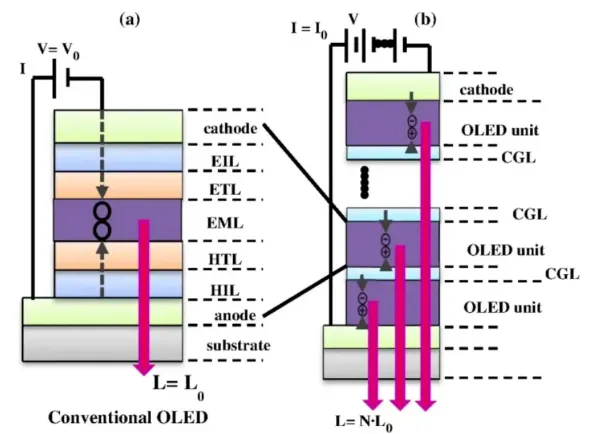
OLED stands for organic light-emitting diode. It is an organic electroluminescent device composed of multiple evaporated material layers that convert electrical energy into light.
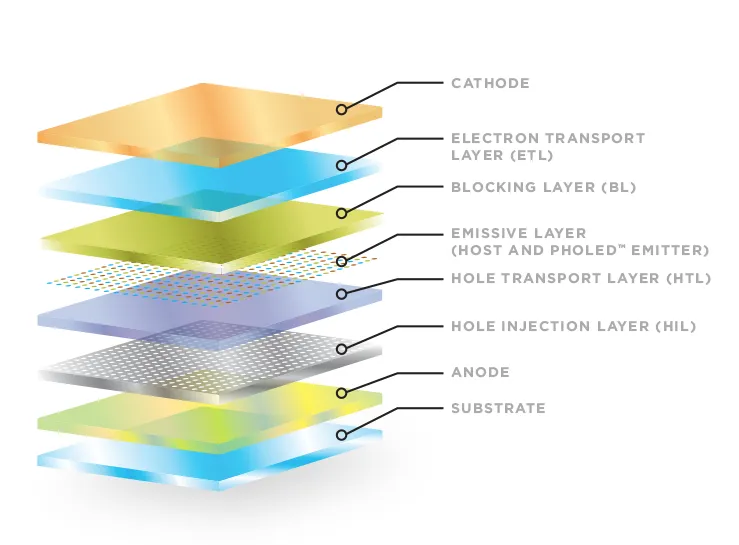
Evaporated OLED materials can be classified by function into encapsulation materials (including light extraction materials and inorganic encapsulation materials), cathode evaporation materials, electron transport layer (ET) materials, hole-blocking (HB) materials, emissive layer (EM) materials, electron-blocking (EB-Prime) materials, hole transport layer (HT) materials, and hole injection (HI) materials.
Electron functional materials, hole functional materials, and emissive functional materials are collectively called functional materials and mainly serve carrier transport and light emission. Electron functional materials include the electron transport layer (ET). Hole functional materials include the hole injection layer (HI) and hole transport layer (HT).
Emissive functional materials include red/green/blue materials, hole-blocking (HB) materials, and three electron-blocking materials (EB-Prime): RedPrime, GreenPrime, and BluePrime. The red/green/blue emissive materials typically include RedHost, RedDopant, GreenHost, GreenDopant, BlueHost, and BlueDopant, which are the primary light-emitting components.
In addition to emissive dopants and hosts, the HB and EB-Prime layers do not emit light themselves but efficiently transport carriers and enhance the emission efficiency of host and dopant materials, improving overall device efficiency.
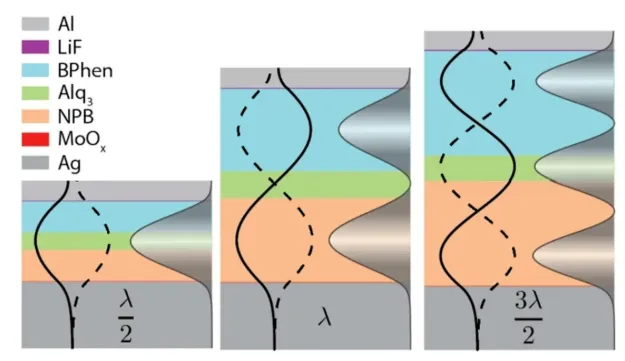
In an OLED panel, the encapsulation materials, electrode materials, injection layers, transport layers, and emissive layers are deposited on a substrate in a sandwich-like multilayer structure. When power is applied, electrons and holes are injected from the cathode and anode respectively, migrate through the electron and hole functional layers into the emissive layer, and form excitons. Excitons undergo radiative transitions and release energy as light, producing the device emission. Light extraction materials sit above the cathode and have a high refractive index; together with the lower-index inorganic encapsulation materials they form a microcavity effect that improves outcoupling efficiency. Inorganic encapsulation materials also protect the organic layers from water and oxygen.
Under OLED evaporation production conditions, the quality of each material layer directly affects panel yield and display characteristics such as color reproduction, brightness/efficiency, and lifetime.
Light Extraction and Functional Materials
Light extraction materials are small-molecule, transparent materials with high glass-transition temperatures and thermal stability. Functional materials are categorized as electron, hole, and emissive materials, and commonly include organic compounds such as arylamines, carbazoles, and biphenyl derivatives.
Because the OLED industry developed earlier abroad and some foreign companies have extensive patent portfolios in organic evaporated materials, panel manufacturers in China initially relied on foreign suppliers for evaporated materials. Material cost and patent access became constraints on OLED display industry development in China.
Background: Purification of Recovered Organic Evaporation Materials
During OLED panel manufacturing, the vacuum evaporation process results in substantial amounts of OLED evaporation materials adhering to shadow masks, chamber walls, and evaporation sources after each run. To improve material utilization, major overseas panel manufacturers commonly recover and purify deposited organic materials after evaporation; the purified materials can meet production purity and quality requirements and reduce material costs for panel manufacturers.
Technical characteristics of recovered-material purification: the service must handle many material species and grades, significant batch-to-batch variation, and variable process conditions. Active species and impurity molecules often have similar structures, so simple purification steps cannot separate them effectively. Suppliers of purification services therefore need strong organic materials theory, experience addressing purification challenges for various materials, and a solid understanding of customers' evaporation processes and optoelectronic performance requirements. Panel manufacturers typically select purification suppliers from their existing materials vendors.
Inorganic OLED Materials
Inorganic materials include cathode evaporation materials and inorganic encapsulation materials. Cathode evaporation materials include metals such as silver and ytterbium. The inorganic encapsulation material commonly used is crystalline, high-purity lithium fluoride.
Industry Overview
Display technology is a core part of the information industry, and has evolved from CRT to flat-panel displays, then branched into PDP, LCD, and OLED technologies.
OLED refers to organic light-emitting diode. Unlike LCD panels that use a backlight to illuminate pixels, OLED panels are self-emissive and can control individual pixels independently. OLED technology offers very high contrast, vivid color reproduction, wide viewing angles, thin form factor, and wide operating temperatures, and has become a mainstream display technology. By driving method, OLED can be passive-matrix (PMOLED) or active-matrix (AMOLED). PMOLED has a simpler structure and higher drive voltage and is suited to low-resolution applications. AMOLED is more complex, requires lower drive voltage, offers longer emitter lifetime, and is suited to high-resolution displays such as smartphones, TVs, computers, tablets, VR devices, and automotive displays. AMOLED is currently the dominant OLED panel technology.
The upstream of the OLED display industry includes equipment manufacturing (lithography/development, inspection, coating, testing, encapsulation), materials manufacturing (evaporated OLED materials, substrates), and assembly components (driver ICs, printed circuit boards, passive components). The midstream is OLED panel manufacturing and the downstream comprises end applications such as smartphones, tablets, OLED TV, and wearables.
Market Growth Driven by End-Product Demand
From the application side, mobile devices dominate OLED demand, with computers, tablets, and wearables contributing to diversified growth. According to industry statistics, mobile OLED (mainly smartphones and smartwatches) accounts for nearly 80% of downstream OLED demand, with smartphones representing about 73%, the largest segment. As market acceptance grows, OLED adoption in TVs and wearables is expected to rise.
Global OLED panel shipments reached 935 million units in 2021, up more than 28% year on year and growing faster than LCD shipments. Analysts projected shipments to exceed one billion units in 2022, and OLED penetration of downstream panels to exceed 25% in 2022.
In 2021 the global OLED panel market was approximately $42 billion, up 35% year on year. Revenue was projected to reach $47.2 billion by 2023.
With rapid development in mobile internet, IoT, cloud computing, and big data, consumer electronics and smart home devices continue to grow, driving OLED demand. Specific application areas are described below.
1) Smartphones
Smartphone demand is the main driver for AMOLED panel shipments, and the arrival of 5G has accelerated growth. Flexible OLED development has supported foldable phones; flexible-screen phone shipments reached 9 million units in 2021. Global smartphone AMOLED shipments increased from 401 million panels in 2017 to 668 million in 2021, a 68.8% increase. As OLED production scales and costs decline, AMOLED will expand from high-end models to broader market segments.
2) Televisions
TVs are another important application. Large-size OLED TV demand was constrained by lower early yields and high production costs, but as technology matured, yields and costs improved and demand has increased. Early mass production was limited to a few suppliers, but from 2020 more companies introduced OLED TVs. Global AMOLED TV panel shipments grew from 1.5 million units in 2017 to 7.3 million units in 2021, a compound annual growth rate of 48.5%, with forecasts of continued growth.
3) Tablets and Laptops
Tablets and laptops still primarily use TFT-LCD panels; AMOLED penetration in these segments was low. However, AMOLED offers superior visual performance and energy efficiency, and manufacturers are expanding investment in this area. Panel makers in China have announced plans to build large-generation OLED lines targeting tablets and laptops.
4) Automotive Displays
OLED adoption in automotive displays has accelerated and may replace TFT-LCD in some applications. Advantages for automotive include high display quality, strong anti-glare performance, fast response, energy efficiency, and long usable lifetime—attributes important for in-vehicle use. Analysts forecast rapid growth of AMOLED in automotive displays through 2025.
5) Wearables
Wearables use both AMOLED and TFT-LCD, with AMOLED offering better power efficiency, contrast, and flexibility. Rigid AMOLED already meets many wearable requirements and is expected to remain a major display type in this sector. Forecasts suggest compound growth in AMOLED shipments for wearables through 2025.
AMOLED Trends and Capacity
By drive type, PMOLED is simpler but unsuited for large or high-resolution panels. AMOLED uses thin-film transistors to control each pixel independently, enabling lower drive voltage, higher resolution, and longer emission lifetime, and is now the mainstream technology for smartphones and TVs.
Major panel makers have been increasing AMOLED capacity. Global AMOLED shipment area grew from 8.08 million m2 in 2019 to 14.20 million m2 in 2021, a 75.8% increase, with forecasts of further growth.
As AMOLED shipments rise, LCD penetration declines. AMOLED share grew from 18% in 2017 to 23% in 2019 and was expected to reach roughly one-third of the market by 2021. Global AMOLED display revenue was $42 billion in 2021 and projected to reach $54.7 billion by 2025.
Flexible AMOLED: The Leading Future Direction
AMOLED panels are classified as rigid or flexible. Flexible AMOLED supports curved and foldable form factors and has clear advantages for consumer devices. Since the first flexible OLED use in smartphones, many brands have launched foldable-screen devices, and growing demand for curved, bezel-less, and foldable devices is driving flexible AMOLED adoption.
Flexible AMOLED shipments reached 347 million units in 2021, nearly eight times the 46.5 million units shipped in 2015, and accounted for more than 50% of AMOLED shipments. Flexible AMOLED has become the most industrialized AMOLED technology, with further growth expected.
Supply Chain and Localization Trends
Core OLED evaporated materials are currently concentrated among overseas suppliers. Production of intermediates has lower added value, while the synthesis and sublimation steps that produce evaporated materials are more complex and higher value. Key patents create high technical barriers, with production concentrated in the United States, Korea, Japan, and Germany. Companies in China have historically focused on intermediates and crude monomers and have had less presence in higher-value evaporated materials.
As global OLED capacity shifts toward China, panel shipments produced in China will grow rapidly and material demand will increase. From a policy perspective and to mitigate supply-chain risk under international trade tensions, China has promoted development of local OLED material suppliers. As some overseas patents expire and Chinese companies increase R&D and obtain intellectual property, more patent barriers may be overcome.
Therefore, the OLED material industry in China is expected to see significant localization and sustained profitability. Suppliers that already have technical reserves, mass-production capabilities, and access to panel supply chains will benefit from this trend.
Market Position of Evaporated OLED Materials
Evaporated OLED materials account for a significant portion of panel cost. Because OLED structure replaces filters, polarizers, backlights, and liquid crystals with evaporated material layers, material costs exceed 30% of total panel cost. For mobile phone OLED panels, evaporated materials account for about 30% of cost; for large TV panels, where material volume is higher, the share can exceed 46%.
As downstream OLED panel markets expand, demand for evaporated materials has grown. Material demand rose from about 77.8 metric tons in 2019 to 88.2 tons in 2020, a 13.4% increase, and reached 110.3 tons in 2021, up 25% year on year. Global sales of evaporated OLED materials totaled $1.686 billion in 2021 and are projected to reach $2.9 billion by 2025, a compound annual growth rate of 14.5%.
Due to international trade frictions and high material prices, panel manufacturers in China have strengthened collaboration with domestic material suppliers through joint development and other means to support local technology breakthroughs. According to industry data, the market for evaporated OLED materials in China exceeded RMB 2.5 billion in 2021 and is expected to grow further.
Device Complexity and Material Segmentation
OLED device structures have evolved from single-layer devices to double-layer, triple-layer, and multi-layer designs. As structures become more complex, material requirements rise, creating opportunities for higher-value, specialized evaporated materials. Flexible AMOLED and thinner packages increase demand for high-performance encapsulation materials that provide strong water and oxygen barriers at minimal thickness and are suitable for evaporation processes.
Cost Reduction and Reuse Market
Because shadow masks, evaporators, and chamber walls accumulate material after each evaporation cycle and are cleaned or replaced, significant material is wasted. Improving utilization through recovery and purification is an effective cost-reduction measure. Purifying recovered organic evaporation materials offers strong economic benefits for customers, and demand for such services is expected to expand as the OLED panel industry grows and cost pressures increase.
Current Market Leaders and Domestic Responses
Overseas suppliers from the United States, Korea, Japan, and Germany currently dominate the evaporated organic materials market and hold many relevant patents. Historically, domestic contribution to evaporated materials has been limited; general-layer materials like electron and hole functional materials account for about 12% of domestic production, while emissive functional materials are under 5%. Companies such as Deshan Metals, LG Chem, Samsung SDI, Toray, Sumitomo Chemical, Idemitsu, Merck, and others hold major shares in various material categories.
As China’s OLED industry matures and domestic panel shipments increase, multiple Chinese companies have entered the evaporated materials market leveraging resources or technical accumulation. Business models among domestic suppliers fall into three categories:
1) Intermediates and crude monomer firms extending downstream
Many Chinese companies originally focused on intermediates and crude monomers for overseas evaporated material makers. As the domestic supply chain matures, these firms are developing higher-value evaporated materials. Some companies also supply evaporation equipment, creating potential synergies.
2) Panel manufacturers extending upstream
To reduce supply-chain risk, panel manufacturers in China have established or supported material subsidiaries to develop and produce evaporated materials locally. These suppliers benefit from stable customer relationships and support from parent panel companies.
3) Independent R&D innovators
Some Chinese firms invested early in evaporated material research and built patents and production capabilities that have enabled partial localization of certain materials. For example, specific domestic suppliers have developed RedPrime products that reduced dependence on foreign suppliers for some emissive-function materials.
Among various evaporated materials, red and green dopants have been dominated by certain suppliers, while blue dopants are mainly supplied by a subset of Japanese and Korean firms. Other major players include Dow Chemical, Toray, Deshan Metals, LG Chem, Samsung SDI, Sumitomo Chemical, and Merck, each holding positions across different material categories.