Overview
Terahertz waves lie between the infrared and millimeter-wave bands and have many unique properties. They therefore have broad potential applications in nondestructive testing, security screening, biomedical diagnostics, cultural heritage conservation, chemical identification, materials characterization, and atmospheric and astrophysical research. However, because terahertz imaging has traditionally relied on single-pixel detectors and raster scanning to acquire image data, existing systems can require imaging times from tens of minutes to tens of hours. The development of terahertz image sensor arrays and advanced computational imaging algorithms is gradually addressing the long acquisition times of traditional systems.
Recent Review and Scope
A recent review in Light: Science & Applications, led by Mona Jarrahi and Aydogan Ozcan at UCLA, examines recent developments in high-throughput terahertz imaging systems from both hardware and computational-imaging perspectives.
Frequency-Domain Sensor Arrays
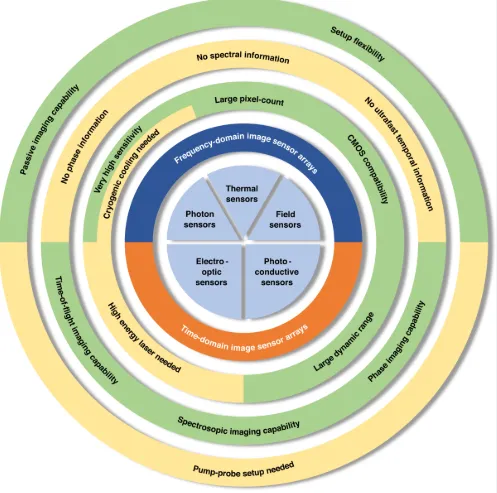
The review describes various image sensor arrays that have been used to develop high-throughput frequency-domain and time-domain terahertz imaging systems. In the frequency-domain category, a sample's single-frequency or frequency-averaged response is captured. Sensor-array types used in frequency-domain terahertz imaging include arrays based on microwave radiometers, field-effect transistors, photonic sensors, and superconducting sensors.
Time-Domain Systems
In the time-domain category, a sample's ultrafast temporal response under pulsed terahertz illumination is captured, which provides amplitude and phase as well as ultrafast temporal and spectral information. The review covers two main non-raster-scan terahertz time-domain imaging approaches: one based on electro-optic sampling combined with an optical camera, and another based on photoconductive antenna arrays. The authors compare the capabilities and limitations of frequency-domain and time-domain terahertz imaging systems and discuss potential modifications to existing systems to achieve new or enhanced functions.
Computational Imaging Methods
As terahertz imaging hardware develops rapidly, computational imaging provides additional functionality and can mitigate some limitations of high-throughput terahertz sensor operation. The review discusses three main computational-imaging methods: digital holography, spatial encoding, and diffractive processing. Digital holography enables terahertz phase imaging using frequency-domain image sensors.
Spatial encoding of the terahertz beam detected by single-pixel imaging systems enables image reconstruction through computational methods such as compressed sensing. Diffractive processing engineers the terahertz front end to encode beams for specific tasks, shifting some computations from the digital backend to the physical optical front end. Diffractive deep neural networks (D2NNs) can exploit light-matter interaction to jointly perform complex functions between input and output fields, enabling tasks such as object classification, imaging through diffusers, and quantitative phase imaging.
Conclusions
The authors anticipate that the review will stimulate further scientific and technical development in terahertz imaging and help accelerate the broader adoption of terahertz imaging systems beyond research laboratories and industrial settings into more widespread practical use.