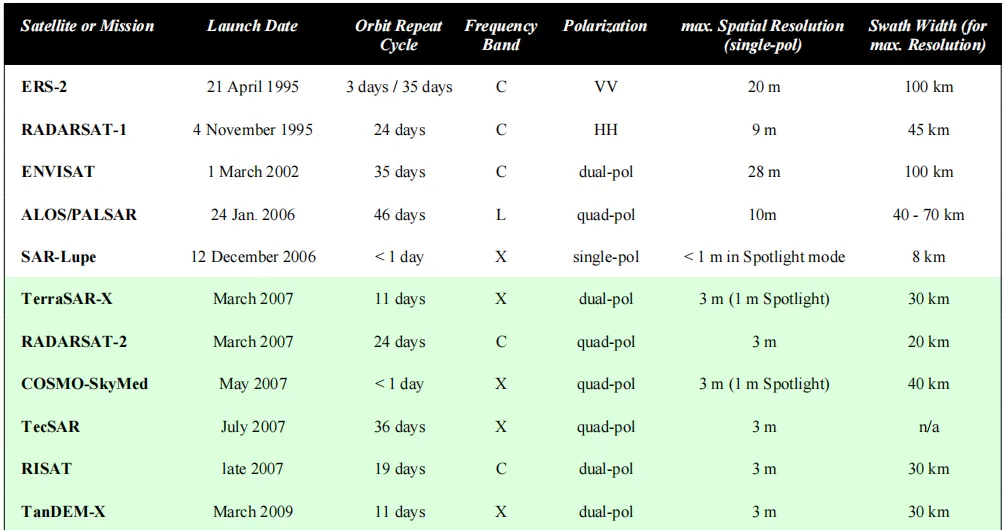
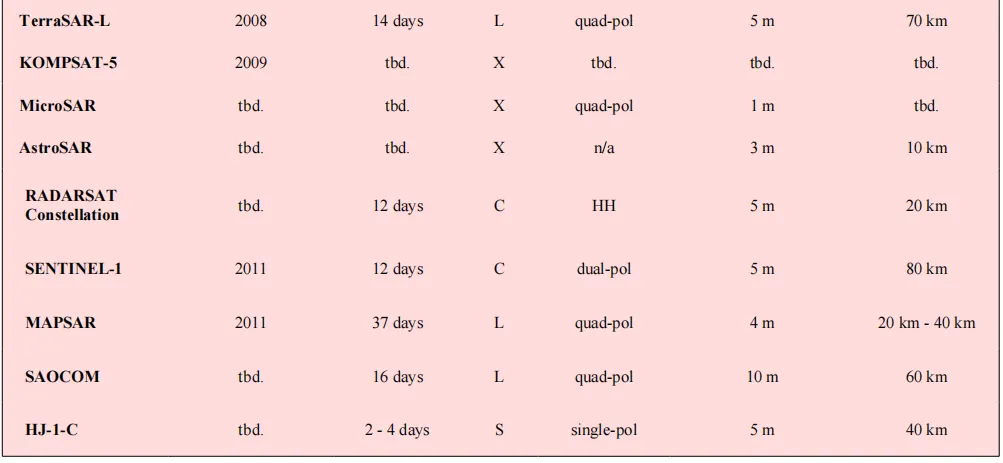
Below is a brief introduction to several spaceborne synthetic aperture radar (SAR) sensors.
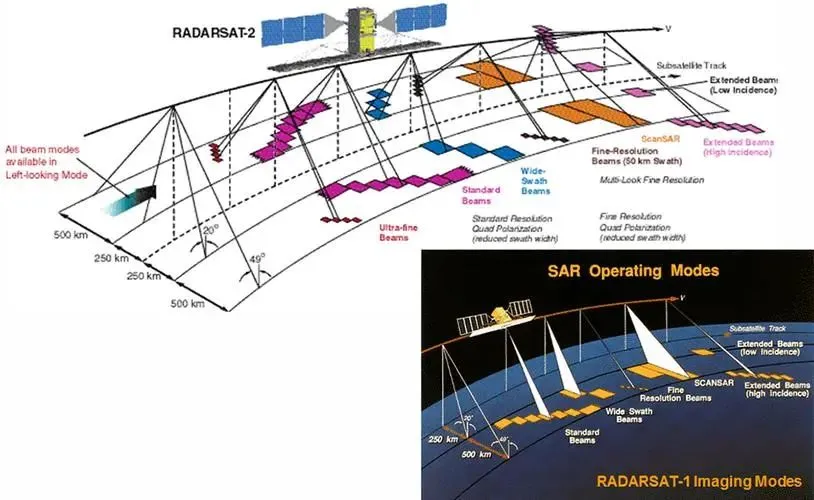
RADARSAT-2
RADARSAT-2 is an upgrade to RADARSAT-1, intended to continue the RADARSAT program and provide data continuity. Enhancements include an extended design life (7 years instead of 5), improved ground resolution (3 m), quad-polarization capability, left-right looking imaging, and an active phased array antenna. The RADARSAT-2 antenna can operate in dual-receive mode for GMTI applications.
COSMO-SkyMed
The COSMO-SkyMed program, funded by the Italian Space Agency (ASI) and the Italian Ministry of Defence, consists of four radar satellites and two optical satellites. It provides global coverage and allows multiple daily revisits of a given area. The radar satellites carry X-band SAR sensors with active phased array antennas that can operate in modes such as dual-polarization or along-track interferometry. Data can be collected in Stripmap, ScanSAR, or Spotlight modes. The satellite constellation can be configured either for rapid ground-track repeatability or in an interferometric orbit for acquiring cross-track InSAR data.
TecSAR
TecSAR is an Israeli SAR technology demonstration satellite. Although its mission is military in nature, it can potentially provide data for civilian use. The sensor operates in X-band with various polarization and swath modes (Stripmap, ScanSAR, Spotlight). The highest Stripmap resolution is 3 m.
ENVISAT (ASAR)
ENVISAT carried multiple instruments, including the Advanced SAR (ASAR) sensor. ASAR can operate in different modes such as Stripmap and ScanSAR acquisition, single and dual polarization, and various incidence angles and swath widths. Its best ground resolution is 28 m with a swath width of 100 km.
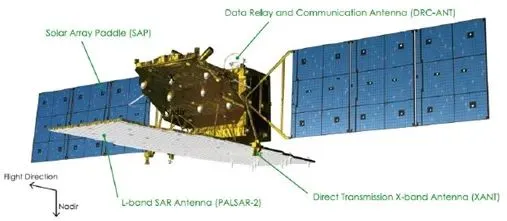
ALOS / PALSAR
ALOS, operated by JAXA, carried the PALSAR (Phased Array type L-band Synthetic Aperture Radar) sensor. PALSAR supports Fine, ScanSAR, and polarimetry modes, with single and dual polarization options, providing high-resolution surface observations. Its best ground resolution is 6 m with a swath width of 70 km.
These spaceborne SAR sensors have distinct characteristics that make them suitable for different applications, such as geological exploration, environmental monitoring, and military reconnaissance.
More spaceborne SAR systems