Overview
Sensors convert received information into electrical signals or other outputs. In an increasingly digital and networked era, sensors are a primary means of acquiring information, and demands for higher sensitivity and wider application scopes are rising. Graphene is a two-dimensional material with properties that make it well suited for wearable, flexible, lightweight, and easily integrated sensors. Its notable properties include high flexibility, low weight, strong mechanical performance (fracture strength around 42 N·m-1), high electron mobility (about 10,000 cm2·s-1 at room temperature), excellent thermal conductivity (single-layer >5000 W·mK-1), and chemical inertness arising from its covalent bonding structure.
Research During the COVID-19 Pandemic
During the COVID-19 pandemic, graphene-based virus sensors were widely investigated in the academic community. These sensors demonstrated accurate and reliable signal detection, providing important references for selecting and manufacturing sensor materials.
Human-Machine Interaction Applications
Graphene sensors, with advantages such as flexibility, light weight, easy integration, and excellent electrical performance, have shown potential in research related to immersive and interactive systems. Over the past decade, Professor Tianling Ren's team at Tsinghua University has focused on developing graphene sensors for human-machine interfaces and healthcare applications, accumulating substantial experience and results.
Professor Ren's team published a review in the journal Carbon Future titled "Graphene-based sensors for human-machine interaction." The review summarizes the signals targeted by various sensors, design approaches, fabrication processes, and performance characteristics, and discusses future directions for graphene sensors in human-machine interaction, including multimodality, improved comfort, and increased intelligence.
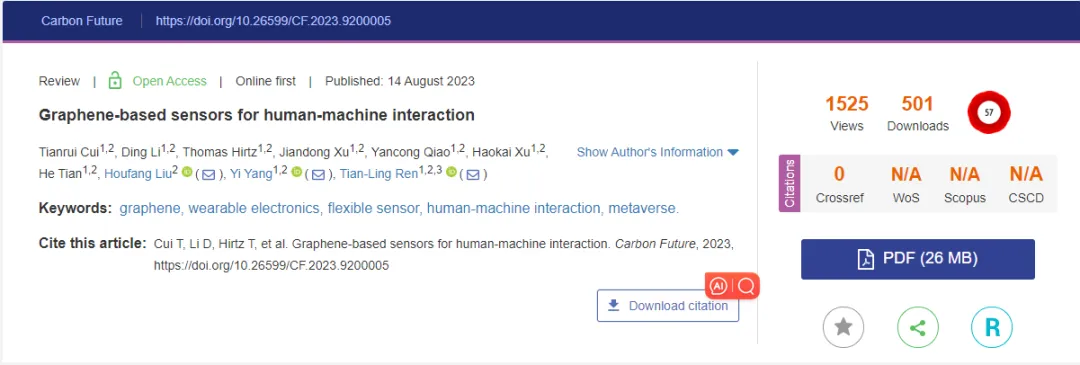
Professor Ren noted that the review outlines advances in graphene sensors used to measure bodily signals. Many parts of the human body have potential as interfaces for human-machine interaction. The brain, eyes, ears, nose, mouth, throat, fingertips, skin, joints, and feet can serve as interfaces based on EEG, EMG, EOG, eye movement, light, respiration, sound, touch, temperature, motion, gait, and other physiological signals.
Throat Interfaces and Artificial Larynx
Regarding throat interfaces, in 2011 Professor Ren's team demonstrated that graphene can produce sound, extending graphene's applications into acoustics. The team developed a range of sensors and actuators for human-machine interfaces using graphene's acoustic properties. One promising application is the artificial larynx, which has potential uses in healthcare and human-machine interaction.
On November 13, 2023, Cai Lei, a former vice president of JD.com and an amyotrophic lateral sclerosis (ALS) patient, trialed a wearable artificial larynx developed by Professor Ren's team, becoming the first ALS patient known to use such a wearable device. The device reportedly captured the vocal signals from his larynx and reconstructed his original voice.
Research Directions and Key Achievements
Professor Ren's team focuses on intelligent micro- and nano-electronic devices, chips, and systems, including intelligent sensors and integrated systems, two-dimensional nanoelectronic devices and chips, flexible and wearable devices and systems, and intelligent information devices and system technologies. Notable achievements from the team include:
- Design of a flexible, attachable smart artificial larynx based on graphene.
- Proposal of a laser-programmed heterogeneous strain sensor method to modulate locally coupled electrical and mechanical properties, enabling customizable sensor performance.
- Development of a graphene "armor" composed of stacked graphene films and porous graphene foam for human electromagnetic interference shielding and motion monitoring.
- Introduction of a laser direct-writing and thermal transfer technique for the scalable fabrication of wearable graphene-based textile sensors.
Outlook
Professor Ren stated that the review is expected to stimulate development of new graphene sensors, promoting more natural human-machine interfaces and improving real-time data collection and response in healthcare. Graphene sensors for human-machine interfaces are anticipated to become more diverse and practical in the coming years, enabling humans and machines to interact through multiple signal modalities at the same body site.