Overview
High-precision, low-cost detection of greenhouse gases in air is an important requirement for environmental monitoring. Phononic crystals (PnCs) are an emerging sensor technology well suited for high-performance acoustic sensing applications.
Principle
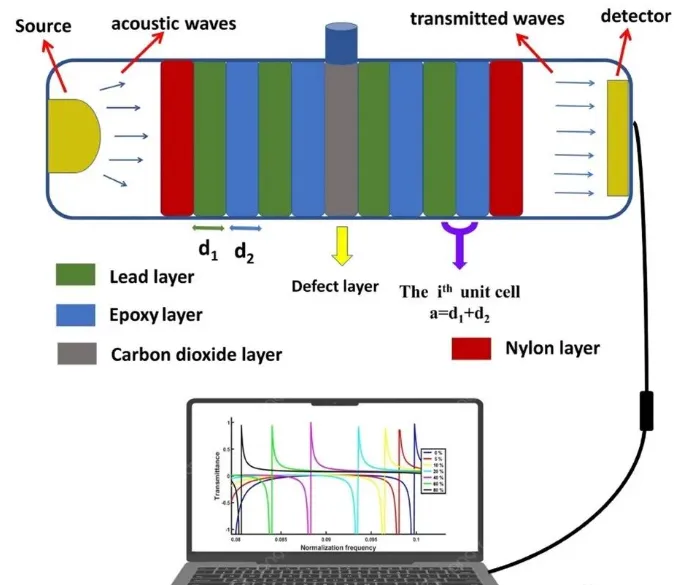
A phononic crystal is an artificial periodic structure composed of two or more materials with contrasting mass density, elastic properties, and sound speed. Phononic crystal structures can be used for greenhouse gas sensing because the speed of sound in a gas mixture varies with composition. Therefore, phononic crystals can function as acoustic gas sensors, enabling low-latency, low-cost sensing by monitoring shifts in resonance features.
Research Summary
According to MEMS Consulting, researchers from Najran University (Saudi Arabia) and Beni Suef University (Egypt) investigated periodic and Fibonacci quasi-periodic phononic crystal structures for CO2 sensing. They proposed that a periodic phononic crystal gas sensor can detect CO2 concentration with a sensitivity up to 31.5 MHz. The results were published in Scientific Reports under the title "A promising ultra-sensitive CO2 sensor at varying concentrations and temperatures based on Fano resonance phenomenon in different 1D phononic crystal designs".
Design and Method
Using phononic crystal designs as gas sensors to detect greenhouse gases such as CO2 focuses on tracking the optimal shift of Fano resonance modes within the phononic band gap. The study considered one-dimensional multilayer sensor geometries, which are straightforward to fabricate both theoretically and experimentally. The proposed sensors use low-cost materials such as lead-containing layers and epoxy resin, enabling operation under harsh conditions including high pressure and high temperature. The design does not rely on complex electronic components.
Measurement Conditions and Metrics
The researchers evaluated two phononic crystal designs (periodic and Fibonacci quasi-periodic) across CO2 concentration ranges of 0–100% and temperature ranges of 0–180°C. The detection mechanism relies on the spectral shift of the Fano resonance mode. Performance metrics were validated for periodic and quasi-periodic (S3, S4 sequences) structures.
Results
The periodic phononic crystal design exhibited superior performance with a concentration sensitivity of 31.5 MHz. The corresponding quality factor (Q) and figure of merit (FOM) were 280 and 95, respectively. The effect of temperature on the Fano resonance position was also examined; in the 0–60°C range, the temperature sensitivity was 13.4 MHz/°C.
Conclusion
This study presents a straightforward approach for CO2 detection using Fano-resonance-based periodic phononic crystal sensors. The periodic design achieved a concentration sensitivity of 31.5 MHz. The sensor uses readily available materials and does not require electronic components for the sensing mechanism, simplifying fabrication. The approach can be extended to detect other greenhouse gases and may be applicable to various industrial and biomedical measurement contexts.