Overview
As 3D sensor technology advances, manufacturing and logistics users are adopting sensors to improve operations. 3D sensors can accurately scan and track moving objects, enabling new applications in manufacturing, warehousing, and logistics that improve efficiency and productivity.
Allied Market Research projects the global 3D sensor market will reach $57 billion by 2031, with a compound annual growth rate of 13% from 2022. The first commercial uses for 3D imaging and detection were in gaming. Over the past decade, demand for smartphones and the use of 3D facial recognition for device unlocking have driven increased adoption of 3D sensing in consumer devices.
Recent applications requiring 3D depth sensing have expanded into manufacturing, logistics, and augmented reality. Benefits of 3D sensing include improved quality control, increased automation, enhanced safety, and optimized storage. For example, 3D sensing can be used in warehouses to maximize space utilization and enable robot pick-and-place operations.
Industrial CMOS image sensors: recent changes
New CMOS image sensors designed specifically for 3D solutions are emerging, representing a step forward for industrial applications. For laser profilometers, these sensors use advanced global shutter pixel technology and sensor architectures to provide ultra-fast sensors with high dynamic range in rectangular formats, addressing application constraints.
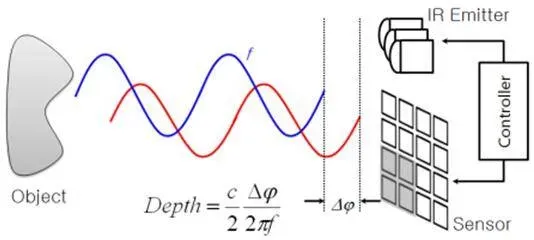
For indirect time-of-flight (iToF) systems, new pixel designs enable fast 3D detection without motion artifacts, while providing iToF-specific features such as high dynamic range management that handles wide distance ranges and a wide span of reflectivities. This makes iToF well suited for reliable real-time decision-making in complex and variable environments. As iToF is applied to robotics, logistics, building surveying, and intelligent transport systems, demand for iToF devices continues to grow.
Increased automation and monitoring, greater use of robotics, and other Industry 4.0 initiatives are driving demand for 3D imaging solutions that deliver high-accuracy distance measurements under challenging conditions.
New 3D sensor applications in Industry 4.0
According to McKinsey, Industry 4.0 is the next phase of digitalization in manufacturing, driven by disruptive trends including data and connectivity, analytics, human-machine interaction, and robotics improvements.
Because 2D vision has limitations for complex object recognition, dimensional measurement accuracy, and range, Industry 4.0 increases demand for 3D vision. 3D imaging also supports human-robot interaction. With 3D vision, factory monitoring systems can distinguish people from robots and other objects, helping to protect workers from potential hazards and creating a safer environment.
3D vision improves autonomy and effectiveness of factory robots and machinery, and is critical for more accurate quality inspection, reverse engineering, and object dimensioning. The use of vision-assisted robots is increasing, and 3D vision is required for better remote guidance, obstacle detection, and accurate motion.
Two specific use cases for dynamic dimensioning in factories and warehouses are large freight or cargo dimensioning and high-speed parcel or package dimensioning.
Large freight or cargo dimensioning
Dynamic dimensioning captures and measures objects or pallets on conveyors or mobile platforms during handling. This technology is used in logistics, warehousing, and transportation to automate dimensioning and improve efficiency. 3D vision systems can precisely measure length, width, and height as objects pass through the system, reducing the need for manual measurement.
For large freight or pallet dimensioning, 3D sensor technology offers significant advantages over static stations. Real-time dimensioning enables higher throughput and more efficient palletizing, including packaging and truck-loading optimization. With advanced on-sensor functionality, 3D systems can operate indoors and outdoors without interference while maintaining performance. High-resolution sensors provide large fields of view and good angular resolution to fully cover pallets larger than one meter. Eliminating motion artifacts yields reliable real-time measurements that save time and cost and improve productivity. Advanced 3D sensors can handle a wide reflectivity range, maintaining consistent accuracy even for low-reflectivity materials such as black rubber.
Dimension data captured by these systems can be used for freight and transport optimization, warehouse space management, automated sorting, and compliance documentation required by safety standards or transport regulations.
Parcel and package dimensioning
High-speed parcel or package dimensioning refers to the rapid, automated measurement of parcel dimensions. Advanced 3D sensors are part of dedicated dimensioning systems that capture length, width, height, and related parameters. In environments that require fast processing of large parcel volumes, high-speed applications are essential. Automating dimensioning reduces manual measurement, which is time-consuming and error-prone, and enables higher throughput, more accurate pricing and classification, and better logistics planning.
For industrial use, 3D sensor technology provides solutions that extend beyond static stations by enabling real-time dimensioning. These solutions meet high-speed production line requirements and can handle short-range, scalable detection with millimeter-level accuracy over distances of two to four meters. Even at conveyor speeds exceeding 30 frames per second, advanced sensors eliminate motion artifacts. They also support a wide reflectivity range, accommodating low-reflectivity materials while maintaining stable and accurate performance across the detection range.
High-speed parcel and package dimensioning systems are used across e-commerce, retail, courier services, distribution centers, and logistics centers. They are typically integrated into conveyor systems or material handling equipment to measure parcels as they move along the processing line. Overall, these systems play a key role in optimizing logistics operations, ensuring accurate freight calculation, and enabling efficient supply chain management.
Ten attributes 3D systems should consider
When evaluating 3D systems for industrial applications, consider several key parameters. Important factors include:
- Distance range: The operational distance required for the use case. For example, autonomous guided vehicles (AGVs) and autonomous mobile robots (AMRs) often require 3D sensing at longer ranges for obstacle detection and navigation, while bin picking requires short-range sensing.
- Accuracy: The precision required by the application. 3D technology typically provides higher accuracy than 2D for certain measurements, and 3D sensors will specify achievable accuracy levels.
- Resolution: The level of detail captured by the 3D sensor and the size of objects to be measured.
- Field of view (FoV): FoV affects sensor selection, resolution requirements, and overall 3D system design.
- Speed: Fast 3D detection must avoid motion artifacts to prevent incorrect distance measurements. Not all 3D technologies can provide measurements at the required speed or handle high-speed moving objects.
- Reflectivity: The minimum and maximum reflectivity the 3D system must handle. Industrial applications may cover a wide reflectivity range, for example 2% to 98%, and the system should maintain adequate accuracy across that range.
- Outdoor operation: Some applications require operation both indoors and outdoors; the chosen 3D technology should be robust against ambient light while maintaining performance.
- Adaptability to varied scenes: Not all 3D technologies are suitable for a wide range of changing operational conditions (lighting, range, indoor/outdoor, accuracy) or for per-frame operation.
- Ease of integration and operation: Consider effort required to integrate the 3D system into the final system, calibration workload, and whether specific setups are necessary for factory or warehouse deployment. These factors directly affect cost.
- Cost: Evaluate the cost-effectiveness of the 3D technology against the specific needs of the application.
These factors are interdependent and should be evaluated holistically when selecting 3D technologies, systems, or sensors.
Conclusion
As 3D sensor technology progresses, manufacturing and logistics users are adopting advanced sensors to enhance quality control, efficiency, and safety. Applications such as large freight dimensioning and high-speed parcel measurement can provide precise measurements and optimize warehouse space, reduce costs and waste, improve safety, and increase overall operational efficiency.