After decades of rapid development, MEMS mirrors are entering new application areas.
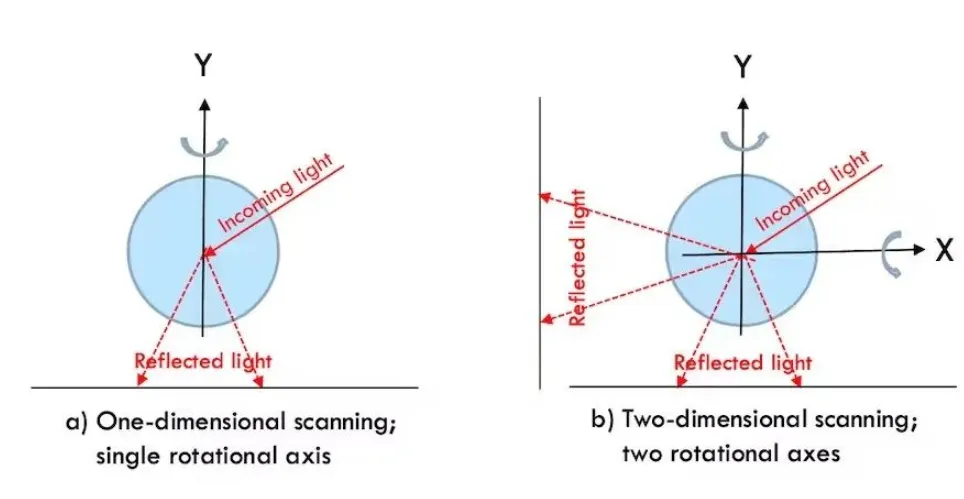
Figure 1: moving a beam with a 1D mirror (single-axis; a) and a 2D mirror (dual-axis; b).
The basic function of MEMS mirrors is to deflect and move a focused beam during exposure. The beam can be moved along a single axis (1D mirror) or two axes (2D mirror) (see Figure 1). This simple action of receiving and redirecting a focused beam is the core of scanning techniques, which are expanding into many applications that would have been hard to imagine until recently.
Three competing design approaches for MEMS mirrors
Manufacturing technologies for MEMS mirrors have matured over the past decade. There are three main, competing design approaches, classified by the actuation principle used to move the mirror: electrostatic, electromagnetic, and piezoelectric actuation. Each approach has its advantages and disadvantages.
All three approaches use silicon as the core material for fabricating MEMS mirrors, although some require additional materials to enable motion. For example, electromagnetic actuators require magnets, and piezoelectric actuators use lead zirconate titanate (PZT) films. System designers must consider the key performance parameters required by a given application before choosing a MEMS mirror.
Mirror size is chosen according to the target application. A survey of MEMS mirror manufacturers shows current mirror diameters range from about 0.5 mm to 10 mm. Most mirrors are circular, while some are elliptical.
Emerging applications
Historically, MEMS mirrors have been used in optical switches for telecommunications, optical projectors, and specialized applications such as biomedical optical coherence tomography (OCT). That landscape is changing as new applications emerge.
The ability of MEMS mirrors to move light has been applied to create two primary product groups that are driving most new use cases: laser projectors for animated visual content and video projection, and LiDAR for three-dimensional (3D) perception sensing.
Laser projectors convert moving light into higher-level visual information for practical uses such as signage, graphics, and video. The information can be presented in vector graphic laser projection (VGLP) mode or raster mode, and MEMS mirrors are critical for both. MEMS-based VGLP is receiving attention because it can deliver high-contrast images even in bright outdoor conditions, enabling new applications.
LiDAR products use various scanning technologies. One approach is MEMS LiDAR, which uses MEMS mirrors to scan and redirect light to generate 3D information about the surrounding environment for a range of applications. Using MEMS mirrors for scanning enables smaller form factors, lower power consumption, performance improvements, and reduced cost.
Combining MEMS mirror scanning with other technologies can produce products with capabilities that would otherwise be difficult. For example, integrating MEMS scanners with cameras has produced 3D metrology systems that are being rapidly adopted in precision manufacturing. These systems offer compact size, fast measurement, micrometer-level resolution, and lower cost.
Automotive applications
Advances in microelectronics and the integration of many sensors have driven widespread adoption of semiconductor devices in vehicles. Modern vehicles contain on the order of 1,500 semiconductor devices, which work together to improve vehicle performance and safety. Safety has become a key priority, and many new features now fall under advanced driver-assistance systems (ADAS). Several ADAS and related automotive functions are well suited to MEMS-mirror systems. Key applications include:
- Automatic emergency braking (AEB) — using MEMS LiDAR
- Pedestrian detection (PD) — using MEMS LiDAR
- Robotaxi and autonomous mobility services — using MEMS LiDAR
- Dynamic laser headlights (DLH) — using MEMS-based white-light projectors
- Courtesy lighting — using MEMS VGLP
Non-automotive applications
Opportunities for MEMS mirrors, MEMS VGLP, and MEMS LiDAR in non-automotive markets are extensive. Non-automotive markets include industrial, telecommunications, commercial, consumer, and medical segments. Key applications include:
- Extended/augmented/virtual reality (XR/AR/VR) — MEMS mirrors
- Biomedical optical coherence tomography (OCT) — MEMS mirrors
- Telecommunications/free-space optical communication (FSOC) — MEMS mirrors
- Precision manufacturing and 3D metrology — MEMS mirrors
- Optical switching — MEMS mirrors
- Smart city systems — MEMS LiDAR and MEMS VGLP
- Robotics — MEMS LiDAR and MEMS VGLP
- Traffic, rail, and bus systems — MEMS LiDAR and MEMS VGLP
- Holiday and architectural lighting — MEMS VGLP
Projected growth of MEMS mirrors
A projected surge in MEMS mirror demand stems from many applications that use multiple MEMS-mirror systems or system solutions incorporating several MEMS mirrors. Some applications may require up to 10 MEMS mirrors per system, implying a very large future demand for MEMS mirrors.
As with other emerging technologies, additional unforeseen applications are likely to appear. Following the commercialization of mature MEMS devices such as pressure sensors, accelerometers, and microphones, the next wave of MEMS deployment is expected to be MEMS mirrors. Shipments could reach approximately 1 billion units per year within the next decade.
By segment, automotive applications will represent the largest device volume. MEMS LiDAR for ADAS, along with robotaxi systems, dynamic laser headlights, and head-up displays, will account for more than 20% of the market. Automotive demand alone could reach several hundred million units.
In non-automotive markets, XR/AR/VR combined with smart city and security applications will be leading uses for MEMS mirrors. Many other applications will each reach multi-million-unit volumes, contributing to the projected annual shipment total of about 1 billion MEMS mirrors.