Help
  • FAQ
    browse most common questions
  • Live Chat
    talk with our online service
  • Email
    contact your dedicated sales:
0

What Is a Smart Sensor? Structure, Features and Trends

Author : AIVON March 24, 2026


Definition

As tools for acquiring information, sensors are a core part of modern information technology. Traditional sensors typically output analog signals and lack onboard signal processing or networking capability; they must be connected to dedicated measurement instruments for processing and transmission. A smart sensor can process raw data internally and exchange data with external systems via standard interfaces. It can also change its behavior through software control according to actual needs, enabling intelligence and networking. Because smart sensors use standard bus interfaces, they offer good openness and scalability, facilitating system expansion.

The concept of the smart sensor was first proposed by NASA during spacecraft development and products emerged around 1979. Spacecraft require large numbers of sensors to continuously send temperature, position, velocity, and attitude data to ground stations or onboard processors. Even a large central computer would struggle to handle such volumes of data simultaneously, and spacecraft impose strict limits on computer size and weight. It was therefore desirable for sensors to perform some information processing locally, which led to combining sensors with microprocessors and the emergence of smart sensors.

A smart sensor is a type of sensor that can sense and detect a measured quantity; learn, reason, and process signals; and provide communication and management functions. Smart sensors can perform automatic zeroing, calibration, compensation, and data acquisition. These capabilities contribute to higher precision and resolution, improved stability and reliability, better adaptability, and, compared with conventional sensors, a favorable cost-performance profile.

Early smart sensors sent conditioned sensor outputs to a microprocessor for computation. In the 1980s smart sensors were built around microprocessors that integrated signal conditioning, memory, and interface circuits on a single chip, adding basic artificial intelligence. In the 1990s measurement technology advanced further, enabling miniaturization, integrated structure, arrays, digital outputs, self-diagnostics, memory and information processing, data storage, multi-parameter measurement, networking, and decision-making functions.

Smart sensors can be categorized roughly into three types: sensors with decision capability, sensors with learning capability, and sensors with creative capability.


Structure of a Smart Sensor

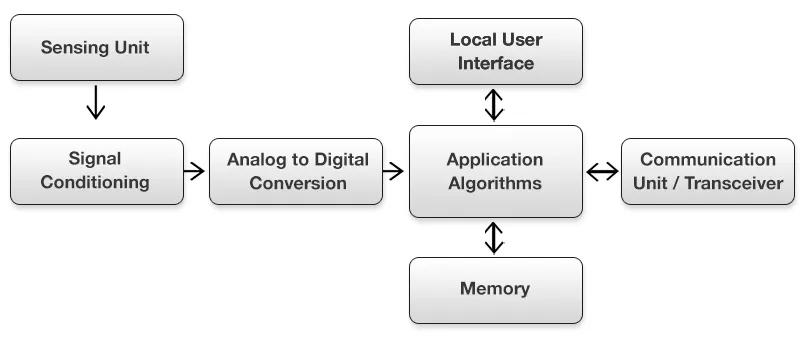
The smart sensor system mainly consists of the sensor element, a microprocessor, and associated circuitry. The sensor converts the physical or chemical quantity being measured into an electrical signal and sends it to the signal conditioning circuit. After filtering, amplification, and A/D conversion, the signal is delivered to the microprocessor. The microprocessor computes, stores, and analyzes the received data. It adjusts the sensor and signal conditioning via feedback loops to control the measurement process, and it outputs processed results through interface circuits in a specified digital format. The microprocessor is the core of the smart sensor, and software functionality largely determines the sensor's intelligence and the resulting performance improvements.


Key Characteristics

High precision

Smart sensors can perform automatic zeroing, compare continuously with a reference standard for real-time calibration, and correct systematic errors such as nonlinearity. They collect large volumes of data for analysis to reduce random error influence and ensure high accuracy.

High reliability and stability

Smart sensors can automatically compensate for drifts in system characteristics caused by changing operating conditions or environmental parameters, such as temperature or supply voltage fluctuations that affect offset and sensitivity. They can automatically change range after a measured parameter changes, perform self-checks, analyze and validate collected data, and handle abnormal conditions.

High signal-to-noise ratio and high resolution

With data storage, memory, and processing functions, smart sensors can apply digital filtering and other analysis to remove input noise and extract useful data. Techniques such as data fusion and neural networks can mitigate cross-sensitivity effects in multi-parameter measurements.

Strong adaptability

Smart sensors can make decisions about power allocation, data transfer rates to host computers, and other parameters based on system conditions to optimize low-power operation and transmission efficiency.

High cost-performance ratio

High performance of smart sensors is achieved not by expensive handcrafted sensor refinement but by combining sensors with microprocessors, cost-effective integrated circuits, and robust software, resulting in strong performance at reasonable cost.


Main Functions

Smart sensor functions emulate coordinated actions of human senses and the brain, and are based on testing technology research and practical experience. A smart sensor is a relatively independent intelligent unit that reduces stringent hardware requirements by relying on software to enhance performance.

Typical functions include:

  1. Composite sensing
    Smart sensors can measure multiple physical and chemical quantities simultaneously, providing more comprehensive information about a phenomenon. Examples include multi-parameter liquid sensors that measure temperature, flow rate, pressure, and density simultaneously, and multi-axis dynamic sensors that measure 3D vibration acceleration, velocity, and displacement at a single point.
  2. Adaptive function
    Smart sensors can automatically adapt within a range to changing conditions. Adaptive techniques can compensate for parameter drift due to component aging, extend device lifetime, and expand operating environments. Adaptive calibration improves repeatability and accuracy by using location-specific correction values rather than average corrections.
  3. Self-test, self-calibration, and self-diagnosis
    Conventional sensors require periodic laboratory calibration and testing. Smart sensors can self-test on power-up, run diagnostic tests to detect component faults, and perform online calibration by comparing measured characteristics with stored metrology data in nonvolatile memory, such as E2PROM.
  4. Information storage
    Smart sensors can store large amounts of information for later retrieval. Stored data can include device history (operating hours, power cycles), measurement data and charts, configuration records, serial numbers, production dates, and final test results, limited only by onboard memory capacity. In addition to process data handling, self-diagnosis, configuration, and storage, smart sensors offer digital communication and adaptive capabilities.
  5. Data processing
    Smart sensors perform process data handling: amplifying signals, digitizing them, and applying software-based signal conditioning. They can linearize nonlinear sensors using lookup tables and apply digital filters to reduce noise. Environmental compensation, such as temperature compensation using a measurement of the sensing element temperature, and nonlinear compensation via lookup tables are common. Microcontrollers enable arithmetic combinations of multiple signals near the sensing point, reducing the need to transmit raw auxiliary signals to a central controller, minimizing long-distance transmission effects like noise or ground potential differences, simplifying central control software, and improving control-loop speed.
  6. Configuration
    Smart sensors support flexible configuration: programmable scaling, unit selection (e.g., Celsius or Fahrenheit), detection ranges, on/off delays, counter selection, normally open/closed settings, resolution selection, and more. Flexible configuration reduces the number of different sensor types required and allows the same sensor model to operate optimally in various scenarios.
  7. Digital communication
    Smart sensors generate much information and require more than a single analog wire for I/O. Serial digital communication networks, especially bus and networked topologies, are preferred. Smart sensors with microcontrollers naturally provide digital serial communications, which are more resilient to environmental interference than analog signals and permit controlled, on-demand data output.


Implementation Approaches

Smart sensors are realized via three development paths: a) integration with computation (smart synthesis), b) use of functional materials (smart materials), and c) use of functional geometric structures (smart structures). Integration with microprocessors is the main approach today.

Based on how sensors and computers are combined, three practical implementations are used:

1. Non-integrated modular approach

Non-integrated smart sensors assemble a conventional sensor, signal conditioning, and a microprocessor with a digital bus interface into one system. This approach grew with fieldbus control systems. Manufacturers add a microprocessor board with a digital bus interface and provide software for communication, control, self-calibration, compensation, and diagnostics, enabling smart sensor functionality rapidly and economically.

2. Integrated implementation

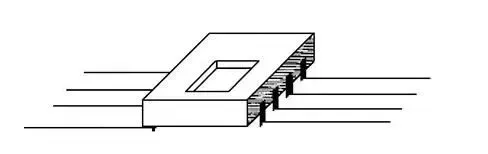
This approach uses microfabrication and large-scale integrated circuit processes, employing silicon to fabricate sensing elements, signal conditioning, and microprocessor units on a single chip. Integration achieves miniaturization and structural unification, improving precision and stability. Arrays of sensing elements combined with image-processing software enable imaging and multidimensional image sensors, representing an advanced form of smart sensors.

integrated-sensor-chip

3. Hybrid implementation

Because integrating all smart sensor system elements on a single chip is challenging, hybrid approaches combine different integrated subsystems (sensing elements, signal conditioning, microprocessor, digital bus interface) across two or three chips assembled in a common package.


Technology Development and Trends

Trends

  1. Higher precision
    As automation increases, sensors must provide higher sensitivity, accuracy, faster response, and good interchangeability to ensure reliable automated production.
  2. Greater reliability and wider temperature range
    Sensor reliability affects device immunity to interference. Developing high-reliability sensors with wide temperature ranges, using emerging materials such as ceramics, remains an ongoing direction.
  3. Miniaturization
    As control equipment becomes more capable, component size must shrink. New materials and microfabrication techniques, especially silicon-based sensors, have enabled significantly smaller sensors with improved interchangeability and reliability. For example, silicon accelerometers manufactured with micromachining offer smaller size and better stability and lifetime than traditional mass-spring designs.
  4. Low power and passive operation
    Sensors typically require power; in remote or off-grid locations they are battery- or solar-powered. Low-power and passive sensors conserve energy and extend system life. Low-power chips are advancing rapidly; for example, some operational amplifiers now feature static currents in the microamp range and low supply voltages.
  5. Digital intelligence
    Sensor outputs are shifting from simple analog signals to digitally processed outputs from embedded microcontrollers. Some sensors also include control functions, forming digital sensors.
  6. Networking
    Networked sensors are an important direction, and their benefits are becoming increasingly evident. Networked sensor systems will continue to influence electronic technology development.

Key development priorities

  1. Apply machine intelligence to fault detection and prognosis. Systems should detect or predict issues before severe consequences occur. Current techniques for abnormal-state detection are limited, and integrating sensor information with domain knowledge is needed.
  2. Improve high-precision sensing under normal conditions and expand capabilities for detecting anomalies and false acts. Fault detection and prediction remain urgent areas for development and application.
  3. Enhance multi-dimensional state sensing. While current sensors can measure single-point physical or chemical quantities accurately, sensing multi-dimensional states such as environmental parameters with spatiotemporal correlations is challenging and requires focused research.
  4. Develop remote sensing for compositional analysis. In many cases sampling is difficult, and remote techniques combining spectroscopy with radar or laser detection are potential solutions. Remote compositional analysis faces interference from noise and media between the sensing system and targets; machine intelligence may help address these issues.
  5. Intelligent sensors to support efficient resource recycling. Automated, efficient recycling of end-of-life products would reduce pollution and resource shortages. Intelligent sensor systems that distinguish target components for automated sorting and recycling are important for circular resource management.

Research hotspots

  1. Study of physical transduction mechanisms
    Digital output is a defining feature of smart sensors and goes beyond simple A/D conversion. Resonant sensors can provide direct digital outputs with high stability, repeatability, interference immunity, resolution, and accuracy. Integrating detection circuits on the same silicon chip enables fast extraction of frequency signals, making resonant MEMS sensors an active research area.
  2. Multi-data fusion
    Data fusion integrates communication, pattern recognition, decision theory, uncertainty theory, signal processing, estimation theory, optimization, computer science, artificial intelligence, and neural networks. It is an important area for integrated smart sensor theory. By combining information from multiple sensors, data fusion yields more accurate and reliable results. For sensor arrays, data fusion leverages complementarity and redundancy to improve measurement accuracy and system lifetime. Recent approaches incorporate genetic algorithms, wavelet analysis, and virtual sensing techniques.

Smart sensors represent the overall direction of sensor development and are recognized globally. With advances in silicon micromachining, next-generation smart sensors will add more functions, employing neural networks, artificial intelligence, and advanced information processing to provide higher-level intelligence. They are also expected to evolve toward microsensor, microactuator, and microprocessor integration into compact microsystems.


Notable Smart Sensor Applications and Examples

Molecular sensors

Researchers at the Weizmann Institute developed fluorescent molecular sensors that generate characteristic emission spectra to distinguish chemical substances. These sensors can discriminate chemicals by producing specific fluorescence signatures, offering alternatives for secure communication where sampling or traditional channels may be vulnerable.

Wireless implantable sensors

Miniaturized wireless sensors for internal health monitoring have been developed to the scale of approximately one cubic millimeter, sometimes called "neural dust." These implantable sensors can monitor tissues, muscles, and nerves in real time. Wireless sensors are also increasingly used across industry, agriculture, military, aerospace, construction, healthcare, and environmental monitoring.

Bioluminescent sensors

A research group used genetically modified luciferase enzymes to create bioluminescent sensors that can track interactions within large neural networks in the brain. Such biosensors serve as novel research tools for neuroscience.

Artificial hair sensors

To give robots skin-like sensory capabilities, researchers have developed artificial hair sensors that mimic fine surface hairs and convey tactile information. For example, some teams replaced hairs with 30-micron filaments embedded in silicone rubber and connected to fine wiring to transmit external stimuli. These systems have potential applications in prosthetics and medical devices.

Composite tactile sensors

Most robotic touch sensors measure force alone, limiting material recognition. Composite tactile sensors combine force sensing with conductive and insulating fabrics and thermistors to enable robots to detect material composition and thermal properties. Such designs can improve object recognition by robots.

Air-quality sensors

Compact air-quality sensors can collect information about particle types and concentrations and detect harmful chemical constituents. These devices are used for outdoor and indoor pollution monitoring and can inform health-related decisions.

Sleep-promoting environmental sensors

Some sleep-monitoring systems integrate sensors that monitor sound, light, temperature, humidity, and air quality, and automatically adjust lighting, heating, and soothing audio to improve sleep environment comfort and provide nightly sleep scoring.

Electromyography (EMG) sensors

EMG sensors detect muscle electrical activity and are applied in rehabilitation and prosthetics. High-sample-rate sensors with strong interference resistance and effective filtering have been used successfully in medical rehabilitation and bionic limbs and are expanding into VR/AR, sports, and exoskeleton applications.

Temperature sensors in wearable health devices

Smart textiles incorporating temperature sensors can monitor inflammation indicators in diabetic patients. Sensors woven into garments, such as socks, provide continuous foot-temperature monitoring and upload data to mobile apps for patient review, supporting early detection of foot complications.

Skin-mounted sensors

Flexible, adhesive sensors printed on thin plastic films can monitor activity levels, heart rate, and UV exposure. These low-cost, bandage-like integrated sensors are suitable for health management and Internet of Things applications and offer convenience compared with traditional semiconductor sensor manufacturing.

AIVON AIVON

As the company's official voice, AIVON shares authoritative insights on PCB technology and industry best practices. It covers PCB ordering, cost control, supply chain decisions, and lead-time optimization, helping engineers make informed choices. Its content reflects the brand’s expertise, reliability, and commitment to supporting the global electronics community.

Related Tags


2026 AIVON.COM All Rights Reserved
Intellectual Property Rights | Terms of Service | Privacy Policy | Refund Policy