Overview
What is RedCap?
RedCap, short for Reduced Capability, is a 3GPP technology standard introduced in the 5G Release 17 work items. The name was previously known to some readers as NR Light.
In short, RedCap is a lightweight form of 5G.
Some articles in the Chinese market have referred to RedCap as "Reduced Capacity." That is incorrect: "capacity" means capacity, while "capability" refers to capability.
China's Ministry of Industry and Information Technology (MIIT) issued a notice on advancing 5G RedCap technology evolution and application innovation. The notice proposed that by 2025 the 5G RedCap industry capabilities should be significantly improved, with new products and business models emerging, scaled integrated applications, and synchronized improvements in security. It also set targets such as achieving scaled RedCap coverage in county-level and above cities in China and achieving tens of millions of additional 5G RedCap connections.
RedCap has since regained attention in the industry.
Background
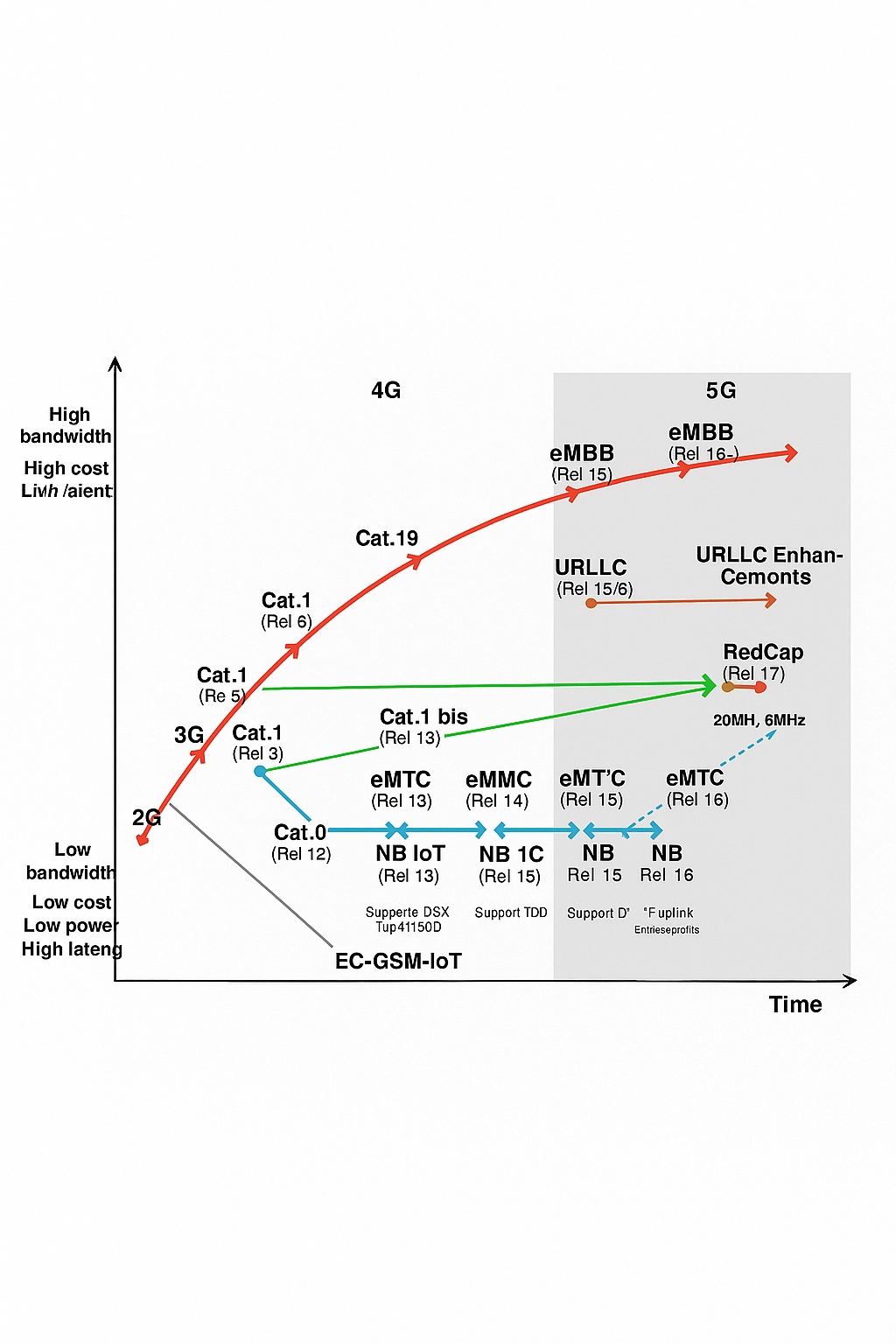
Since Release 8, while mobile broadband (MBB/eMBB) rates have continued to increase, 3GPP has also introduced multiple cellular IoT technologies such as LTE Cat 1, Cat 1 bis, eMTC, NB-IoT, EC-GSM, and RedCap.
These cellular IoT technologies apply different degrees of feature trimming to reduce terminal and module complexity, cost, size, and power consumption, tailoring solutions to different IoT requirements.
How 5G RedCap Base Stations Differ
5G RedCap is a solution based on 5G technology. Compared with traditional 4G base stations, the distinctions commonly highlighted are:
- Higher data rates: 5G RedCap base stations use higher-frequency radio transmissions and can provide higher data throughput than 4G. This enables faster uploads and downloads for users.
- Lower latency: 5G RedCap can achieve lower network latency, meaning shorter time for data to travel from sender to receiver. This benefits real-time interactive applications such as online gaming, remote healthcare, and autonomous driving.
- Greater capacity: 5G RedCap base stations can support more simultaneous connections and higher device density, due to additional bandwidth and spectrum resources available to 5G.
- Network slicing: 5G RedCap supports network slicing, allowing network resources to be partitioned into slices that provide specific quality-of-service guarantees for different application scenarios. This flexibility can accommodate use cases such as IoT, industrial automation, and virtual reality.
Compared with 4G base stations, 5G RedCap base stations are described as offering higher data rates, lower latency, greater capacity, and more flexible network slicing, which support the development of smart applications and IoT deployments.