Introduction
Electronic hobbyists often face the challenge of balancing project budgets with reliable performance. CEM-3 PCB emerges as a practical solution for those seeking affordable yet functional circuit boards. This material supports simple designs without compromising basic electrical insulation or flame retardancy. Hobbyists appreciate its role in prototypes, LED projects, and basic controllers where cost matters most. Understanding CEM-3 helps in making informed choices for low-cost PCB manufacturing.
What Is CEM-3 PCB and Why It Matters for Hobbyists
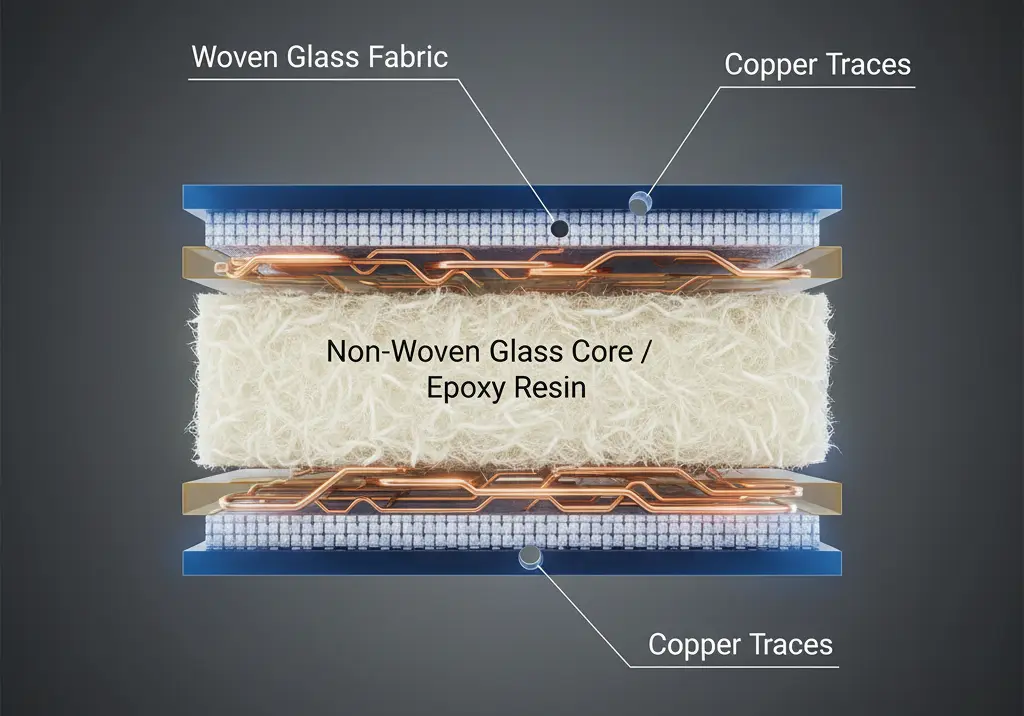
CEM-3 PCB refers to a composite epoxy material used in printed circuit boards, specifically a copper-clad laminate with woven glass fabric surface layers and a non-woven glass fiber core impregnated with epoxy resin. This construction provides a sandwich-like structure that differs from the uniform woven glass in higher-end materials. The result is a flame-retardant board suitable for single-sided and double-sided applications. For electronic hobbyists, CEM-3 matters because it offers a cheap PCB material option that reduces expenses on entry-level projects like sensor boards or power supplies. Its milky white color also aids in visual inspection during assembly, simplifying troubleshooting for beginners.
In the realm of budget-friendly electronics, CEM-3 stands out for enabling quick iterations without high material costs. Hobbyists prototyping on breadboards often transition to custom PCBs, and CEM-3 fits perfectly for single-sided CEM-3 PCB designs. Factory insights reveal its consistent dielectric properties support plated through-holes for double-sided needs. This versatility makes it relevant for garage inventors aiming to keep projects under tight budgets. Overall, CEM-3 bridges the gap between perfboards and professional FR-4 boards.
Technical Properties of CEM-3 PCB
CEM-3 exhibits a glass transition temperature typically between 125°C and 140°C, allowing it to handle moderate thermal stresses in hobbyist applications. Its coefficient of thermal expansion in the Z-axis is higher than premium materials, which influences stability in varying temperatures. Drillability stands out with low bit wear, extending tool life during manufacturing. Thermal conductivity ranges from 0.20 to 0.35 W/m·K, sufficient for dissipating heat in low-power circuits. These properties align with IPC-4101 specifications for base materials used in rigid printed boards.
Flame retardancy meets UL 94 V-0 standards, ensuring safety in consumer-grade electronics. The material's higher density from fillers contributes to rigidity, though it can make boards more brittle under impact. Electrical insulation remains reliable with comparative tracking index values up to 600V in enhanced grades. Machinability supports punching over routing for high-volume runs, a factory-driven advantage. Hobbyists benefit from these traits in projects avoiding extreme conditions.
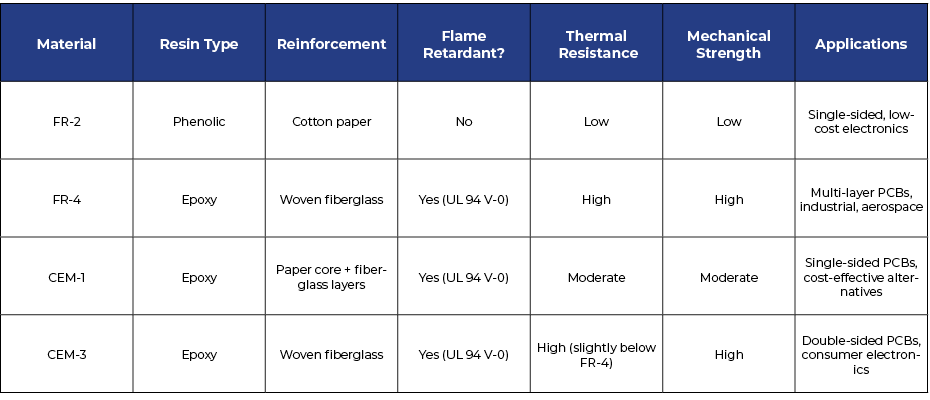
Compared to CEM-1, CEM-3 upgrades to full glass reinforcement without paper cores, enabling double-sided use. Its epoxy formulation provides better moisture resistance than phenolic-based alternatives. These characteristics position CEM-3 as a step up for cost-conscious designs.
CEM-3 PCB Cost Analysis and Price Comparison
CEM-3 PCB cost analysis reveals it as a prime choice for cheap PCB material in hobbyist workflows. Material expenses run lower than FR-4 due to the composite construction using non-woven cores instead of continuous glass cloth. Factory production benefits from reduced tool wear and punching compatibility, further trimming low-cost PCB manufacturing overheads. Qualitative savings make it ideal for bulk prototypes where every dollar counts. For single-sided CEM-3 PCB, the economy shines brightest in simple layouts.
In CEM-3 PCB price comparison, it undercuts FR-4 by leveraging affordable raw inputs while maintaining usability. Hobbyists ordering small quantities notice the difference most in entry-level services. Double-sided options add minimal premium compared to FR-4 equivalents. Factors like board thickness and copper weight influence final quotes, but base laminate savings persist. This analysis underscores CEM-3's role in scalable hobby projects.
- Property: Cost Relative to FR-4 — CEM-3: Lower; FR-4: Baseline; Advantage: Budget savings
- Property: Drillability — CEM-3: Excellent; FR-4: Standard; Advantage: Reduced manufacturing costs
- Property: Layers Supported — CEM-3: Single/Double; FR-4: Multi; Advantage: Suitable for hobbyist needs
Applications and Best Practices for Low-Cost Manufacturing
Electronic hobbyists deploy single-sided CEM-3 PCB in LED drivers, basic timers, and relay controls where simplicity rules. Double-sided versions suit motor drivers or audio amplifiers with through-hole components. Its white base enhances solder mask reflectivity for lighting projects. Avoid high-frequency signals or temperatures exceeding 100°C continuously to prevent degradation. These apps highlight CEM-3's factory-aligned practicality. See real-world thermal performance in our article on Thermal Management on a Budget: CEM-3 PCBs for LED Lighting.
Best practices start with designing for punchability: wide traces and large pads minimize routing needs. Specify standard thicknesses like 1.6mm to optimize low-cost PCB manufacturing. Pre-bake boards to reduce moisture absorption before soldering. Test for warpage per IPC-6012 guidelines on rigid boards. Incorporate generous clearances for thermal expansion.
Troubleshooting common issues involves checking via reliability, as metalized holes perform adequately but not optimally. Use through-hole components over SMD for budget assembly. Scale to double-sided only if routing demands it. These steps ensure reliable outcomes in hobbyist setups.
Insights for Hobbyists: When to Choose CEM-3
For garage projects, CEM-3 excels in power supplies under 50W or sensor networks. Its CTI supports mildly humid environments like home automation. Pair with aluminum heatsinks for better dissipation. Limitations appear in vibration-heavy apps due to brittleness. Factory experience shows longevity in normal conditions.
Visual inspection eases debugging: opaque color reveals defects clearly. Combine with stencils for precise paste application in prototypes. This material empowers iterative design without financial strain.
Conclusion
CEM-3 PCB proves its worth as the unsung hero for budget-friendly electronics through cost-effective properties and manufacturing ease. Hobbyists gain from its support for single and double-sided boards in everyday projects. While not matching FR-4 in extremes, it delivers where affordability leads. Embrace CEM-3 for prototypes, then upgrade as needs evolve. Key takeaways include prioritizing simple designs and standard specs for optimal results.
FAQs
Q1: What does CEM-3 PCB cost analysis reveal for hobbyists?
A1: CEM-3 offers lower material and production costs than FR-4 due to its composite structure, making it a cheap PCB material for prototypes. Savings stem from easier machining and raw input economics. It is ideal for small runs of single-sided CEM-3 PCB in LED or control projects. Factory processes confirm consistent pricing advantages without performance trade-offs in basic applications.
Q2: How does CEM-3 PCB price comparison stack up against FR-4?
A2: CEM-3 consistently prices lower than FR-4, often by leveraging non-woven cores for reduced expenses in low-cost PCB manufacturing. This gap widens in volume orders due to punching feasibility. Hobbyists see value in double-sided needs without multilayer premiums. Select CEM-3 for non-critical thermal applications to maximize savings.
Q3: Is single-sided CEM-3 PCB suitable for electronic hobbyist projects?
A3: Yes, single-sided CEM-3 PCB shines in simple circuits like timers or indicators, providing flame retardancy and drill ease at minimal cost. Its white base aids assembly visibility. Limit to low-power, DC operations for best reliability. Pair with basic components for quick builds.
Q4: What makes CEM-3 a go-to for cheap PCB material in prototypes?
A4: CEM-3's epoxy-glass composite ensures affordability with adequate insulation for hobbyist prototypes. Superior punchability cuts manufacturing steps versus routing-heavy alternatives. Standards compliance adds confidence. Use it for cost-sensitive iterations before scaling.
References
IPC-4101E — Specification for Base Materials for Rigid and Multilayer Printed Boards. IPC, 2020
IPC-6012E — Qualification and Performance Specification for Rigid Printed Boards. IPC, 2017
IPC-A-600K — Acceptability of Printed Boards. IPC, 2020