Overview
Oak Ridge National Laboratory (ORNL) researchers report an urgent need for battery chemistries tailored to eVTOL applications to address anode plating and cathode instability.
Context and Publication
After eVTOL service, second-life reuse strategies will become important. The study was published in ACS Energy Letters.
Power Profile and Testing
High power is a key requirement for lithium-ion batteries to meet advanced air mobility load profiles. The team simulated the initial takeoff sequence of an eVTOL vehicle powered by lithium-ion batteries and observed a severe 15C discharge pulse at the start of the discharge cycle, followed by lower-rate discharge. Extensive electrochemical testing showed that, although some performance recovery occurs at low rates, reapplying high rates leads to severe cell failure.
To probe the impact of high-strain events such as takeoff on lithium-ion cell stability, researchers conducted a series of stress tests and monitored performance changes. The team fabricated a set of cells containing electrolytes formulated for fast charging and discharging to mimic the rapid, high-power discharge required during vertical takeoff.
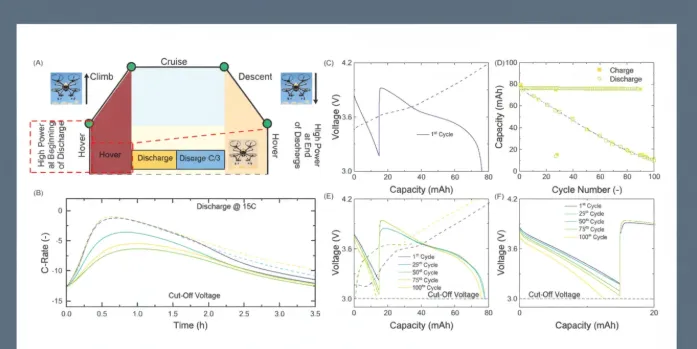
After the initial discharge pulse, the cells were discharged at a more typical rate and then recharged. The researchers found that under these high-stress conditions, none of the tested cells endured beyond 100 cycles; most began showing performance decline around 85 cycles.
Conclusions
Researchers conclude that additional work is needed to develop alternative battery technologies better suited for vertical takeoff and other high-power-demand applications. The results also indicate that lithium cells commonly used in drones could be retired from aviation use and repurposed for applications with more typical power requirements, such as backup power and grid energy storage. The study was funded by the U.S. Army Combat Capabilities Development Command (DEVCOM) Army Research Laboratory.