Background
Wireless power transfer (WPT) overcomes limitations of contact-based power delivery by offering flexible installation, improved safety, environmental robustness, and low maintenance. It is relevant for aerospace, high-voltage transmission, smart grids, implantable medical devices, household appliances, and electric vehicles. A development trend in WPT is systems with a high distance-to-diameter ratio; however, their electromagnetic characteristics, including harmonic content, become more complex.
Summary of Results
To address large high-frequency circulating currents and low transmission efficiency in high distance-to-diameter WPT systems, this work analyzes the electromagnetic characteristics, establishes a distributed-parameter model for the single-sided coil of a loosely coupled transformer, and reveals the mechanism of parasitic capacitance in loosely coupled transformers. Based on this analysis, a segmented series-compensation method is proposed to reduce coil high-frequency circulating current while improving system efficiency and power density. To address reactive power associated with rectification, an improved rectifier topology is proposed to reduce transmitted reactive power and high-frequency voltage harmonics caused by duty-cycle loss, expanding the usable load range and improving system efficiency.
Key Findings
1) Considering coil dielectric loss, a precise distributed-parameter model of the single-sided coil in a loosely coupled transformer is developed, revealing the role of parasitic capacitance and showing that dielectric loss of high-frequency WPT coils is non-negligible. Two compensation methods are proposed: single-turn segmented series compensation and single-layer segmented series compensation. By placing compensation capacitors in series at coil midpoints, inter-turn and inter-layer voltage stress is substantially reduced, which lowers circulating currents driven by parasitic capacitance and thus reduces dielectric loss, while significantly improving efficiency and power density in high distance-to-diameter WPT systems.
2) The load equivalent impedance characteristics of conventional C-filter and LC-filter rectifiers are analyzed. The critical-mode load impedance of the C-filter rectifier is proportional to the high-frequency output inductance, whereas that of the LC-filter rectifier is inversely proportional to the high-frequency output capacitance. Improved rectifier structures are proposed: adding a small capacitor in parallel before a conventional C-filter rectifier, and adding a small series inductor before a conventional LC-filter rectifier. The improved rectifiers prevent duty-cycle loss, eliminate high-frequency harmonics caused by duty-cycle loss, and make the load equivalent impedance approximately resistive across the full load range. With minimal additional components, these measures reduce harmonic content and improve transmission efficiency.
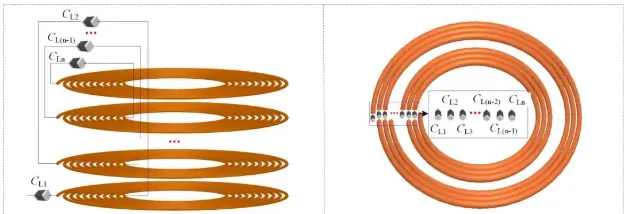
Figure 1 Segmented series compensation method
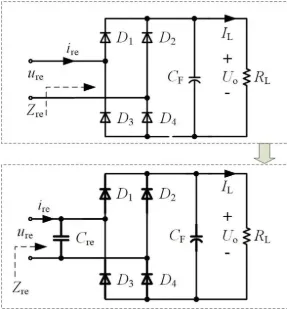
Figure 2 Improved C-filter rectifier
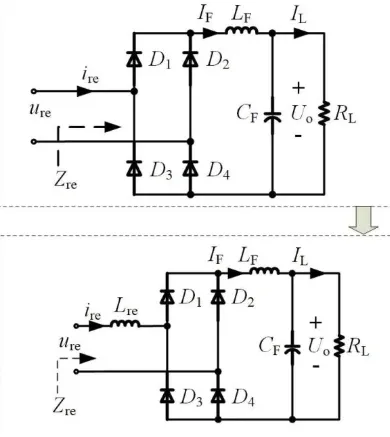
Figure 3 Improved LC-filter rectifier
Prospects and Applications
To improve transmission efficiency and power density in high distance-to-diameter WPT systems, this work proposes a segmented series-compensation method to mitigate coil dielectric loss and improved rectifier circuit structures to reduce rectifier reactive power. The electromagnetic characteristics are analyzed to address high dielectric loss and large rectifier reactive power in such systems, providing theoretical and technical support for further development. Potential application areas include aerospace, high-voltage power networks, underwater sensing, electric vehicles, and consumer electronics.
Contributors and Research Team
Ma Jianwei
Ma Jianwei is an assistant researcher at the School of Electrical Engineering and Automation, Harbin Institute of Technology. His research focuses on inductive wireless power transfer and simultaneous energy-data transfer. He has led a national postdoctoral fund project and contributed as a core member to several projects funded by the National Natural Science Foundation, an industry education development program, and collaborative projects with aerospace industry groups. He has published 17 papers in leading domestic and international power and electrical engineering journals, including IEEE Transactions on Industrial Electronics and IEEE Transactions on Power Electronics.
Honors include IEEE Transactions on Industrial Electronics Outstanding Reviewer 2022, an innovation achievement award, national graduate scholarship, and other academic recognitions. He serves on the IEEE IES TC-DDCM committee and was invited to give a lecture at the 18th annual meeting of the Power Electronics Committee of the Chinese Society for Electrical Engineering. He is a reviewer for journals including IEEE Transactions on Industrial Electronics, IEEE Transactions on Power Electronics, and IEEE Journal of Emerging and Selected Topics in Power Electronics.
The Power Electronics and Electric Drives Research Institute at Harbin Institute of Technology, the associated key laboratories and research centers, are equipped with test and measurement resources such as Chroma programmable AC power supply 61705, Chroma programmable DC power supply 62150H-600, E&I RF power amplifier A500, KEYSIGHT LCR meter E4990A, YOKOGAWA precision power analyzer PX8000, Tektronix oscilloscope DPO4104B, and a FLIR infrared camera T360.