In a previous article titled "iPhone 15 Pro Max: which chips were used?", using iFixit's teardown report I analyzed the RF module of the latest iPhone 15 family. On that separate RF PCB the visible components included a Qualcomm X70 modem, two Qualcomm SDR735 RF transceivers, and a millimeter-wave transceiver SMR546. The remainder consisted mainly of front-end modules.
But how many different wireless communication systems can that single RF PCB actually support? And on which frequency bands do those systems operate?
No.1 Wireless cellular network communication
Cellular connectivity is a fundamental function of modern smartphones. Attention to cellular details is often limited to whether a device supports 5G. Historically, handset variants and supported network standards were critical choices for buyers, especially when importing devices. Today, mobile communication standards and multi-band support have become much more unified, and most modern phones support a wide array of cellular modes and bands so they can operate on most available networks.
From 2G GSM to 3G WCDMA, through 4G LTE (FDD-LTE and TDD-LTE), and now 5G NR, supported frequency bands have proliferated. For example, Xiaomi lists support for all 2G modes (GSM and CDMA) across 4 bands, 3G WCDMA across 6 bands, 4G LTE across 17 bands, and 5G NR across 12 bands, totaling 39 mobile bands if identical-frequency cases across modes are not consolidated.
Apple lists support for 2G GSM across 4 bands, 3G WCDMA across 5 bands, 4G LTE across 27 bands, and 5G NR across 23 bands. If bands that coincide across modes are treated separately, iPhone 15 supports 59 bands in total.
Comparing supported cellular bands shows substantial differences between models. A device supporting fewer bands can still provide equivalent service quality for most users if the bands used by local operators are included. Which frequency bands are mainly used in China? China Mobile operates bands including B8 900 MHz, B3 1800 MHz, B34 2.0 GHz, B39 1.9 GHz, B40 2.3 GHz, B41/N41 2.6 GHz, and N79 4.9 GHz. Although N79 is allocated to China Mobile, live N79 base stations are limited and the band is often used for private networks or 5G hotspots.
China Unicom currently operates B8 900 MHz, B3 1800 MHz, B1 2.1 GHz, B40 2.3 GHz, and N78 3.5 GHz. The former B41 2.6 GHz was reallocated to China Mobile. N78 is jointly used by China Unicom and China Telecom, with each operator obtaining about 100 MHz of bandwidth.
China Telecom operates B5 BC0 850 MHz, B3 1800 MHz, B1 2.1 GHz, and N78 3.5 GHz. The B41 band was also reallocated to China Mobile after network clearing.
Therefore, whether a phone supports tens of bands or dozens of bands, in the Chinese market both can operate without issues as long as the device includes the bands used by local operators. For global travel, users should verify that a device supports the destination country's bands.
No.2 Short-range wireless communication
In addition to cellular connectivity, modern smartphones routinely include short-range wireless systems such as Wi-Fi for local networks, Bluetooth for audio and peripherals, ultrawideband (UWB) for precise ranging, and NFC for card emulation and contactless interactions.
Wi-Fi
Wi-Fi is a wireless LAN technology based on IEEE 802.11. Since its introduction in 1997, Wi-Fi has evolved to Wi-Fi 7. Link rates have increased from a few megabits per second to up to about 30 Gbps in the latest generation.
Wi-Fi primarily operates in the ISM bands at 2.4 GHz and 5 GHz. The 2.4 GHz band spans 2.4 GHz to 2.4835 GHz with about 83.5 MHz of bandwidth and is widely used by many wireless systems, including Bluetooth and other consumer devices, so it is prone to interference. Later Wi-Fi versions added the 5 GHz band (5.15 GHz to 5.85 GHz, roughly 700 MHz), which offers higher throughput and lower interference but shorter range due to higher propagation loss. Wi-Fi 7 also includes support for 6 GHz operation. Best performance is achieved by dual-band support where 2.4 GHz provides wider coverage and 5 GHz/6 GHz provide higher data rates.
Bluetooth
Bluetooth is widely used for wireless audio and peripheral connections. Since its introduction in 1998, Bluetooth has evolved through multiple major versions and incremental updates, improving data rate and range. Bluetooth operates in the 2.4 GHz ISM band and uses frequency-hopping spread spectrum (FHSS) to reduce interference by dividing the band into 1 MHz channels and rapidly hopping among them at up to 1600 hops per second.
Common Bluetooth standards include Bluetooth Classic, which supports basic rate (BR) and enhanced data rate (EDR), and Bluetooth Low Energy (LE), which is optimized for low power and is commonly used in battery-constrained applications. Bluetooth LE can support improved audio quality and additional audio features compared with earlier LE profiles.
Ultrawideband (UWB)
UWB is a short-range radio technology that supports high-precision ranging and spatial awareness. Apple introduced UWB spatial awareness in iPhone 11, enabling precise relative positioning. Xiaomi has also introduced UWB-enabled features marketed as one-finger connectivity. UWB operates from 3.1 GHz to 10.6 GHz, providing about 7.5 GHz of spectrum, or a relative bandwidth in excess of 100%. According to Shannon's theorem, wide channel bandwidth increases channel capacity and allows lower power spectral density, enabling high-precision ranging at low transmit power while minimizing interference to other systems.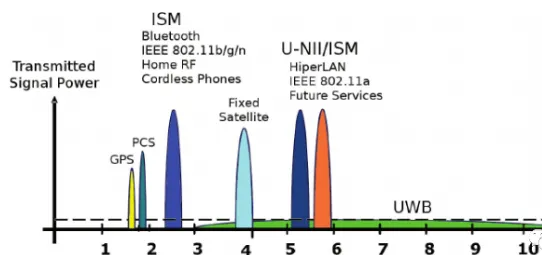
UWB is supported on some phones such as iPhone 15, while other models may omit it. UWB provides capabilities that are useful for device-to-device ranging and secure proximity services, but it is not universally required for all users.
NFC
NFC (near-field communication) is now a standard smartphone feature for contactless payments and credential use. NFC evolved from contactless RFID and interconnection technologies and operates at 13.56 MHz. It communicates in the near-field region, typically at data rates of 106, 212, or 424 kbit/s, and has a short range of about 10 cm, which supports secure applications such as mobile payments, transit cards, access control, electronic tickets, and digital keys.
NFC implementations on various Android devices often provide convenient user workflows for reading and writing everyday electronic cards. Device behavior and available NFC features vary by vendor and platform.
No.3 Satellite positioning and navigation
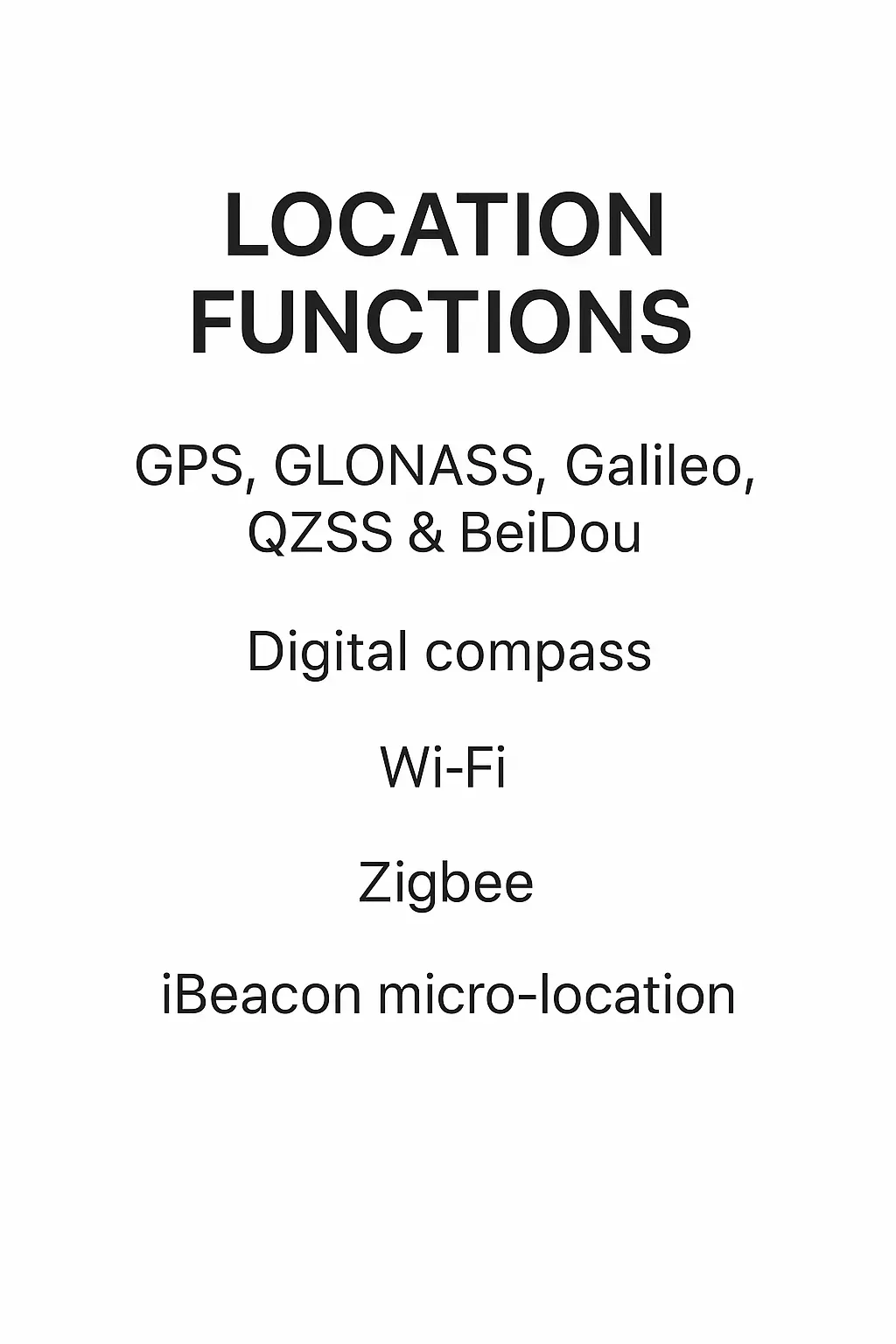
Satellite-based positioning is a basic smartphone function used for navigation and location-based services. Many phones support multiple GNSS constellations. For example, iPhone 15 supports GPS (United States), GLONASS (Russia), Galileo (European Union), QZSS (Japan), and BeiDou (China).
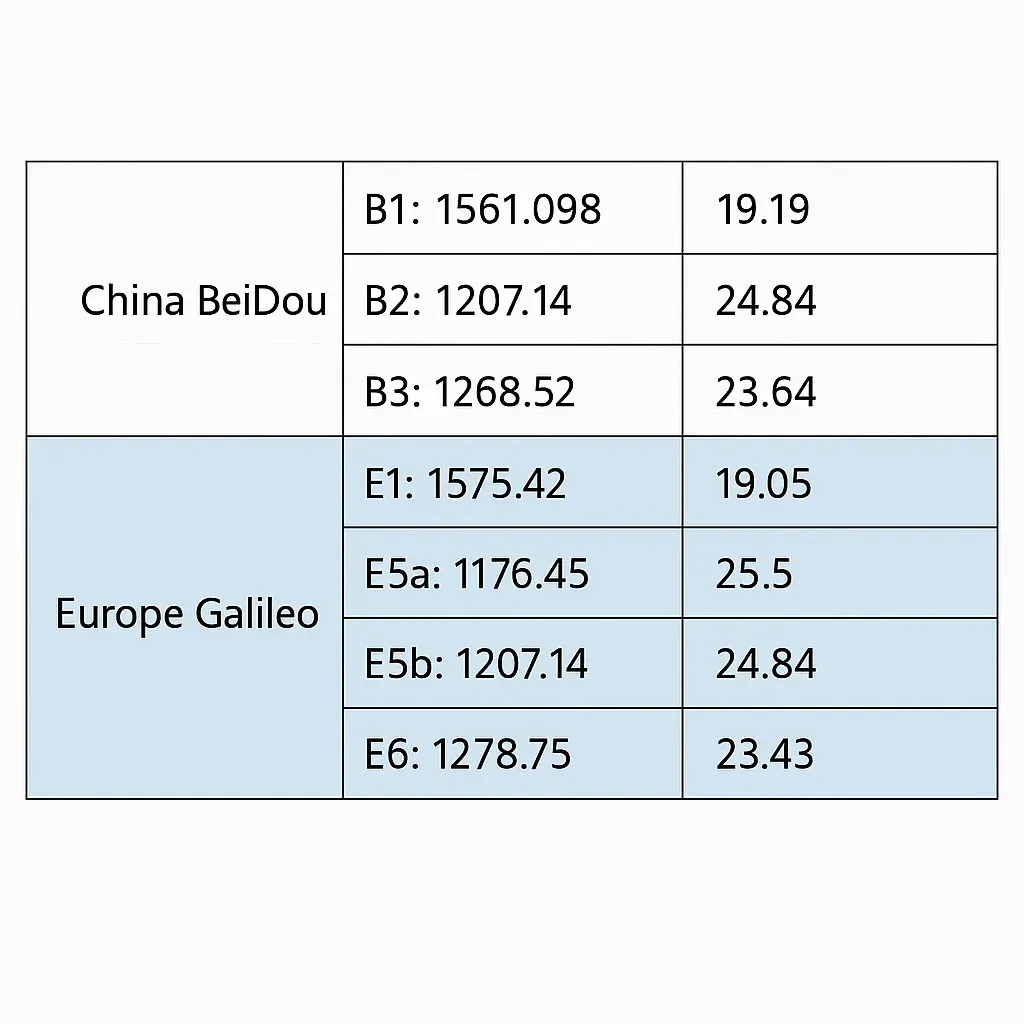
GPS operates on L1, L2, and L5 frequency bands and is the earliest global navigation system. GLONASS uses L1, L2, and L3 bands. Galileo uses E1, E5, and E6 bands, while BeiDou uses B1, B2, and B3 bands. Constellation design and historical timing have influenced which GNSS obtained various L-band allocations. BeiDou has become the primary GNSS used domestically in China, offering high accuracy and additional services such as short message communications.
No.4 Satellite telephony
Satellite-based voice and data services are emerging in consumer phones. Starlink, a large low-Earth-orbit satellite system, uses Ka-band and Ku-band spectrum for backhaul and user links and can provide broadband Internet globally. Starlink satellite-to-user links operate roughly in the 10.7 GHz to 12.7 GHz range, while ground station uplinks use millimeter-wave bands near 27.5 GHz to 30 GHz.
Some smartphone vendors have implemented satellite telephony using existing satellite services. For example, certain models support direct satellite voice via a regional satellite system operating in the S-band, with uplink around 1980 MHz–2010 MHz and downlink around 2170 MHz–2200 MHz, suitable for voice and low-rate data for many users. Integrating high-gain satellite antennas into a compact handset remains a technical challenge, which limits the number of phones that support full two-way satellite broadband like Starlink.
Summary
A single smartphone RF PCB integrates a wide variety of wireless systems: cellular (2G/3G/4G/5G), Wi-Fi across multiple bands, Bluetooth, UWB, NFC, GNSS (GPS, GLONASS, Galileo, QZSS, BeiDou), and in some cases satellite telephony. This broad support is enabled by RF component integration and advances in antenna design that allow many bands and functions to coexist within a compact handset form factor.