Satellite sun outage is a predictable form of radio-frequency interference that occurs when the Sun aligns directly behind a satellite as viewed from a ground station. The Sun acts as a powerful broadband microwave noise source, elevating the noise floor at the receiver and degrading or interrupting the downlink signal.
Mechanism of Sun Outage Interference
Geostationary satellites experience sun outages when solar transit places the Sun within the main beam or near side-lobes of the receiving antenna. The receiver then captures both the desired satellite transponder signal and intense solar noise. Interference severity ranges from modest carrier-to-noise ratio degradation to complete signal loss, depending on antenna gain, beamwidth, and solar activity level.
Antenna beamwidth is a primary determinant of outage duration. Narrow-beam, high-gain parabolic dishes (typical for satellite reception) limit exposure to a few minutes per event, whereas wider-beam antennas may experience outages lasting up to 30 minutes. Solar noise can raise the system noise temperature by 10–20 dB even during periods of low solar activity, directly affecting link margin and bit-error-rate performance.
An approximate sun outage angle (the angular separation at which degradation begins or ends) can be estimated from downlink frequency and antenna diameter, although precise prediction requires site-specific equipment parameters.

Timing and Predictability
For geostationary satellites, sun outages occur near the equinoxes—primarily March/April and September/October—when the Sun crosses the celestial equator and passes behind the satellite arc. In the Northern Hemisphere, peak events cluster in early March and early October; in the Southern Hemisphere, they occur in early April and early September. Exact timing depends on satellite longitude, ground-station latitude and longitude, and antenna pointing accuracy.
Because orbital geometry is well understood, outage windows are calculable days or weeks in advance using satellite ephemeris and station coordinates. Many operators schedule maintenance or switch to redundant links during these brief windows.
System Impact and Mitigation Approaches
Sun outages affect all satellite services that rely on downlink reception, including direct-to-home broadcasting, VSAT networks, telemetry, and backhaul links. While short in duration, they can disrupt real-time applications if unmitigated. Common countermeasures include:
- Margin budgeting that accounts for the expected noise increase
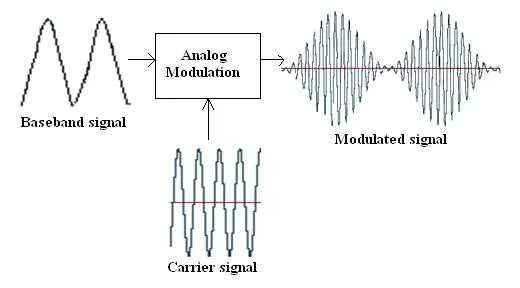
- Automatic uplink power control or adaptive coding and modulation on the satellite side
- Site diversity or redundant receive antennas with spatial separation
- Precise antenna tracking to minimize beamwidth exposure time
Receiver electronics must maintain stable performance across the elevated noise conditions, placing demands on low-noise amplifiers (LNAs), downconverters, and digital signal processing.
RF Electronics and Receiver Design Considerations
Ground-station receivers require high dynamic range and low noise figures to preserve link margin during solar interference. Key design elements include:
- Cryogenic or thermoelectrically cooled LNAs for minimal added noise
- High-linearity mixers and IF amplifiers to handle strong solar signals without compression
- Digital filtering and adaptive equalization to suppress broadband solar noise
- Precise local-oscillator stability to maintain carrier recovery under fluctuating signal-to-noise conditions
These circuits must operate reliably in outdoor environments subject to temperature extremes, humidity, and lightning-induced transients.
PCB and Electronic Manufacturing Relevance
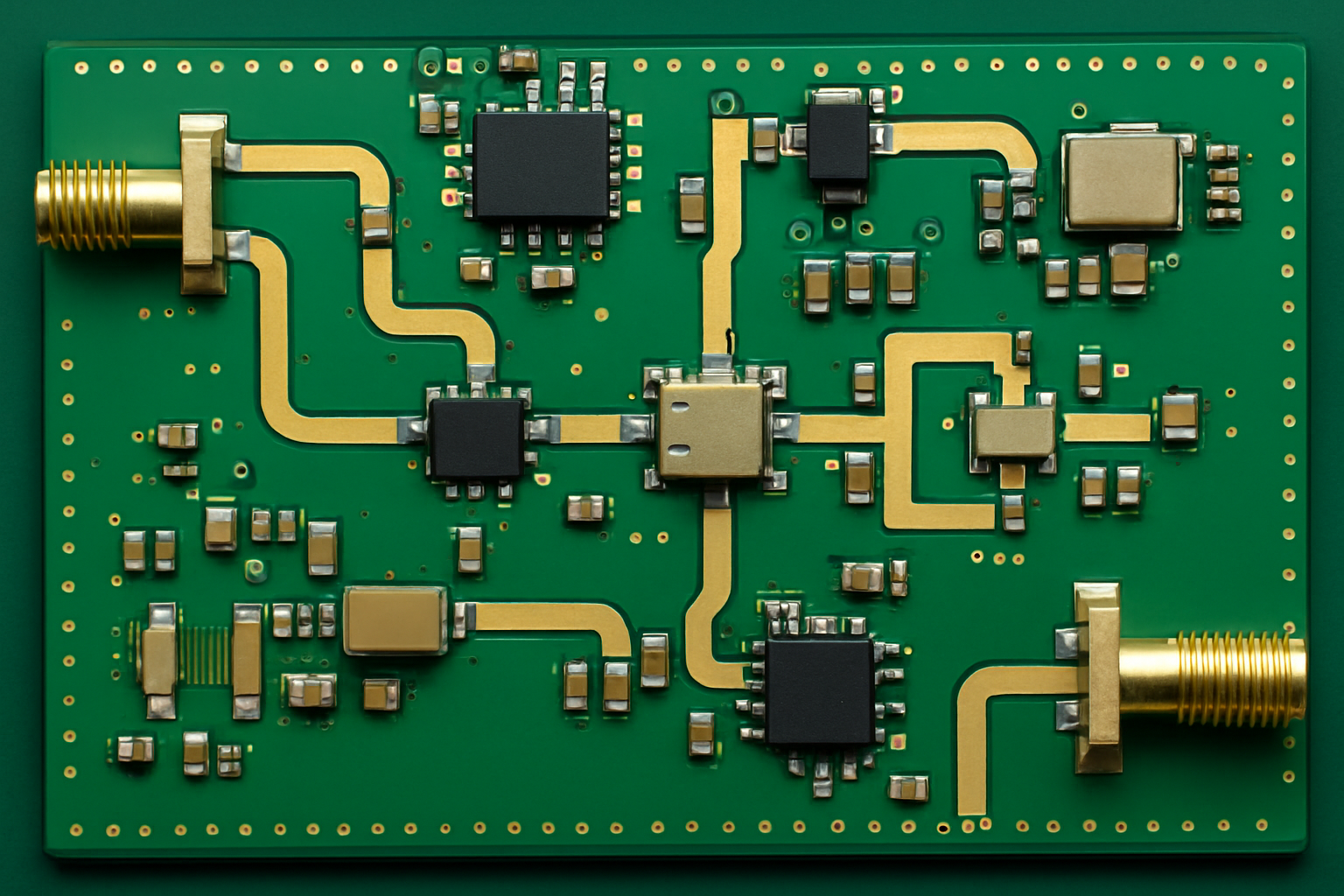
Satellite ground-station electronics rely on specialized PCB technologies optimized for RF and microwave performance. Low-loss dielectric materials (PTFE, hydrocarbon ceramics, or liquid-crystal polymers) minimize insertion loss and maintain consistent dielectric constant across temperature and frequency. Controlled-impedance microstrip or stripline traces, precise via structures, and surface finishes such as ENIG or immersion silver preserve signal integrity at Ku-, Ka-, and higher bands.
Flexible printed circuits (FPC) enable compact interconnects between feed horns, LNAs, and downconverters in reflector assemblies. Thermal management solutions—metal-core PCBs, embedded heat spreaders, or active cooling interfaces—stabilize LNA junction temperatures. Environmental protection through conformal coatings, robust soldermask, and sealed enclosures ensures long-term reliability under outdoor exposure.
Manufacturing processes such as laser-drilled microvias, sequential lamination, and automated RF testing verify performance before integration into antenna systems. These practices parallel the precision required for satellite payloads themselves and directly influence receiver noise figure, phase noise, and overall system availability during sun outage events.
Industry Trends and System Integration
Expansion of high-throughput satellite constellations, 5G non-terrestrial networks, and direct-to-device satellite services increases the density of ground stations and the importance of outage-resilient receiver design. Higher-frequency bands (Ka, Q/V) exhibit narrower beamwidths but greater susceptibility to atmospheric and solar effects, driving demand for advanced materials and tighter manufacturing tolerances. Integration of AI-based link adaptation and predictive outage scheduling further emphasizes the need for high-reliability electronics at every ground terminal.
Conclusion
Satellite sun outage is a well-characterized geometric and electromagnetic phenomenon whose impact is managed through antenna design, link budgeting, and robust receiver electronics. Realizing reliable performance during these events depends on precise RF circuit design, low-loss PCB materials, thermal management, and rigorous environmental qualification. PCB fabrication and assembly capabilities that support controlled-impedance routing, high-frequency dielectrics, and outdoor-grade reliability enable satellite ground systems to maintain connectivity even when solar noise briefly dominates the downlink.