What is modulation?
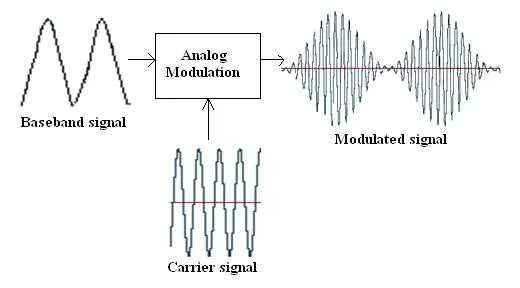
Modulation is the process of shifting a signal that needs to be transmitted to a higher-frequency carrier, achieving spectrum translation. The transformation that converts an input signal into a waveform suitable for transmission over a channel is called modulation. The original signal is called the modulating signal or baseband signal; the high-frequency waveform that carries the baseband is called the carrier.
Modulation matches the spectrum of the source to the passband of the channel.
What are the signals being transmitted?
The signals to be transmitted are baseband signals. Historically these were voice signals; today they are various digital data including programs, images, voice, and video.
What is the purpose of modulation?
By varying carrier parameters, modulation allows information (voice, data, etc.) to be transmitted through a chosen medium.

Why do signals need modulation?
For digital communications, modulation enables transmission of more data within a limited frequency band.
Key reasons include:
- Low-frequency signals are not suitable for propagation through the air. Antenna size is proportional to signal wavelength, so modulation shifts the spectrum to higher frequencies for practical antennas.
- Wireless spectrum is limited and transmissions must occur in specified bands; modulation enables frequency multiplexing and reuse.
- Modulation can improve resistance to interference and increase spectral efficiency.
Modulation techniques in modern wireless communication
Most wireless services use complex carrier modulation schemes. Improvements in modulation techniques, components, and error-correction codes have pushed channel capacity closer to Shannon's theoretical limits. Common modulation types fall into two broad categories: analog modulation and digital modulation.
Analog modulation
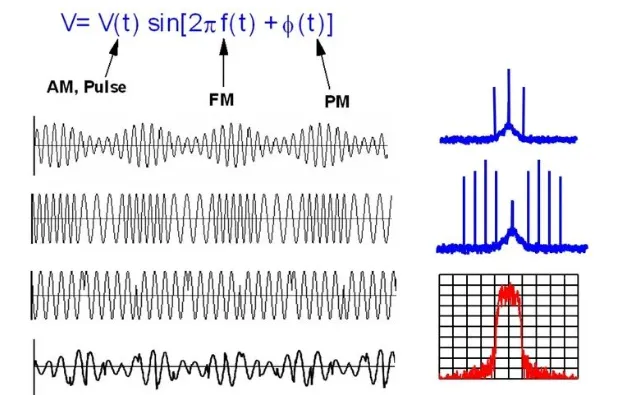
Analog modulation uses a continuously varying signal to modulate a high-frequency sine wave. The three basic types are amplitude modulation (AM), frequency modulation (FM), and phase modulation (PM).
Amplitude Modulation (AM)
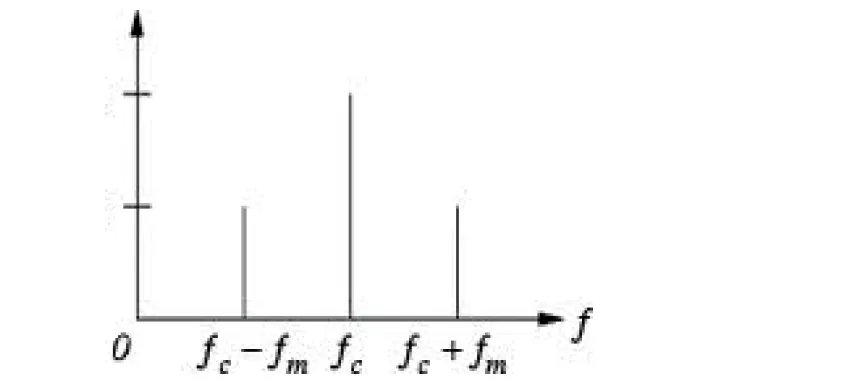
AM varies the carrier amplitude in proportion to the modulating audio signal while keeping frequency and phase constant. For a sinusoidal audio input the frequency-domain representation shows the carrier plus two sidebands separated by the modulation frequency. AM changes the signal's amplitude and is used historically for audio broadcasting.
Frequency Modulation (FM)
FM keeps amplitude constant and varies the instantaneous frequency of the carrier proportional to the modulating signal. In the frequency domain FM produces the carrier and a set of sidebands whose amplitudes can be predicted using Bessel functions. FM limits amplitude noise because information is carried in frequency variations, allowing amplitude limiting stages to suppress amplitude noise and improve audio quality for high-fidelity analog broadcast.
Phase Modulation (PM)
PM keeps amplitude constant while varying the carrier phase. In the time domain PM appears similar to FM; both are often referred to as angle modulation. In the frequency domain PM produces the carrier plus sidebands predictable with Bessel functions. PM and FM are closely related—one is essentially the derivative of the other—and PM has become widely used for data transmission in recent years.
Digital modulation
What is digital modulation?
Digital modulation refers to schemes where digital states are represented by carrier amplitude, frequency, and/or relative phase. Although called digital modulation, the actual transmitted waveform is analog: the carrier parameters are varied according to a digital baseband sequence. The modulating baseband signal is digital, while the modulation process remains analog.
In digital modulation, information is contained in the carrier's relative phase, frequency, or amplitude.
Baseband digital signals
Digital signals have a finite set of states. The simplest example is a binary sequence of 0s and 1s.
Increasing data throughput with advanced modulation
To increase data throughput, each symbol period can carry more information by increasing the number of discrete symbol states. This increases spectral efficiency by encoding multiple bits per symbol.
Descriptions of modulation signals
The only fundamental difference between analog and digital modulation is whether the carrier state changes continuously (analog) or discretely (digital). In practice, time-domain and frequency-domain representations of both types are similar. The analog methods AM, FM, and PM correspond to ASK, FSK, and PSK in digital modulation. Quadrature amplitude modulation (QAM) is a vector modulation that simultaneously changes amplitude and phase. Each modulation has trade-offs; bandwidth and implementation cost are primary concerns.
Key trade-offs
Choosing a complex modulation scheme for better noise resilience often requires more channel bandwidth or higher transmit power and can increase implementation complexity and cost. Poorly controlled transmit power can push amplifiers into nonlinear regions, causing distortion and adjacent-channel interference. I/Q modulation is widely used in digital communications for its spectral efficiency.
Analog vs. digital modulation
Analog modulation reflects continuously varying waveforms; digital modulation conveys discrete states. Digital systems are typically evaluated by bit error rate or frame error rate and can use optimal detection techniques such as matched filtering and maximum likelihood decisions. Because digital modulation uses discrete states, it can tolerate more waveform distortion without loss of the discrete information, making digital modulation more robust to noise in many cases. This robustness is a major reason commercial communication systems have transitioned from analog to digital.
Reasons for the shift to digital in commercial systems
Reasons include increased system capacity, preserved quality over long distances, and support for data transmission. Digital designs still require trade-offs between information bandwidth and available RF bandwidth, power consumption, and battery life. System optimization typically focuses on one or more of these metrics: spectral efficiency, power efficiency, or cost efficiency.
Modulation formats
Simple modulation formats
On-off keying (OOK) is the simplest format and uses amplitude to represent binary data: laser on for '1' and laser off for '0' in optical systems. In OOK, phase is typically random.
Composite modulation formats
Composite modulation encodes multiple bits per symbol. Rather than sending a binary stream, multiple bits are encoded into a single symbol. For example, quadrature phase-shift keying (QPSK) uses four symbols to encode two bits per symbol, effectively doubling data throughput for the same bandwidth. Higher-order modulation increases bits per symbol and data rate further.
Why use composite modulation?
At very high data rates (for example 100 Gbps and above) OOK occupies a large spectral width and becomes susceptible to filtering-induced intersymbol interference and adjacent-channel overlap. Composite modulation uses amplitude and phase (or frequency) to encode information, improving spectral efficiency. For instance, QPSK addresses these issues by encoding two bits per symbol.
PDM, intensity, IQ, and WDM
Electromagnetic waves include two orthogonal polarization components Ex and Ey. In polarization-division multiplexing (PDM), these orthogonal components serve as two independent channels that carry independent signals. In wavelength-division multiplexing (WDM), different frequencies act as independent channels. For composite modulation, both amplitude E and optical phase φ can be modulated to define symbols. The optical field can be represented on the I/Q complex plane where I is the in-phase component and Q is the quadrature component. Symbols correspond to points in this constellation, defined by amplitude and phase and sampled at symbol clock times.
QPSK example
QPSK has four constellation points equally spaced in phase on a circle of radius E, so symbols differ by phase only. Each symbol encodes two bits. In the time domain, QPSK symbols can be represented as combinations of two orthogonal waveforms with equal amplitude and different phase. Using QPSK doubles data rate compared to OOK in the same bandwidth. Coherent detection is typically required for phase detection.
Phase-shift keying (PSK)
PSK transmits data by changing the phase of a reference carrier. Each allowed phase maps to a binary pattern; each symbol represents a fixed number of bits. In binary PSK (BPSK or 2PSK), two phases 0 and π represent binary 0 and 1. BPSK has large symbol separation and good resistance to distortion and noise, making it suitable for long-distance applications such as submarine optical links at lower symbol rates. BPSK requires coherent detection for absolute phase determination, whereas OOK can often be detected by direct photodetection.
Differential PSK (DPSK)
DPSK encodes information in the phase difference between consecutive symbols rather than absolute phase, avoiding the need for coherent detection. For example, a π phase change can represent a binary 0 while no phase change represents a binary 1. At the receiver, the data stream is split into two delayed copies and combined to obtain a signal that can be detected directly by a photodetector. DPSK encodes one bit per symbol and is less suited for very high data rates compared to higher-order formats.
Quadrature Amplitude Modulation (QAM)
What is QAM?
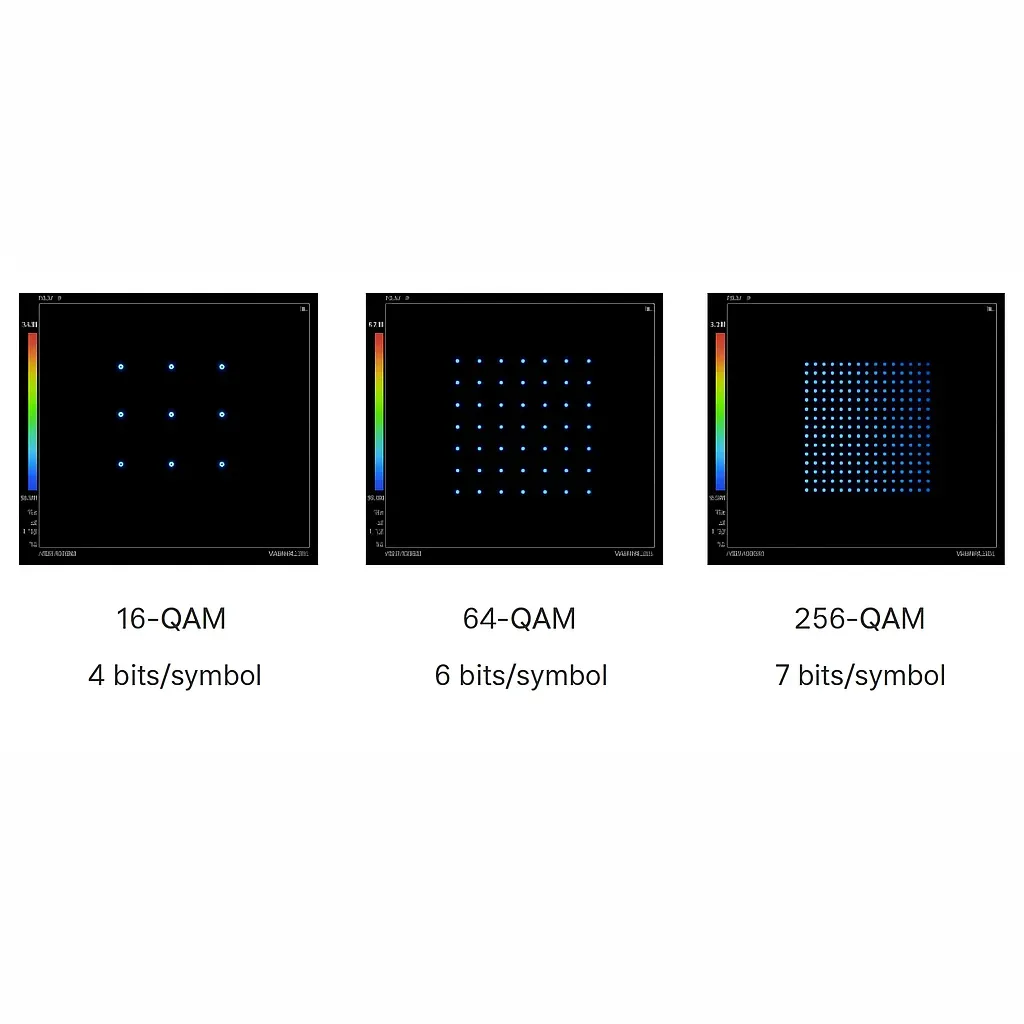
QAM modulates amplitude on two orthogonal carriers, typically sine and cosine waves 90 degrees out of phase. Data are represented by amplitude variations on these two carriers, plotted as constellation points on an I/Q grid. High-order QAM enables very high data rates, e.g., 400 Gbps or higher, but requires more complex transceivers and higher SNR. In 2^n-QAM, 2^n constellation points represent n bits per symbol commonly arranged in a square lattice.
2-QAM is equivalent to BPSK; 4-QAM is equivalent to QPSK; 8-QAM is impractical due to inefficient constellation packing. 16-QAM offers double the spectral efficiency of 8-QAM with modest BER increase and is widely used.
APSK and nonlinear channels
Amplitude- and phase-shift keying (APSK) places constellation points on concentric rings rather than a square grid. APSK was introduced for satellite systems where power amplifiers are nonlinear and offers better tolerance to nonlinear amplification. In optical systems with nonlinear noise, APSK can improve tolerance to fiber nonlinearity. For very high data rates such as 400 Gbps and above, 16-QAM's larger constellation spacing makes it easier to implement and provides better optical SNR, often making it the preferred choice.
Combining composite modulation with other multiplexing
Composite modulation can be combined with other multiplexing methods. For example, in PDM a second optical wave orthogonally polarized to the first carries independent information over the same fiber. Using QPSK doubles the data rate; applying PDM can double the throughput again.
Signal rates: bit rate vs. symbol rate
Two rates are important: the bit rate f_tx in bits per second, and the symbol rate S in symbols per second (baud).
If polarization multiplexing is used, divide the result by 2. For example, a 100-Gbps QPSK signal has S = (100 Gbps) / log2(4 bits/symbol) / (2 polarizations) = 25 Gbaud, so the minimum optical bandwidth occupancy is 25 GHz.
Thus the bandwidth required by a composite-modulated signal depends on symbol rate and the number of bits per symbol rather than raw bit rate. Increasing bits per symbol reduces required bandwidth for a given data rate, improving spectral efficiency.
Shannon limit
What is the Shannon limit?
Claude Shannon showed that the maximum error-free data rate of a communication channel depends on bandwidth and noise. This maximum bit rate is the channel capacity, commonly called the Shannon limit. The Shannon-Hartley theorem gives channel capacity C as:

where B is bandwidth in Hz, S is average received signal power in watts, and N is average noise power in watts. S/N is the signal-to-noise ratio. Channel capacity depends on bandwidth and SNR but not the absolute carrier frequency. Increasing bandwidth or improving SNR raises capacity. Shannon proved the existence of schemes that can reach arbitrary low error rates at rates up to C, but did not provide specific constructions. Modern digital modulation and coding are practical tools to approach the Shannon limit. SNR remains a fundamental limiting factor for high data rates and long-distance communications.
Electro-optic control of optical phase (MZ phase modulators)
To modulate phase in optics, the electro-optic effect can be used. Certain crystals, such as lithium niobate, have a refractive index n that depends on the local electric field: n = n0 + aE + bE^2 + ... . The linear term is the Pockels effect and the quadratic term is the Kerr effect. Changing n changes propagation speed v = c/n and the optical wavelength in the material, so applying a voltage alters the phase of light exiting the crystal. This principle enables phase control via applied voltage.
What is a Mach-Zehnder modulator?
A Mach-Zehnder (MZ) modulator applies the electro-optic effect by splitting an optical beam into two paths, applying phase shifts via electro-optic elements on one or both paths, and recombining them. The relative phase difference ΔΦ between the two paths depends on the voltage difference ΔU applied. When recombined, ΔU determines constructive or destructive interference and therefore transmitted power. The half-wave voltage Vπ is the voltage required to produce a π phase shift that switches between 0% and 100% power transmission.
Using an I/Q representation, MZ modulators can generate phase and amplitude variations. For example, applying different voltages to the two arms can produce constructive or destructive interference and realize phase modulation or amplitude modulation depending on the applied voltages.
MZ modulation for QPSK transmission
QPSK encodes two bits per symbol using four constellation points on the same amplitude circle with phase separations of π/2. At the transmitter, the electrical bitstream is demultiplexed into I and Q components. Each component modulates one arm of an MZ modulator to create the required phase relationships; for QPSK the Q arm is shifted by π/2 relative to the I arm. Recombining the two arms yields the QPSK optical signal.