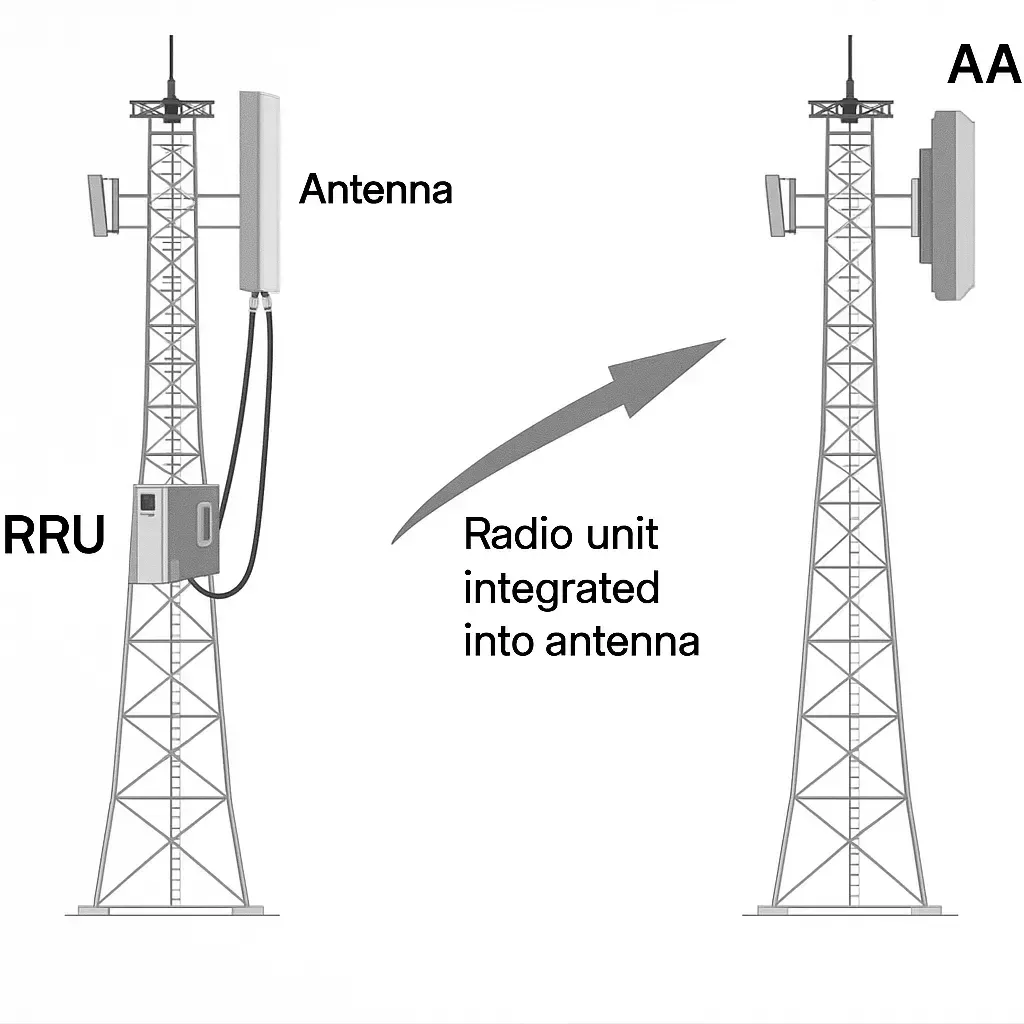
The dawn of next-generation 6G wireless systems envisions massive multiple-input multiple-output (MIMO) as a key enabling technology. Following successful deployments in 5G and subsequent wireless systems, massive MIMO has demonstrated advantages in integrability and scalability. Recent evolutionary features and disruptive trends in massive MIMO are emerging and are likely to reshape future 6G systems and networks.
Overview
Future massive MIMO systems and signals will be enhanced by combining other innovations, architectures, and strategies such as intelligent surfaces/intelligent reflecting surfaces, artificial intelligence, terahertz communications, and cell-free architectures. In addition, more vertical applications based on massive MIMO are expected to emerge and expand, including wireless positioning and sensing, vehicular communications, non-terrestrial communications, remote sensing, and interplanetary links.
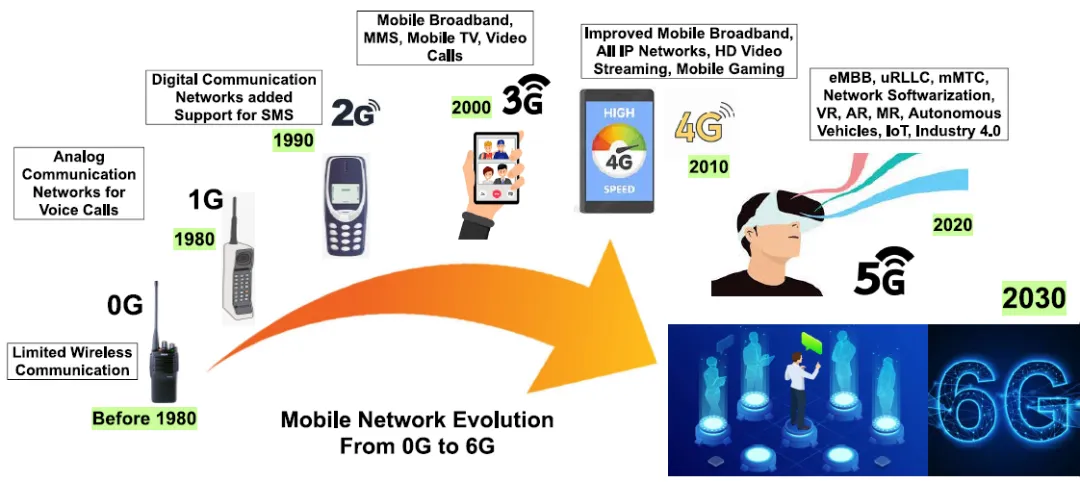
Massive MIMO has been a cornerstone of 5G wireless communications and has experienced unprecedented development and deployment growth. Rapid technological innovation and large commercial demand suggest that massive MIMO will continue to evolve and more broadly reshape telecommunications and related fields. The 5G NR standard (Release 15) inherently supports massive MIMO. As the first NR release, Release 15 includes basic features supporting massive MIMO across deployment scenarios, such as TDD operation leveraging channel reciprocity, multiuser MIMO with high-resolution channel state information (CSI) feedback, and advanced beam management for high-frequency analog beamforming. Subsequent releases have further advanced massive MIMO: Release 16 reduced CSI feedback and beam-management overhead through spatial and frequency-domain compression and introduced non-coherent joint transmission from multiple transmission/reception points (TRPs). Release 17 extended the evolution by leveraging angular-delay reciprocity to further reduce CSI feedback overhead, introducing a unified transmission configuration indication (TCI) framework for multi-beam operation, and improving multi-TRP support with inter-cell multi-TRP enhancements and TRP-specific beam management features.
Release 18, the first phase of 5G-Advanced, includes further massive MIMO evolution. Potential directions under study include uplink MIMO enhancements (for example, using eight transmit antennas for uplink and multi-panel uplink transmissions), extending the unified TCI framework from single-TRP to multi-TRP scenarios, increasing the number of orthogonal demodulation reference signal (DM-RS) ports for MU-MIMO, and improved CSI reporting for medium- to high-speed user equipment.
With rapid standardization and promising commercialization, massive MIMO is becoming a foundational technology for 5G and beyond and is expected to combine with other enablers and expand into new verticals.
1. IOS/IRS Physical Fundamentals for Massive MIMO
Driven by explosive wireless data growth, future 6G systems require innovative paradigms to support high data rates. Massive MIMO exploits the inherent randomness of the wireless environment. Traditional massive MIMO relies on large phased arrays, but phase shifters introduce hardware cost and power consumption, which limits scalability when antenna counts grow.
Intelligent metasurfaces, composed of tiled subwavelength scatterers, provide a thin, reconfigurable medium that can economically realize large-scale MIMO. By selectively reflecting and/or refracting incident signals and applying flexible phase shifts, such surfaces can actively shape the uncontrolled wireless environment into desired forms.
The reconfiguration of each surface element is typically achieved by one or two PIN diodes controlled by bias voltages. Compared with conventional phased arrays, metasurfaces involve far less hardware and power cost and can be scaled to large sizes, offering a practical route to large-scale MIMO.
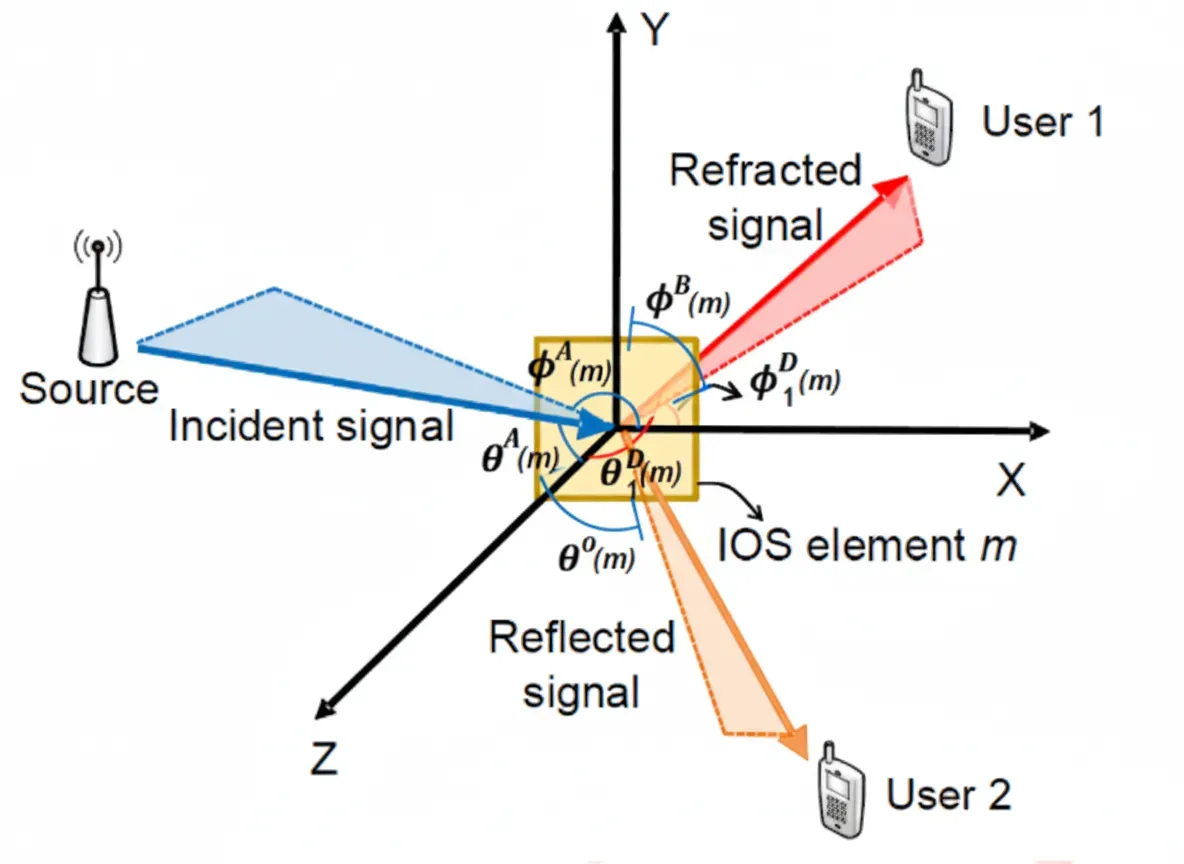
When an incident signal hits a surface element, part of the energy is reflected and the remainder refracted. Defining the reflection-refraction ratio yields three surface types:
- When the reflection coefficient epsilon = 0, the surface only reflects the incident signal, forming an intelligent reflecting surface (IRS). It can be mounted on walls to act as reflective relays for coverage.
- When epsilon tends to infinity, the surface only refracts the incident signal, acting as a reconfigurable refractive surface (RRS). It can replace a base station antenna array for transmission and reception.
- When 0 < epsilon < 1, the surface can simultaneously reflect and refract incident signals, known as an intelligent omnidirectional surface (IOS). Compared with IRS, IOS can provide full-dimensional wireless communication regardless of user position relative to the surface.
Both IOS and IRS are considered effective approaches to implement large-scale MIMO; however, IOS introduces specific challenges:
- The refracted and reflected signals of IOS are coupled and jointly determined by the PIN diode states. This coupling raises questions about whether IOS-assisted transmission preserves channel reciprocity across both sides of the surface.
- To exploit IOS reflection and refraction, optimal placement and orientation of the IOS must be explored for a given base station and user distribution to expand coverage on both sides of the surface.
- Because reflection and refraction for different users are interdependent, beamforming schemes need to be reconsidered and adjusted for IOS-assisted links.

2. Positioning and Sensing with IOS/IRS-enabled Massive MIMO
Future 6G is expected to integrate native wireless positioning and sensing for navigation, transportation, healthcare, and other uses. These services demand high-resolution sensing and precise positioning. Massive MIMO is promising because larger antenna arrays reduce beamwidth and improve spatial resolution. However, wireless environments are increasingly complex; line-of-sight (LoS) links can be blocked by buildings or objects, reducing sensing and positioning accuracy. IOS and IRS can provide favorable propagation conditions to improve sensing and positioning accuracy.
IOS can provide additional paths to targets, extending coverage; it can also manipulate propagation conditions to tailor signals from different objects to make them easier to distinguish.

Integrating IOS into wireless sensing and positioning systems faces several challenges:
- Optimizing IOS configurations for sensing and positioning differs from communication-oriented designs. New metrics must be defined, for example, the distance between signal patterns corresponding to different targets under given IOS configurations, so receivers can better distinguish targets. Exhaustive enumeration of configurations is impractical when the number of IOS elements is large, so selecting an appropriate subset of configurations is necessary to balance latency and accuracy.
- Decision functions are coupled with IOS optimization, complicating the search for optimal functions. Receivers require decision functions to map received signals to target or position information; because IOS modifies received signals, the choice of decision function depends on IOS configuration. Joint optimization of decision functions and IOS settings is required to improve performance.
- Practical deployment issues include where to place IOS and determining appropriate IOS size, considering environmental topology and other constraints.
In summary, massive MIMO is well suited to integrated communication, positioning, and sensing. IOS, by enabling customization of the propagation environment, is a key driver for such integration.
3. Ultra-Massive MIMO at Terahertz Frequencies
According to ITU-R, terahertz frequencies span 0.1 THz to 10 THz, with the sub-terahertz range between 0.1 THz and 0.3 THz often termed the sub-THz region. Terahertz and sub-THz signals bridge radio and optical frequencies. Their short wavelengths in millimeter and sub-millimeter ranges make them strong candidates for extremely high-capacity communications, high-resolution sensing, and situational awareness in 6G. However, small wavelengths come with highly uncertain channel characteristics and intermittent, unreliable links caused by one or more of the following impairments:
- High path loss and molecular absorption, blockage, and scattering. Small antenna apertures at these frequencies cause high free-space path loss and additional attenuation from molecular absorption, blockage, scattering, and weather effects, resulting in intermittent links that require ultra-narrow beamforming to improve reliability.
- Low power efficiency. For a given power amplifier technology, RF output power decreases roughly 20 dB per decade, impacting link budget and encouraging large antenna arrays with many elements.
- Large transceivers. High beamforming gain for link reliability requires very large transceivers, often with thousands of elements, presenting significant challenges for mobility and beam tracking due to extremely narrow beams.
- Phase noise. At sub-THz/THz frequencies, phase noise causes intercarrier interference that degrades CP-OFDM performance. Increasing subcarrier spacing mitigates this but shortens symbol duration and reduces coverage.
- Channel sparsity. Ultra-narrow beams and quasi-ray propagation yield few spatial degrees of freedom, often dominated by a LoS component and limited multipath, challenging MIMO operation.
- Spherical wave and near-field effects. Large arrays exhibit significant spherical-wave and near-field effects, complicating MIMO precoding strategies.
- Beam squint. The narrowband response of phase shifters in planar arrays causes frequency-dependent beam misalignment, known as beam squint. Beam-widening techniques can mitigate this at the cost of coverage, and true-time-delay units can avoid beam squint at the expense of complexity.
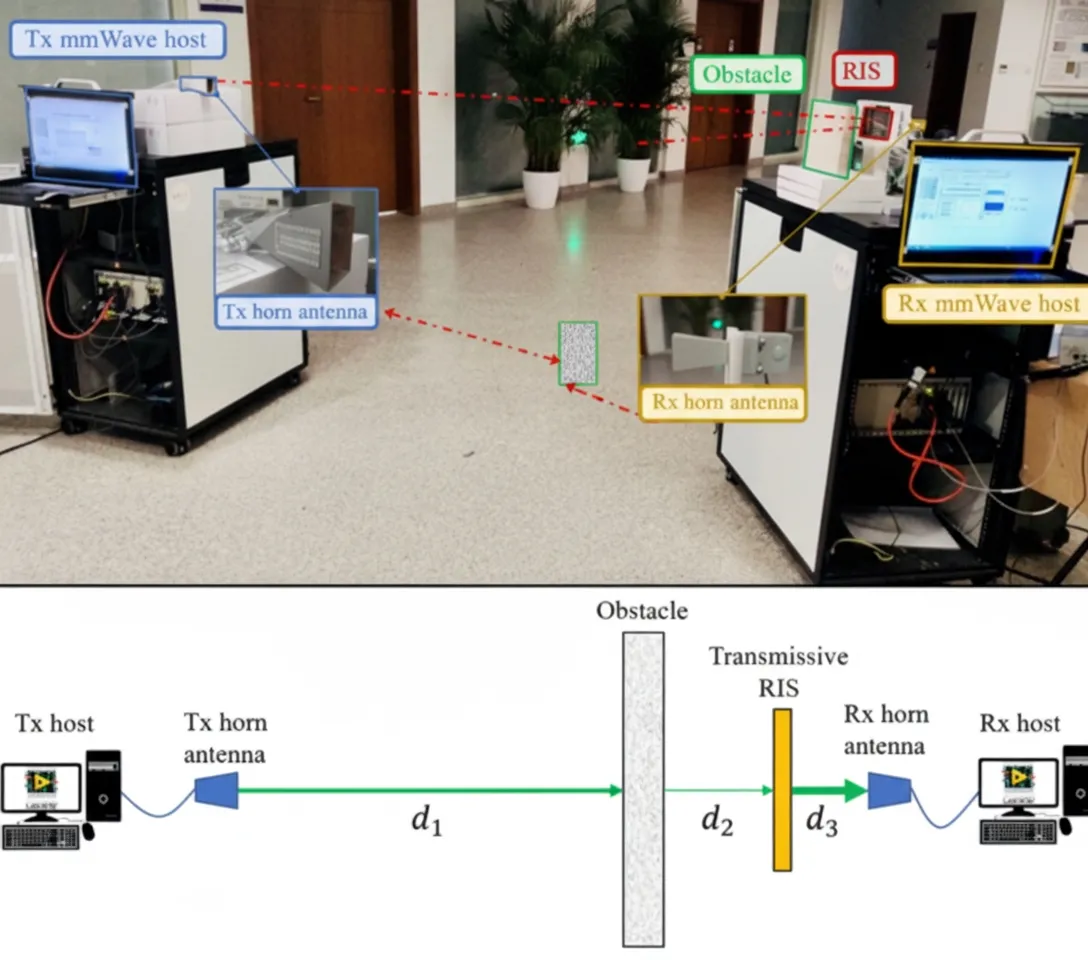
Research into transceiver architectures and network solutions aims to mitigate these issues, particularly those arising from sub-THz/THz propagation. In network solutions, IRS/RIS with many small antenna elements are receiving significant attention because they can adapt reflection and refraction properties. Sub-THz/THz IRS/RIS can deflect rays to overcome blockage and path loss, focus beams to exploit near-field effects for improved beamforming and 3D imaging, and enhance channel multipath richness to improve spatial multiplexing capability at these frequencies.
4. Cell-Free Massive MIMO
Cell-free massive MIMO, also called distributed MIMO or distributed massive MIMO, is viewed as a promising B5G technology for improved spectral and energy efficiency. It leverages joint transmission/reception, dense deployment of low-cost access points, and macro diversity to provide nearly uniform service quality across a coverage area. Scalable designs for receiver combining, precoding, and power allocation have been developed to limit processing complexity and fronthaul signaling.
In scalable cell-free systems, an access point serves only a limited number of users. A user-centric access point architecture can serve each user with multiple access points that offer the best channel conditions within a local region. Centralized processing units and fronthaul links between access points and the central processor are key layers for practical operation. When an edge cloud sits between access points and the central cloud, collaborative processing across edge and central clouds adds another component.
End-to-end analyses, from the wireless edge to the central cloud, are necessary to understand bottlenecks, constraints, and energy consumption. End-to-end studies of low-cost, energy-efficient cell-free deployments are critical to accelerate practical 6G adoption.
The fronthaul/midhaul links connecting access points to central processors align with the cloudification trend in mobile networks, motivating consideration of virtualized C-RAN frameworks. Virtualized C-RAN centralizes digital units in edge or central clouds for resource sharing. Deployment options for cell-free massive MIMO have also been discussed in the context of O-RAN to enable intelligent, virtualized, and interoperable 6G architectures.
Fronthaul and midhaul transport technologies are important to cost-effective cell-free deployments. Dedicated fiber to each access point is often prohibitively expensive. Radio-stripe fronthaul architectures reduce cost by integrating access points along a shared transport line. When access points are widely distributed, high-bandwidth wireless fronthaul solutions such as millimeter wave and terahertz wireless links can avoid costly fiber deployment. Hybrid fiber-wireless fronthaul/midhaul combinations can strike a balance between link quality and cost. Deploying short-range wireless fronthaul between each access point and its edge cloud while maintaining reliable fiber between edge and central clouds is one practical option. Handling hardware impairments from low-cost transceivers at access points and wireless fronthaul nodes is another important consideration.
Energy-efficient operation is increasingly important. Methods such as access point on/off switching and virtualization and sharing of cloud and fronthaul/midhaul resources help minimize end-to-end energy consumption. Ultimately, limitations, energy models, and saving mechanisms for digital units and processors at the edge and central clouds must be considered to fully address efficiency in cell-free massive MIMO systems.
5. Artificial Intelligence for Massive MIMO
AI applied to massive MIMO can support advanced human-machine interaction and reliable, low-latency transmission for future industrial applications. Increasing antenna counts create new challenges, notably rising overhead for channel estimation and feedback and the need for improved prediction accuracy. AI has the potential to address these issues, but several challenges remain from both industry and research perspectives.
Industry challenges include:
- Bridging the gap between training datasets and real-world channels. Lack of AI generalization can degrade system performance.
- Adapting classic AI algorithms from image and speech domains to wireless data, which has distinct characteristics.
- Designing wireless AI solutions that work across diverse and dynamic communication scenarios with limited compute resources.
Research trends and opportunities include:
- Applying machine learning to resource allocation to enable low-complexity implementations and reduce operational costs, improving spectral and energy efficiency, supporting more users, and lowering latency and power consumption.
- Using machine learning and deep learning for signal detection to mitigate the high complexity of traditional linear and nonlinear detectors.
- Leveraging AI for interference management, such as identifying and predicting the number and strength of interference sources to aid suppression.
- Developing tailored AI strategies for specific verticals as massive MIMO expands into new application domains.
6. Massive MIMO-OFDM for High-Mobility Applications
In massive MIMO, large antenna arrays reduce multiuser interference in spatial multiplexing or compensate for path loss at high frequencies. Coherent demodulation schemes typically use MIMO-OFDM with channel estimation and pre/post-equalization, which requires significant pilot overhead and increases latency. High-mobility scenarios, such as vehicular communications, challenge coherent demodulation because pilots cannot track fast channel variations at affordable overhead.
As an alternative, non-coherent demodulation schemes combining differential modulation with massive MIMO-OFDM have been proposed. Studies show these can outperform coherent schemes in high-mobility settings without pilot symbols and with reduced complexity. Key considerations for successful deployment include:
- Large antenna counts are essential. In uplink, arrays act as spatial combiners to reduce noise and self-interference from differential modulation. In downlink, beamforming combined with differential schemes increases coverage and enables spatial multiplexing.
- Mapping differential modulation onto the two-dimensional time-frequency grid of OFDM. Time-domain, frequency-domain, and hybrid-domain mappings have been proposed; hybrid-domain performs best by minimizing signaling per transmitted burst.
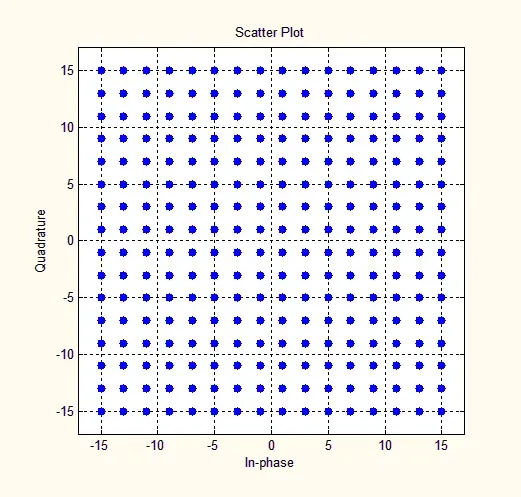
- Constellation-domain multiplexing across users provides an additional domain beyond space, time, and frequency. Each user chooses its own constellation at the transmitter; the receiver observes the composite constellation formed by the superposition. Overall BER performance depends on joint constellation design and symbol mapping, which leads to a nonconvex optimization that can be addressed with evolutionary computing methods.
Hybrid demodulation schemes have also been proposed that replace pilot symbols in coherent schemes with differentially encoded data streams that can be non-coherently detected and subsequently used for channel estimation. Such hybrid schemes combine the strengths of coherent and non-coherent detection, improving spectral efficiency while maintaining near-coherent estimation performance and low complexity.
7. Massive MIMO for Non-Terrestrial Networks
3GPP Release 17 introduced 5G NR support for satellite communications, a major form of non-terrestrial networks (NTN). NTN encompasses networks involving airborne or spaceborne platforms, including satellite constellations, high-altitude platform systems (HAPS) such as aircraft, balloons, and airships, and air-to-ground networks. Satellite networks offer ubiquitous connectivity and enhanced coverage for remote or rural areas and support both low-data-rate direct links to handheld devices and higher-data-rate satellite backhaul for customer premises equipment. Recent interest in broadband access via low Earth orbit (LEO) satellite constellations has been unprecedented, with major commercial actors deploying large constellations.
Several catalysts accelerate satellite broadband development, including reduced launch costs, private capital, AI and cloud/edge computing deployment, and advanced satellite radio and networking technologies. From the wireless and massive MIMO perspective, key trends and challenges include:
- Deploying and operating expanding satellite constellations below 2000 km creates coexistence and competition challenges. Many LEO constellation operators prefer lower orbits to minimize latency, leading to a crowded orbital environment. Regulatory, policy, and technical measures are needed to manage space traffic and mitigate collision risks, including safety and disposal of spacecraft.
- Spectrum management is critical due to limited spectrum resources. 3GPP Release 17 studied support for satellite backhaul and low-data-rate direct links in sub-7 GHz S-band, while higher frequencies above 10 GHz are under study for Release 18. Commercial systems often use Ku and Ka bands and plan to expand into V-band. Spectrum overlap with terrestrial 5G may cause interference and coexistence issues that require coordinated spectrum management and interference mitigation strategies.
- Interference types within and across spatial networks are diverse. Intra-constellation interference can appear as in-band or out-of-band emissions between user terminals and ground stations. In multi-constellation scenarios, transmissions from one constellation may interfere with receivers of another. Traditional coordination and shared frequency allocations are one approach, but higher-performance interference suppression techniques will be needed as complexity grows.
- NGSO mega-constellations could be coordinated with GEO networks, HAPS, air-to-ground networks, and UAV networks to form a broader NTN ecosystem, increasing coexistence challenges. Space-enabled networks and massive MIMO will also extend to near-space and beyond, from low Earth altitudes to lunar orbit. Very large propagation distances and delays pose significant challenges for wireless sensing and communication, motivating solutions such as AI, edge computing, distributed and federated learning.
Overall, massive MIMO is rapidly extending human communication and sensing capabilities beyond the Earth, contributing to a growing space-enabled communications era.