Introduction
Drone avionics systems form the core of unmanned aerial vehicles, integrating flight controllers, sensors, communication modules, and power distribution circuits on printed circuit boards. These PCBs must operate reliably in dynamic flight conditions while meeting stringent size, weight, and power constraints. HDI drone PCB design presents additional engineering challenges because high-density interconnect structures allow more circuitry to fit into increasingly compact airframes.
Engineers must optimize routing density, signal integrity, thermal dissipation, mechanical durability, and component placement within limited board areas. Microvias, blind vias, fine-pitch components, and multilayer structures can help support compact avionics layouts, but they also increase fabrication and assembly requirements. This article examines the major challenges in drone avionics PCB design and presents practical drone PCB solutions for miniaturization, weight reduction, power distribution, vibration resistance, and communication performance.

HDI Drone PCB Design: How High-Density Avionics Supports Compact Drone Electronics
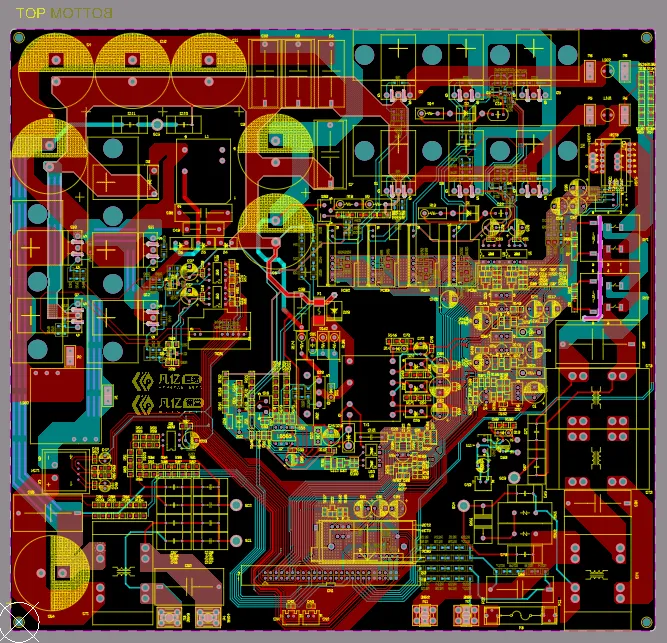
HDI drone PCB design involves creating circuit boards that house critical electronics for navigation, stabilization, telemetry, communication, and propulsion control. These boards connect microcontrollers, inertial measurement units, GPS receivers, and radio transceivers in a tightly integrated package.
Unlike conventional consumer electronics PCBs, drone avionics boards must operate under rapid maneuvers, vibration, temperature changes, and other external disturbances. The design process therefore requires a balance between electrical performance, thermal dissipation, mechanical integrity, and overall board size.
HDI technology can support these requirements by using microvias, blind vias, fine-line routing, and multilayer structures to increase routing density without proportionally increasing the PCB footprint. This is particularly useful when engineers need to place multiple functional circuits within a limited airframe volume.
Effective avionics PCBs also support autonomous operations by enabling precise data processing and low-latency control loops. They must support high-speed interfaces such as SPI, I2C, and UART while minimizing electromagnetic interference. As drones become smaller and longer-endurance, the relationship between HDI drone PCB architecture and overall system performance becomes increasingly important.
Miniaturized HDI Drone PCB Challenges: Routing Density, Size, and Signal Integrity
Miniaturized drone PCB design demands high component density to fit avionics into airframes with limited volume. HDI technology can address this challenge through microvias, blind vias, fine-pitch components, and additional routing layers.
However, higher density also increases routing complexity. Closely packed traces can contribute to crosstalk and reflections at higher operating frequencies. Via-in-pad structures may be required around fine-pitch packages, increasing the need for accurate fabrication and assembly.
Thermal hotspots can also develop when power-dissipating components are concentrated in small areas. Fabrication tolerances become more demanding as line widths, spaces, pads, and microvia structures decrease. These factors increase the importance of coordinated PCB design and manufacturing controls for an HDI drone application.
Miniaturized HDI Drone PCB Challenges: Routing Density, Size, and Signal Integrity
Miniaturized HDI Drone PCB Challenges
Miniaturized drone PCB design demands extreme component density to fit avionics into airframes with limited volume. High-density interconnects and fine-pitch components challenge routing and assembly precision, often requiring via-in-pad configurations. Signal integrity degrades with closely packed traces, leading to crosstalk and reflections at operating frequencies above 100 MHz. Thermal hotspots emerge from concentrated power dissipation in small areas, complicating heat spreading. Fabrication tolerances tighten to microns, increasing yield risks during multilayer lamination. These factors collectively strain standard design flows, necessitating specialized strategies.

Lightweight Drone PCB Challenges
Achieving lightweight drone PCB construction involves selecting thin cores and minimal copper weights without sacrificing strength. Reduced board thickness heightens warpage risks during reflow soldering, potentially misaligning components. Material choices must balance low density with mechanical stability, as thinner laminates flex under aerodynamic loads. Power planes thin out, raising resistance and voltage drops in distribution networks. Assembly processes demand careful handling to avoid delamination from handling stresses. Overall, lightweight drone PCB design trades durability for mass reduction, requiring meticulous stack-up planning.
Power Management Drone PCB Challenges
Power management drone PCB design must distribute energy efficiently from compact batteries to motors, sensors, processors, and communication electronics. Voltage regulators generate heat in confined areas, while propulsion loads can create significant current changes.
HDI layouts need careful separation of power, ground, and sensitive signal structures. Wide traces, copper planes, and via stitching can reduce impedance and distribute current more effectively. Thermal vias beneath power devices can transfer heat toward internal copper planes or chassis structures.
Switching regulators can also generate EMI that couples into sensitive analog and sensor circuits. Component placement, return-path control, ground partitioning, and local decoupling are therefore important for maintaining stable avionics performance.
Vibration Resistant Drone PCB Challenges
Vibration-resistant drone PCB design must account for high-frequency oscillations generated by propellers, motors, and aerodynamic disturbances. These stresses can fatigue solder joints, traces, vias, and component connections over repeated flight cycles.
In an HDI structure, mechanical stress can also affect small vias and fine-pitch interconnections. Mounting points should therefore be designed to distribute mechanical loads, while component placement should avoid creating unnecessary stress concentrations.
Rigid-flex connections can provide useful mechanical flexibility where the airframe requires folded or constrained PCB geometries. Low-profile components, suitable mounting methods, damping materials, and accelerated life testing can further support vibration resistance.

Additional challenges include electromagnetic compatibility and thermal management. High-speed signals from IMUs demand controlled impedance to preserve timing accuracy. Operating temperatures swing widely, stressing material Tg limits.
HDI Drone PCB Solutions: Practical Design and Manufacturing Strategies
HDI-Based Solutions for Miniaturized Drone PCB Design
Engineers can address miniaturized drone PCB challenges through HDI technology, employing microvias and blind vias for vertical transitions between routing layers. Layer counts can be increased to separate power, ground, and signal functions while reducing unnecessary routing congestion.
Component placement should be coordinated with the HDI stack-up so that via-in-pad structures and fine-pitch footprints can be manufactured reliably. Simulation tools can verify signal integrity before layout release, helping engineers adjust trace widths, lengths, impedance, and return paths.
Fabrication partners must also support the required fine-line and microvia structures. The actual manufacturing capability should be reviewed during DFM rather than assuming that every HDI fabricator can support the same minimum geometries.
Lightweight Drone PCB Solutions Using Thin Materials and Rigid-Flex Structures
Lightweight drone PCB solutions can use high-Tg FR-4 or polyimide laminates with reduced thickness where the mechanical requirements allow. Hybrid rigid-flex constructions can conform to airframe contours and reduce the need for additional connectors.
Copper distribution can also be optimized so that high-current paths retain sufficient conductivity while unnecessary copper is minimized. Conformal coatings can provide environmental protection without adding substantial mechanical bulk.
Stack-up symmetry remains important because thin boards are more sensitive to warpage during fabrication and reflow. Material selection should therefore consider thermal expansion, mechanical stability, and the actual assembly process rather than mass alone.
Power Distribution and Thermal Solutions for HDI Drone PCBs
For power-management circuits, dedicate suitable inner layers to power and ground planes and use via stitching to maintain low-impedance current paths. Buck converters should be positioned close to their loads, with input and output capacitors located according to the power-stage requirements.
Thermal vias under high-power ICs can transfer heat into larger copper areas. Current-sensing shunts should be integrated carefully into the intended current path, while analog and digital sections can be separated where necessary to reduce noise coupling.
These HDI drone power-management strategies help balance compact routing with current-carrying capacity and thermal performance.
Vibration-Resistant Drone PCB Solutions for High-Density Avionics
Vibration-resistant drone PCB solutions can incorporate mounting holes with suitable pad structures, mechanical reinforcement, damping materials, and appropriate component selection. Solder fillet profiles should follow applicable assembly requirements, while rigid-flex transitions should include suitable strain-relief geometry.
Low-profile components with secure mechanical attachment can reduce the risk of movement during repeated vibration. Accelerated life testing can then be used to validate the board against the vibration spectrum expected in the target application.
Troubleshooting HDI Drone PCB Assembly and Avionics Reliability Issues
Common issues in drone avionics PCB design include intermittent sensor dropouts, regulator overheating, vibration-induced opens, and soldering defects.
Poor grounding can cause intermittent sensor behavior. Engineers should verify return paths and measure impedance under representative load conditions. Regulator overheating can indicate insufficient copper area or inadequate thermal-via structures, requiring thermal paths to be reviewed.
Vibration-induced failures may occur when traces, vias, components, or mounting structures are mechanically unsupported. Reinforcing mechanically sensitive regions and reviewing component placement can reduce these risks.
For dense HDI assemblies, X-ray inspection can also reveal hidden soldering defects beneath BGA or other bottom-terminated packages. Prototyping and iterative testing remain important for validating the combined electrical and mechanical behavior of the final drone PCB.
Conclusion
HDI drone PCB design brings together miniaturization, weight reduction, power distribution, communication, signal integrity, thermal management, and vibration resistance. HDI structures can provide the routing density needed for compact UAV avionics, but they also require appropriate fabrication and assembly controls.
Practical drone PCB solutions should therefore be developed around the actual airframe constraints, electrical loads, communication requirements, environmental conditions, and manufacturing capability. Microvias, multilayer stack-ups, rigid-flex structures, thermal vias, controlled-impedance routing, and mechanical reinforcement can each contribute to a reliable design when applied according to the system requirements.
FAQ
Q1: What Are the Types of Circuit Boards Used in Drones?
A1: The types of circuit boards used in drones can include flight-control, navigation, sensor, communication, power-management, and payload boards. Each board serves different electrical and mechanical requirements. HDI structures are useful when high component density and compact routing are required. The appropriate PCB architecture depends on circuit complexity, current demand, signal frequency, mechanical space, and environmental conditions.
Q2: How Does an HDI Drone PCB Support Miniaturized UAV Designs?
A2: An HDI drone PCB supports miniaturization by using microvias, blind vias, fine-line routing, and additional interconnection layers to increase routing density within a limited footprint. These structures can help integrate processors, sensors, communication interfaces, and power circuits into compact avionics assemblies. Successful implementation still depends on appropriate stack-up design, registration control, fabrication capability, and assembly requirements.
Q3: What Are Common Drone PCB Solutions for Lightweight Designs?
A3: Common drone PCB solutions for weight reduction include thin laminates, optimized copper distribution, rigid-flex structures, and reduced connector requirements. Material selection must balance low mass with mechanical stability and thermal performance. Thin boards can be more sensitive to warpage and handling, so stack-up symmetry and fabrication controls remain important when developing lightweight PCB assemblies for UAV applications.
Q4: How Should a Drone Communication PCB Be Designed?
A4: A drone communication PCB should be designed around the required wireless interfaces, operating frequencies, antenna connections, power integrity, and electromagnetic compatibility requirements. Controlled-impedance routing and appropriate return paths are important for high-speed or RF signals. In compact HDI assemblies, engineers must also coordinate communication routing with microvias, dense copper structures, power circuits, and other sensitive avionics functions.
Q5: How Does HDI Improve Drone Avionics PCB Routing?
A5: HDI improves drone avionics PCB routing by providing vertical interconnection options through microvias and blind vias while increasing the number of usable routing paths. This can help separate power, ground, control, sensor, and communication signals within a compact stack-up. The benefit is most relevant when board area is constrained, although HDI structures require tighter fabrication and registration control.
Q6: What Should Engineers Consider When Choosing Drone PCB Solutions?
A6: Engineers should consider board size, weight, layer count, current density, signal frequency, thermal conditions, vibration, environmental exposure, and manufacturing capability when selecting drone PCB solutions. For compact avionics, HDI may provide useful routing density, while rigid-flex can help with mechanical integration. The final structure should be matched to the UAV's electrical and mechanical requirements rather than selected from board technology alone.
References
IPC-6012E — Qualification and Performance Specification for Rigid Printed Boards. IPC, 2017
IPC-A-610H — Acceptability of Electronic Assemblies. IPC, 2019
J-STD-001G — Requirements for Soldered Electrical and Electronic Assemblies. IPC, 2011