Introduction
Flex PCB impedance control plays a critical role in modern electronics where high-speed signals must travel through dynamically bending circuits. Flexible printed circuits, or flex PCBs, enable compact designs in applications such as wearables, medical devices, and aerospace systems. However, achieving consistent characteristic impedance in these structures presents unique hurdles due to material properties and mechanical stresses. This article explores the core principles behind impedance control flexible circuits, outlines key design challenges in Flexible PCB impedance control, and delivers practical solutions for electrical engineers tackling flexible PCB design. By addressing these elements, designers can ensure signal integrity and reliability. Understanding these aspects aligns with industry needs for high-performance interconnects.
What Is Flexible PCB Impedance Control?
Understanding Controlled Impedance in Flex Circuits
Flexible PCB impedance control is the process of designing and manufacturing a transmission line to achieve a specified characteristic impedance. The target value depends on the interface, signal type, driver, receiver, and system-level requirements.
In a flex circuit, impedance is affected by several physical factors, including:
-
Trace width
-
Copper thickness
-
Dielectric thickness
-
Dielectric constant
-
Distance to the reference plane
-
Coverlay and adhesive structure
-
Ground-plane design
-
Shielding layers
-
Trace spacing and routing geometry
The goal is to create a predictable signal path and reduce problems such as signal reflection, crosstalk, and loss. For high-speed or sensitive signals, impedance control should be considered during the early design stage rather than after the layout has been completed.
When Does a Flexible PCB Need Impedance Control?
Not every flexible printed circuit requires controlled impedance. It becomes more important when the circuit carries fast signal transitions, high-frequency signals, differential pairs, or signals that are sensitive to reflections and noise.
Typical examples include:
-
High-speed digital interfaces
-
RF and wireless circuits
-
Camera and display connections
-
High-speed memory interfaces
-
Differential signal pairs
-
Sensitive analog circuits
-
Compact communication modules
-
Rigid-flex boards with high-speed transitions
The required impedance should come from the interface specification or system design. Engineers should also identify which nets require impedance control and whether the requirement applies to the entire circuit or only selected signal paths.
Technical Principles of Flexible PCB Impedance Control
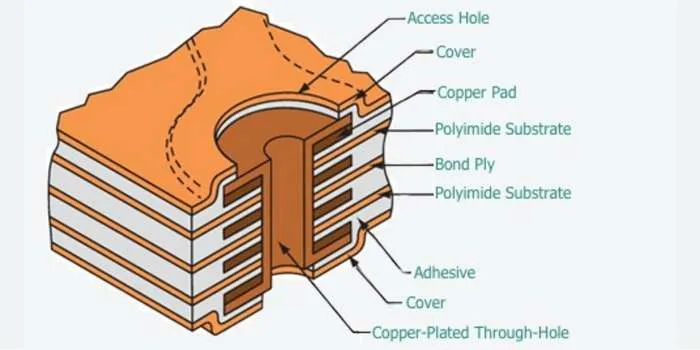
Characteristic impedance in flex circuits derives from the interaction of inductance per unit length and capacitance per unit length, governed by Z0 equals square root of L over C. Key factors include trace width, copper thickness, dielectric height, and the effective dielectric constant of materials like polyimide cores and coverlays. In microstrip designs common to single-layer flex, the signal trace sits atop the dielectric with air above, leading to a hybrid effective epsilon. Stripline configurations embed traces between ground planes, offering better shielding but requiring symmetric dielectrics. Manufacturing processes introduce variables such as adhesive flow and lamination pressure, which alter these dimensions. Engineers model these using field solver equations adapted for flexible substrates.
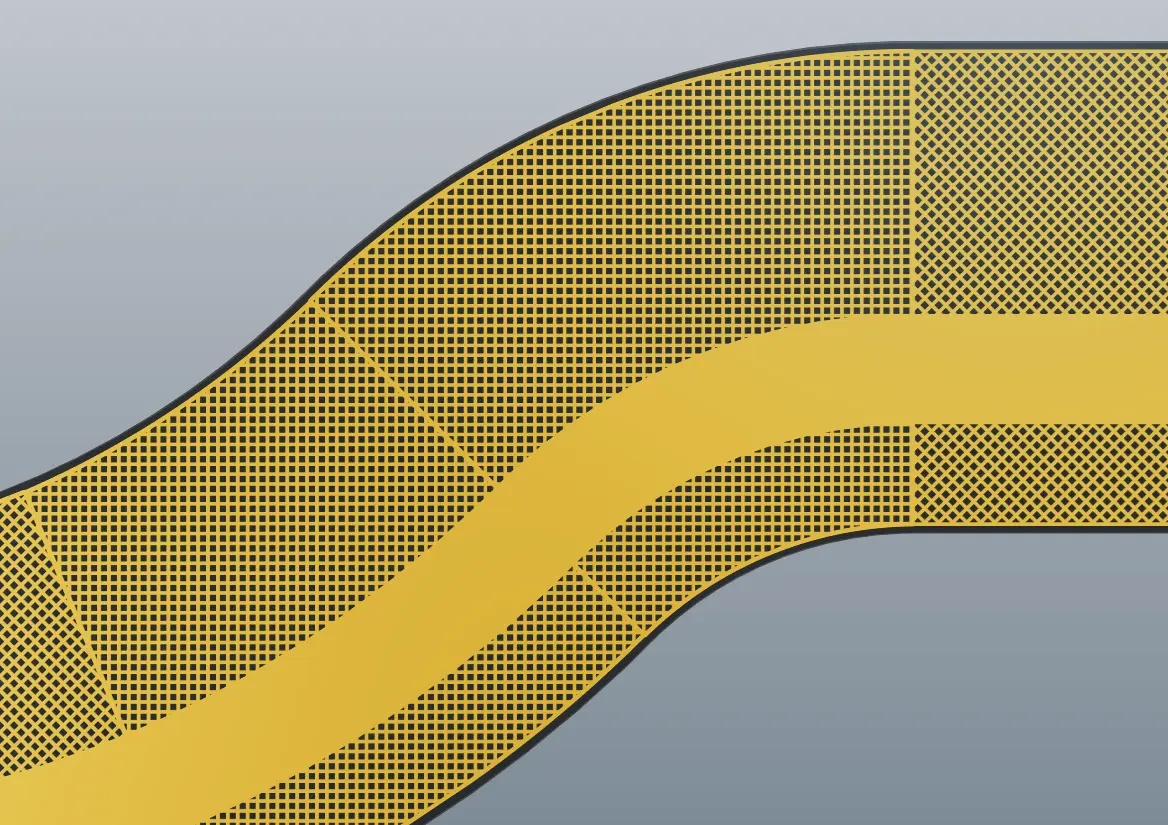
Hatched ground planes frequently appear in flex PCB impedance control to mitigate mechanical stress during bending, yet they modify field distribution and thus Z0. The hatch fill percentage influences return path effectiveness, with denser fills approximating solid planes but risking cracks. Polyimide's low dielectric constant aids higher impedances, but anisotropy under flex can shift values. Temperature and humidity further impact epsilon_r, demanding robust stackup choices. Dynamic bending compresses or expands dielectric height, dynamically altering capacitance. These principles underscore the need for iterative simulation in flexible PCB design.
Flexible PCB Impedance Control Design Challenges
Material and Thickness Variation
FPC materials are thin and may be more sensitive to dimensional variation than conventional rigid-board materials. Changes in dielectric thickness or conductor geometry can affect the distance between the signal trace and its reference plane.
These variations may come from material tolerance, lamination, coverlay alignment, plating, or handling during production.
To reduce the risk, engineers should work with the manufacturer to confirm:
-
Material construction
-
Finished dielectric thickness
-
Copper thickness
-
Stackup tolerance
-
Coverlay alignment
-
Impedance measurement method
Impedance Changes During Bending
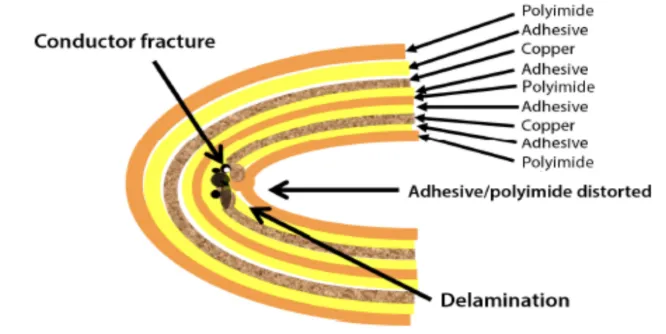
Bending can change the physical relationship between signal traces, dielectric layers, and reference conductors. The effect depends on the construction of the flex circuit and the direction and radius of the bend.
Static folding and continuous dynamic bending should be evaluated differently. A circuit that is bent once during installation may have different requirements from a circuit that moves repeatedly during operation.
The design review should consider:
-
Bend direction
-
Bend radius
-
Number of bending cycles
-
Movement speed
-
Location of the signal traces
-
Ground-plane structure
-
Copper type and thickness
-
Mechanical support
The required FPC bend radius should be reviewed together with the impedance structure because repeated bending can affect both mechanical reliability and signal behavior.
Impedance Discontinuities at Rigid-Flex Transitions
Rigid-flex PCBs may contain different dielectric structures, copper thicknesses, and reference-plane arrangements in the rigid and flexible sections. These differences can create impedance discontinuities at the transition area.
Potential problem areas include:
-
Changes in trace width
-
Changes in dielectric thickness
-
Via transitions
-
Connector areas
-
Reference-plane gaps
-
Shielding transitions
-
Layer changes between rigid and flex sections
The rigid-flex boundary should be reviewed as part of the complete signal path. A straight trace may meet its target impedance while the transition area still creates reflections or signal-integrity problems.
Differential Pair and Return-Path Challenges
Differential pairs require consistent spacing and a predictable electromagnetic environment. Unequal trace geometry, inconsistent spacing, asymmetric etching, and poorly planned layer transitions can affect differential signaling.
The return path is also important. Even though differential signals are carried by two traces, the surrounding ground and reference structures still influence the electromagnetic field.
When routing differential pairs on a flex circuit, engineers should review:
-
Trace width
-
Pair spacing
-
Trace-length matching
-
Reference-plane continuity
-
Via placement
-
Connector transitions
-
Shielding structure
-
Bend-zone location
Practical Solutions and Best Practices for Flexible PCB Impedance Control
Optimizing stackup forms the foundation of solutions for flex PCB impedance, starting with thicker dielectric cores to achieve lower target Z0 values like 50 or 90 ohms. Designers adjust trace widths and spacings iteratively using impedance calculators based on IPC-2141 principles, accounting for flex-specific parameters. Symmetric striplines provide stable shielding, while microstrips suit space-constrained areas. Early collaboration with fabricators refines tolerances to 10 percent or better through process controls. Simulation tools model hatched fills, targeting 50 to 70 percent density for balanced mechanical and electrical properties.
Hatched plane strategies mitigate bend-induced failures, with simulations predicting impedance shifts from hatch geometry. Uniform trace routing avoids bends over 90 degrees, adhering to IPC-2223E bend radius ratios based on copper ductility. Differential pairs benefit from edge-coupled configurations with tight spacing controls. Pre-production coupons enable TDR verification on representative sections. Multilayer designs laminate flex sections separately before rigid integration, preserving impedance profiles.
Verification integrates time-domain reflectometry and vector network analysis post-fabrication, correlating measurements to design models. Design rules specify minimum ground clearance and via stub lengths to minimize discontinuities. Material selection favors low-loss polyimides with consistent properties across batches. For rigid-flex, fanout traces gradually in transition zones. These best practices in impedance control flexible circuits yield robust designs.
Common Flexible PCB Impedance Control Problems
Impedance Mismatch
Impedance mismatch occurs when the transmission line does not maintain the expected electrical characteristics along the signal path.
Possible causes include:
-
Incorrect stackup assumptions
-
Dielectric thickness variation
-
Trace-width variation
-
Copper-thickness variation
-
Coverlay misalignment
-
Plating variation
-
Reference-plane changes
-
Poorly designed transitions
The solution is to review the complete transmission-line structure instead of checking only the nominal trace width.
Signal Reflection and Loss
Signal reflection may occur when a transmission line encounters an impedance discontinuity. In a flex circuit, discontinuities may appear around:
-
Vias
-
Connectors
-
Rigid-flex transitions
-
Shielding layers
-
Layer changes
-
Changes in trace geometry
-
Reference-plane gaps
Signal loss may also be influenced by conductor resistance, dielectric properties, frequency, and the length of the transmission path.
A complete signal-path review can help identify the most important sources of reflection and loss.
Crosstalk Between Adjacent Traces
Crosstalk can increase when traces are routed too closely or when the return path is poorly controlled. The risk may be higher in compact flex circuits where routing space is limited.
Designers should review:
-
Trace spacing
-
Parallel routing length
-
Signal rise time
-
Reference-plane structure
-
Ground shielding
-
Differential pair routing
-
Noisy and sensitive signal separation
Increasing spacing or improving the reference structure may help reduce unwanted coupling.
Impedance Variation After Bending
A flexible PCB may meet its impedance target in a flat condition but behave differently after folding or repeated movement.
The change may be related to:
-
Altered dielectric spacing
-
Movement between conductor layers
-
Reference-plane deformation
-
Shielding movement
-
Copper stress
-
Repeated mechanical fatigue
If the circuit operates while bent, the design should define the expected mechanical condition and validate the electrical behavior under representative conditions.
Problems at Connectors and Transition Areas
Connectors can introduce impedance discontinuities because their pin arrangement, contact geometry, dielectric structure, and grounding method may differ from the flex circuit.
Special attention should be given to:
-
Connector launch areas
-
Pin escape routing
-
Ground pin placement
-
Differential pair symmetry
-
Shield termination
-
Trace-width changes
-
Reference-plane continuity
Connector selection and layout should be included in the early impedance-control review.
Conclusion
Mastering flexible PCB impedance control requires balancing electrical precision with mechanical flexibility through informed stackup design, optimized geometries, and rigorous verification. Challenges like material variability and bending effects demand proactive solutions rooted in standards and simulation. By implementing these strategies, electrical engineers achieve reliable high-speed performance in flexible PCB design. Key takeaways include early tolerance planning and hatched plane management. Future advancements in materials will further ease these demands, but current best practices suffice for demanding applications.
FAQs
Q1: What are the main challenges in flex PCB impedance control?
A1: Challenges flex PCB impedance arise from dielectric thickness variations, mechanical bending altering geometry, and hatched ground effects on field distribution. Manufacturing tolerances in thin films amplify trace width sensitivity. Solutions involve precise stackup modeling and TDR testing to maintain 10 percent tolerance. Adhering to IPC-2223E bend rules prevents dynamic shifts.
Q2: How does bending affect impedance control in flexible circuits?
A2: Bending compresses dielectrics, changing capacitance and thus Z0 in impedance control flexible circuits. Minimum bend radii per IPC-2223E guidelines mitigate this by preserving trace integrity. Hatched planes relieve stress but require simulation for impedance stability. Testing under flexed conditions verifies performance. Flexible PCB design must factor static versus dynamic use.
Q3: What are effective solutions for flex PCB impedance matching?
A3: Solutions for flex PCB include thicker cores, optimized trace dimensions, and 50 to 70 percent hatched fills. Field solver-based calculations per IPC-2141 ensure targets like 90 ohms. Stackup symmetry in striplines enhances shielding. Fabricator feedback refines tolerances. Post-build TDR confirms compliance.
Q4: Why is stackup critical for flexible PCB design impedance?
A4: Stackup dictates dielectric height and Er, directly impacting Z0 in flexible PCB design. Thinner flex layers demand wider traces for control, risking mechanical limits. Multilayer lamination sequences preserve uniformity. Early definition avoids respins. IPC-6013E qualification ties to stable construction.
Q5: What information should I provide to a flex PCB manufacturer for impedance control?
A5: When requesting a controlled-impedance flex PCB, provide the target impedance, signal type, layer structure, material requirements, copper thickness, trace dimensions, bend conditions, and connector information. Gerber files, stackup drawings, impedance tables, and mechanical drawings can help the manufacturer evaluate feasibility and provide more accurate feedback.
Q6: Can flex PCB manufacturers guarantee a specific impedance value?
A6: A flex PCB manufacturer can design and manufacture toward a specified impedance target, but the achievable tolerance depends on the material system, stackup, conductor geometry, fabrication process, and testing method. The target value and acceptable tolerance should be agreed upon during engineering review rather than assumed from a standard flex PCB construction.
Q7: How should controlled impedance be specified on flex PCB fabrication drawings?
A7: The fabrication drawing should identify the controlled nets, target impedance, tolerance, layer or structure, trace requirements, and test expectations. If only selected sections require impedance control, those sections should be clearly marked. The drawing should also identify any special requirements for differential pairs, rigid-flex transitions, or shielding layers.
Q8: Does EMI shielding always improve flexible PCB signal integrity?
A8: EMI shielding can reduce unwanted electromagnetic coupling, but it does not automatically improve every signal-integrity problem. Shielding performance depends on the shield structure, grounding method, coverage, spacing, and connection to the return path. The shield may also affect flexibility, thickness, and impedance, so it should be evaluated as part of the complete circuit design.
Q9: Can a flexible PCB maintain controlled impedance after repeated bending?
A9: A flexible PCB may maintain its impedance performance during bending when the material structure, trace geometry, reference plane, and bend conditions are properly designed. However, repeated movement can change the physical relationship between conductors and may introduce mechanical fatigue. Dynamic bending requirements should be defined and evaluated before production.
Q10: Is a solid ground plane always better than a hatched ground plane in a flex circuit?
A10: A solid ground plane can provide a more consistent electrical reference, but it may reduce flexibility or increase mechanical stress. A hatched ground plane can improve flexibility, but its pattern affects the electromagnetic field and return path. The choice should be based on impedance stability, EMI requirements, bending behavior, and overall reliability.
Q11: What testing methods are used for controlled impedance flex PCBs?
A11: Controlled-impedance flex PCBs may be evaluated using test coupons, time-domain reflectometry, or other suitable electrical measurement methods. The test structure should represent the actual board construction. For circuits that operate while bent, the project may also require mechanical and electrical validation under representative conditions.
Q12: Should impedance control be reviewed before or after flex PCB layout?
A12: Impedance control should be reviewed before routing is finalized. Early planning allows the designer and manufacturer to select an appropriate material stackup, reference-plane structure, trace geometry, and shielding approach. Reviewing impedance only after layout completion may lead to routing changes, stackup revisions, or manufacturing limitations.
Q13: What is the difference between controlled impedance and EMI shielding in a flex PCB?
A13: Controlled impedance focuses on maintaining predictable signal transmission through a defined conductor structure. EMI shielding focuses on limiting unwanted electromagnetic coupling between the circuit and its surroundings. They support different goals, but both affect the electrical design and should be reviewed together when a flex PCB carries sensitive or high-speed signals.
Q14: How can I choose a flex PCB manufacturer for a high-speed circuit?
A14: When evaluating flex PCB manufacturers for controlled impedance, review their experience with flex stackups, high-speed routing, impedance testing, coverlay processing, shielding structures, rigid-flex transitions, and prototype validation. It is also useful to confirm whether the manufacturer can provide engineering feedback before production and explain how impedance-related tolerances will be controlled.
References
IPC-6013E — Qualification and Performance Specification for Flexible/Rigid-Flexible Printed Boards. IPC, 2021
IPC-2223E — Sectional Design Standard for Flexible/Rigid-Flexible Printed Boards. IPC, 2020
IPC-2141 — Controlled Impedance Circuit Boards and High Speed Logic Design. IPC, 1996