Introduction
High-frequency PCB design presents unique challenges for electrical engineers working on RF and microwave applications. These boards must maintain signal integrity at frequencies often exceeding 1 GHz while keeping manufacturing costs manageable. Traditional materials like pure PTFE deliver excellent performance but drive up the high frequency PCB cost due to their processing difficulties and raw material expenses. Taconic materials emerge as a practical solution, offering a balance between low-loss electrical properties and affordability. Engineers can achieve reliable performance in applications such as antennas, radar systems, and 5G infrastructure without exceeding budget constraints. This article explores strategies for cost-effective PCB design using Taconic laminates, focusing on material selection and design optimizations.
Why High-Frequency PCBs Demand Specialized Materials
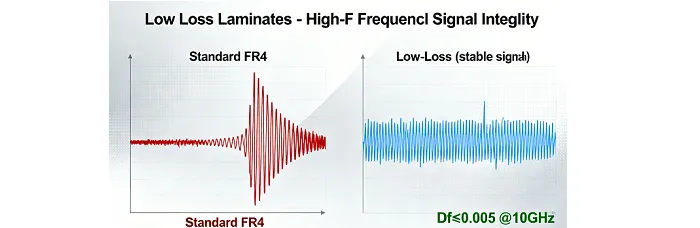
High-frequency signals propagate differently than DC or low-speed signals, primarily due to increased skin effect and dielectric losses. At elevated frequencies, the wavelength shortens, making trace dimensions critical for controlled impedance and minimal attenuation. Standard FR-4 materials suffer from high dissipation factors and dielectric constant variations with frequency and temperature, leading to signal distortion. Taconic PCB materials address these issues with engineered composites that provide stable dielectric constants and low loss tangents across a wide frequency range. This stability ensures predictable performance in dynamic environments like automotive radar or satellite communications. Selecting the right Taconic grade directly impacts the PCB material selection cost, allowing engineers to match requirements without over-specifying.
Key Electrical and Mechanical Properties of Taconic Laminates
Taconic offers a family of laminates tailored for high-frequency use, including ceramic-filled and woven glass-reinforced variants. These materials exhibit low dielectric constants, typically in the range suitable for RF circuits, which minimizes signal delay and crosstalk. Their dissipation factors remain low even at microwave frequencies, reducing insertion loss and preserving signal amplitude over long traces. Mechanical properties like low moisture absorption prevent dimensional changes during assembly, ensuring reliability under thermal cycling. Thermal stability matches copper foil expansion, reducing warpage risks in multilayer stacks. These attributes make Taconic an affordable RF PCB option compared to ultra-premium alternatives.
Factors Influencing Taconic PCB Cost in High-Frequency Designs
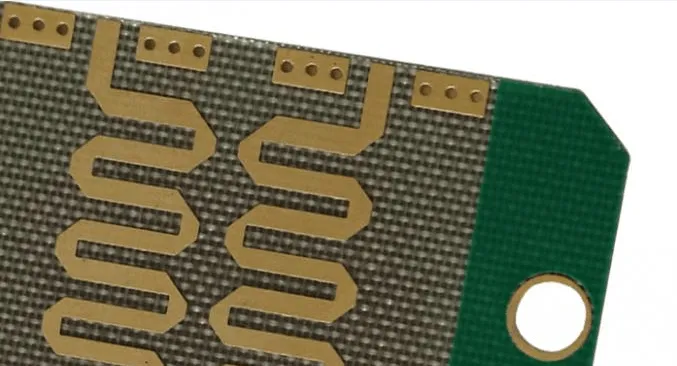
The Taconic PCB cost varies based on laminate grade, thickness, copper weight, and panel yield. Lower-cost ceramic-filled grades suffice for frequencies up to several GHz, while woven glass types handle higher bands with minimal additional expense. Volume production lowers per-unit high frequency PCB cost through optimized panel utilization and standard thicknesses. Hybrid constructions, pairing Taconic cores with FR-4 for non-critical layers, further reduce PCB material selection cost. Engineers must evaluate trade-offs between performance specs and budget, prioritizing low-loss layers only where signal paths demand it. Fabrication yield improves with standard processes, avoiding custom handling fees.
Design Principles for Cost-Effective High-Frequency Performance
Effective stackup design starts with simulating dielectric properties to achieve 50-ohm impedance traces. Microstrip or stripline configurations leverage Taconic's uniformity for consistent propagation constants. Minimize via count by using blind or buried vias, as through-hole transitions introduce discontinuities at high frequencies. Ground plane integrity prevents cavity resonances, with stitching vias placed at lambda/20 intervals. Adhering to IPC-2221B guidelines for high-speed design ensures these elements align with industry-proven methods. Such structured approaches maintain performance while controlling overall high frequency PCB cost.
Material Selection Strategies to Optimize PCB Material Selection Cost
Begin material selection by defining frequency range, power levels, and environmental exposures. For moderate RF up to 10 GHz, select Taconic grades with balanced Dk and Df for everyday affordable RF PCB needs. Higher-frequency designs benefit from ultra-low loss variants, but assess if hybrid stacks justify the slight premium. Consider CTE matching to copper for multilayer reliability, avoiding delamination during reflow. Prototype with standard thicknesses to validate simulations before scaling. This methodical process minimizes iterations and keeps Taconic PCB cost in check.
Fabrication Best Practices for Taconic-Based High-Frequency PCBs
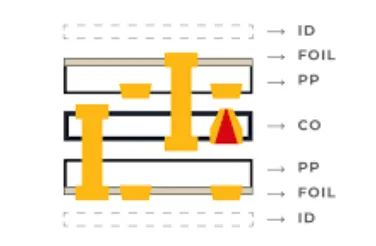
Taconic laminates process similarly to FR-4 but require controlled lamination pressures to avoid voids. Plasma cleaning enhances adhesion for electroless plating, crucial for fine-line etching. Sequential lamination builds complex stacks without compromising dielectric integrity. Bake-out removes moisture prior to soldering, per J-STD-020E for reflow sensitivity. Inspection follows IPC-A-600K criteria, focusing on surface finish and plating uniformity. These steps ensure high yields, directly lowering the effective high frequency PCB manufacturing cost.
Troubleshooting Common Issues in Cost-Effective Designs
Engineers often encounter insertion loss exceeding simulations due to unaccounted surface roughness. Select low-profile copper foils to mitigate skin effect losses at Taconic interfaces. Warpage in hybrids arises from CTE mismatches; symmetric stacks and constrained lamination resolve this. Signal skew in multilayers demands length-matched traces with phase array considerations. Thermal management via embedded heat spreaders prevents hotspots in power RF apps. Addressing these proactively upholds performance without inflating costs.
Real-World Application: Affordable RF PCB for Base Station Antennas
In a typical base station antenna design operating at 2-6 GHz, engineers chose a Taconic ceramic-filled laminate for the RF feed network. Hybrid integration with FR-4 outer layers cut material expenses by 30% while meeting gain specs. Controlled impedance traces routed on the inner Taconic layers minimized radiation losses. Fabrication used standard FR-4 compatible tooling, achieving high panel yields. Field tests confirmed low VSWR across the band, validating the cost-effective PCB design approach. This example demonstrates scalable balancing of Taconic PCB cost and performance.
Conclusion
Cost-effective high-frequency PCB design hinges on strategic Taconic material selection and optimized layouts. By prioritizing low-loss properties where needed and hybrids elsewhere, engineers reduce high frequency PCB cost without sacrificing integrity. Key practices like impedance control, CTE matching, and standard processes ensure manufacturability. Electrical teams can deliver affordable RF PCBs for demanding apps through logical trade-off analysis. Ultimately, Taconic enables performance-price equilibrium, empowering innovation in RF and microwave realms.
FAQs
Q1: What factors primarily drive Taconic PCB cost in high-frequency applications?
A1: Taconic PCB cost depends on laminate grade, with ceramic-filled options cheaper for mid-range frequencies and woven glass pricier for ultra-low loss. Stackup complexity, copper thickness, and production volume influence pricing, as higher yields lower per-board expenses. Hybrid designs with FR-4 further optimize costs. Fabrication tolerances for thin dielectrics add minor premiums but improve signal performance. Selecting per spec avoids overpaying.
Q2: How can engineers achieve cost-effective PCB design for high-frequency RF circuits?
A2: Cost-effective PCB design starts with matching Taconic material to frequency needs, using hybrids for non-RF layers. Simulate stackups for impedance control to minimize redesigns. Standard thicknesses and low-profile copper reduce processing costs. Volume planning improves panel utilization. Following IPC guidelines ensures first-pass yields, balancing high frequency PCB cost with reliability.
Q3: Why is PCB material selection cost critical for affordable RF PCB projects?
A3: PCB material selection cost dictates 40-60% of total expenses in RF projects, as high-frequency laminates exceed FR-4 prices. Taconic offers grades scaling from budget ceramic-filled to premium low-loss, fitting diverse budgets. Over-specifying inflates costs without gains; precise matching per application specs delivers value. Environmental factors like thermal cycling guide choices for long-term savings.
Q4: What role do standards play in managing high frequency PCB cost?
A4: Standards like IPC-6012E guide qualification, ensuring Taconic boards meet performance without excess testing. J-STD-020E handles reflow processes compatibly, avoiding yield losses. Consistent adherence streamlines fab, cutting high frequency PCB cost through predictable outcomes. They standardize inspections, reducing rework in cost-sensitive designs.
References
IPC-2221B — Generic Standard on Printed Board Design. IPC, 2012
IPC-6012E — Qualification and Performance Specification for Rigid Printed Boards. IPC, 2017
IPC-A-600K — Acceptability of Printed Boards. IPC, 2020
J-STD-020E — Moisture/Reflow Sensitivity Classification for Nonhermetic Surface Mount Devices. JEDEC/IPC, 2014