The Growing Demand for Optimized Robot Power Systems
The mobile robot market continues to expand rapidly, with applications ranging from industrial automation and logistics to service robots and specialized inspection platforms. Modern robots must deliver real-time decision-making, handle diverse payloads, and support evolving capabilities such as AI-driven autonomy - all while meeting strict size, weight, power, and cost constraints.
A well-designed power distribution network (PDN) is foundational. It must provide high power density, scalability, and efficiency to support motors, servo drives, sensors, processors, and communication systems. Optimized architectures reduce overall system weight, improve thermal performance, and enable future upgrades without major redesigns.
1. Battery Voltage Selection for Lightweight, Low-Loss Distribution
Higher distribution voltages significantly impact system efficiency and weight. According to Ohm's law, operating at higher voltages (e.g., 48 V or above instead of traditional 12 V) reduces current for the same power level. This allows thinner, lighter cabling with lower I2R losses and reduced heat generation.
Efficient DC-DC converters, such as fixed-ratio bus converters (BCM) and regulated modules like the DCM series, support these architectures by stepping down from battery voltage to intermediate rails (24 V / 48 V) and lower SELV voltages for subsystems. Selecting the right battery voltage early helps minimize cabling mass and thermal management overhead.

2. PDN Optimization for Charge Cycles and Future Payloads
Robot platforms evolve quickly - processors gain performance, actuator counts increase, and sensor suites become more power-hungry. Designing the PDN around a stable higher-voltage battery bus (≥48 V) allows capacity expansion through parallel battery packs without re-engineering voltages and downstream converters.
Fixed-ratio converters excel here due to their high efficiency, compact size, and ability to maintain stable intermediate buses. This approach future-proofs the system and reduces redesign cycles when adding new payloads or enhanced computing capabilities.
3. Managing Dynamic Loads Without Excess Weight
Peak loads from motors and actuators often have low duty cycles. Oversizing cables for worst-case peaks adds unnecessary weight and cost. Better strategies include:
- Local energy storage (e.g., capacitors near high-transient loads)
- Fixed-ratio converters that provide reflected capacitance benefits
- Optimized placement of modular DC-DC regulators to handle peaks efficiently
These techniques reduce cabling cross-section while maintaining stability and minimizing overall system mass.
4. Planning for Autonomous and AI-Driven Operation
Even manually operated robots are increasingly moving toward higher autonomy. AI and machine learning hardware can introduce significant power demands. Incorporating headroom in the power architecture during initial design simplifies integration of compute-intensive modules later, avoiding costly retrofits.
Modular power solutions with parallelable converters support this scalability while maintaining high efficiency across varying load profiles.
5. Battery vs. Tethered Power Trade-offs
While battery power enables full mobility, tethered systems offer compelling advantages in constrained or high-duty environments such as warehouses, factories, underwater inspection, or arena applications. Higher tether voltages (400 V, 800 V+) deliver more power through smaller-diameter cables, extending operational range and supporting high-bandwidth data alongside power delivery.
Lightweight DC-DC conversion modules at the robot end further reduce mass and improve payload capacity in tethered designs.

6. Achieving Long-Term Value Through Modularity
Standardized power interfaces enhance serviceability and upgradeability. As 48 V architectures become more prevalent, bidirectional converters and efficient bridges help maintain compatibility with existing 12 V or 24 V subsystems while enabling higher-voltage distribution.
This preserves modularity, supports field-replaceable units (FRUs), and extends platform lifespan in dynamic markets.
PCB Design and Manufacturing Considerations for Robot Power Systems
Implementing these power architecture principles requires sophisticated electronics hardware:
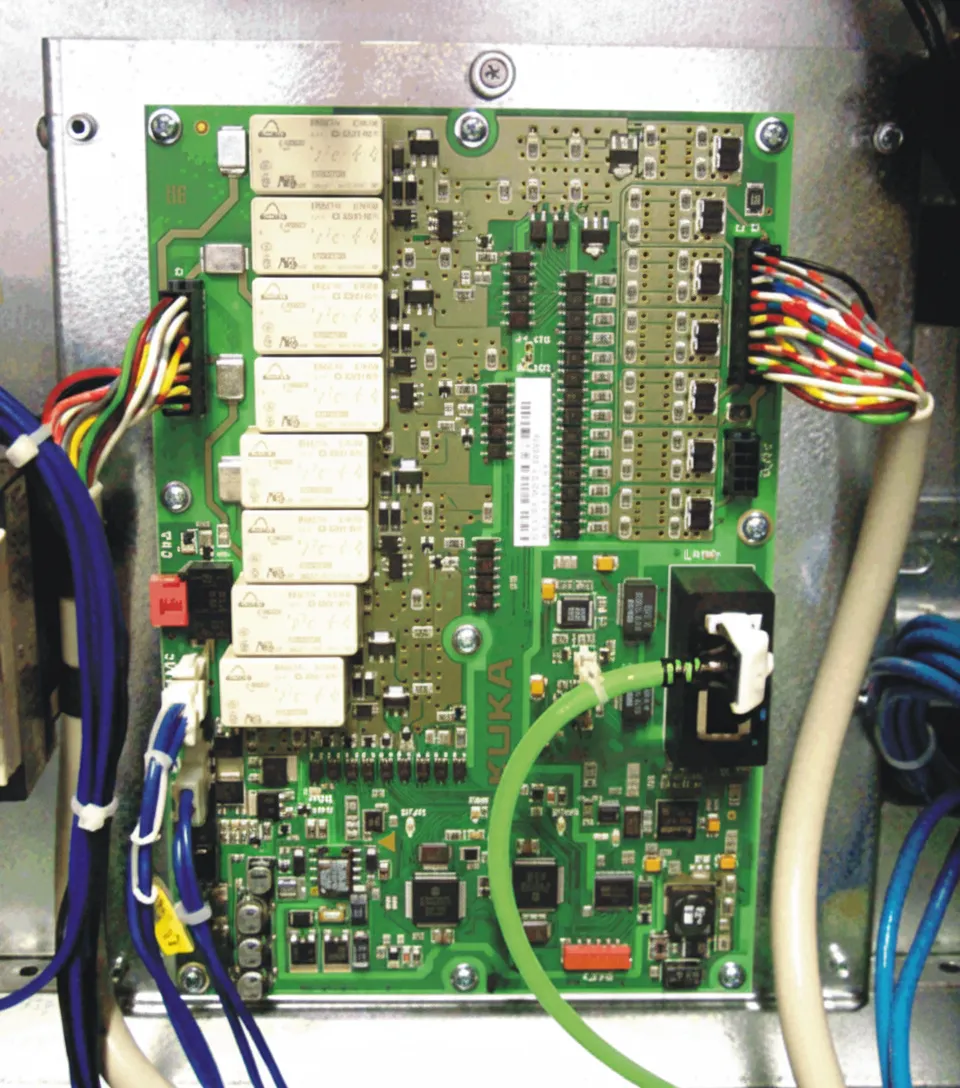
- High-Current PCB Layouts: Heavy copper layers, wide traces, and busbars for efficient power distribution with minimal voltage drop.
- Thermal Management: Thermal vias, copper pours, and insulated metal substrates (IMS) to handle heat from DC-DC converters and motor drives.
- Power Integrity: Multilayer designs with dedicated power/ground planes, decoupling, and controlled impedance for stable voltage rails.
- Modular Integration: Support for parallelable power modules, flexible circuits for moving joints, and high-density interconnects (HDI) in compact chassis.
- Reliability Features: Robust assembly, conformal coating, and testing for vibration, thermal cycling, and industrial environments.
Electronics manufacturing partners experienced in robotics and power systems help translate these design considerations into reliable, manufacturable solutions that optimize performance, weight, and scalability.
Better Power Delivery Outcomes
Addressing these six considerations results in PDNs that deliver lower mass and thermal impact, improved scalability, easier future upgrades, and enhanced overall robot performance.
FAQ
Q1: Why is higher voltage distribution preferred in robot PDNs?
A1: Higher voltages (48 V+) reduce current, enabling thinner/lighter cabling, lower losses, and reduced system weight while maintaining power delivery.
Q2: What are fixed-ratio converters and why are they useful?
A2: They provide high-efficiency voltage transformation (acting like ideal transformers) with reflected capacitance benefits, supporting compact, lightweight designs for dynamic loads.
Q3: How do PCBs support advanced robot power architectures?
A3: Through heavy copper layouts, optimized thermal management, power integrity features, and reliable integration of DC-DC modules for efficient, scalable power distribution.