Overview of Visual Servoing in Robotics
Robot visual servoing integrates machine vision with real-time robot control to create closed-loop systems that use visual feedback for precise motion guidance. It is a complex, nonlinear, and strongly coupled field combining image processing, robot kinematics/dynamics, and control theory.
Advances in cost-effective cameras, computing power, and algorithmic techniques have moved visual servoing from research labs into practical industrial applications such as assembly, welding, pick-and-place, and quality inspection.

Machine Vision and Visual Servoing Fundamentals
Machine Vision involves the automatic acquisition and processing of images using optical sensors to extract information for decision-making or robot control. It extends beyond human-visible spectra and can capture internal or non-visible features.
Visual Servoing goes further by creating a continuous feedback loop from image acquisition through processing to robot actuation. Unlike early open-loop "look-then-move" approaches, modern visual servoing maintains ongoing visual participation in the control loop for higher accuracy and adaptability.
Major Classifications of Visual Servoing Systems
Visual servoing architectures are categorized along several dimensions:
By Number of Cameras
- Monocular Systems: Use a single camera, providing 2D information. Depth estimation relies on additional techniques or assumptions.
- Stereo Vision Systems: Most common in practice - two cameras enable 3D reconstruction and better depth perception.
- Multi-Camera Systems: Offer richer data from multiple viewpoints but increase computational load and stability challenges.
By Camera Placement
- Eye-in-Hand Configuration: Camera mounted on the robot end-effector. Offers high precision potential but is sensitive to calibration errors and robot dynamics.
- Eye-to-Hand (Fixed Camera): Camera mounted externally. Less affected by robot kinematic errors but may have lower pose estimation accuracy for dynamic tasks.
By Control Reference Frame
- Position-Based Visual Servoing (PBVS): Extracts the full 3D pose of the target from images, then computes required robot motions in Cartesian space. Requires accurate calibration of camera, target, and robot models.

- Image-Based Visual Servoing (IBVS): Controls directly in image space by minimizing feature errors (e.g., pixel coordinates). Avoids explicit 3D reconstruction but depends heavily on the image Jacobian matrix (interaction matrix) that relates image feature changes to camera velocity.
Hybrid Approaches combine strengths of PBVS and IBVS for improved robustness and convergence.
By Control Architecture
- Dynamic Observation-Motion Systems: Use inner-loop joint controllers for stability while vision provides outer-loop velocity or position commands.
- Direct Visual Servoing: Image features generate control inputs directly for joint motors, offering tighter integration but demanding high-performance real-time processing.
Technical Challenges in Visual Servoing
- Accurate and real-time image feature extraction under varying lighting, occlusion, and motion blur.
- Computation and estimation of the image Jacobian, particularly target depth in IBVS.
- Ensuring global stability and robustness over large workspaces.
- Balancing computational demands with real-time control requirements (typically milliseconds).
PCB Design and Manufacturing Considerations for Visual Servoing Systems
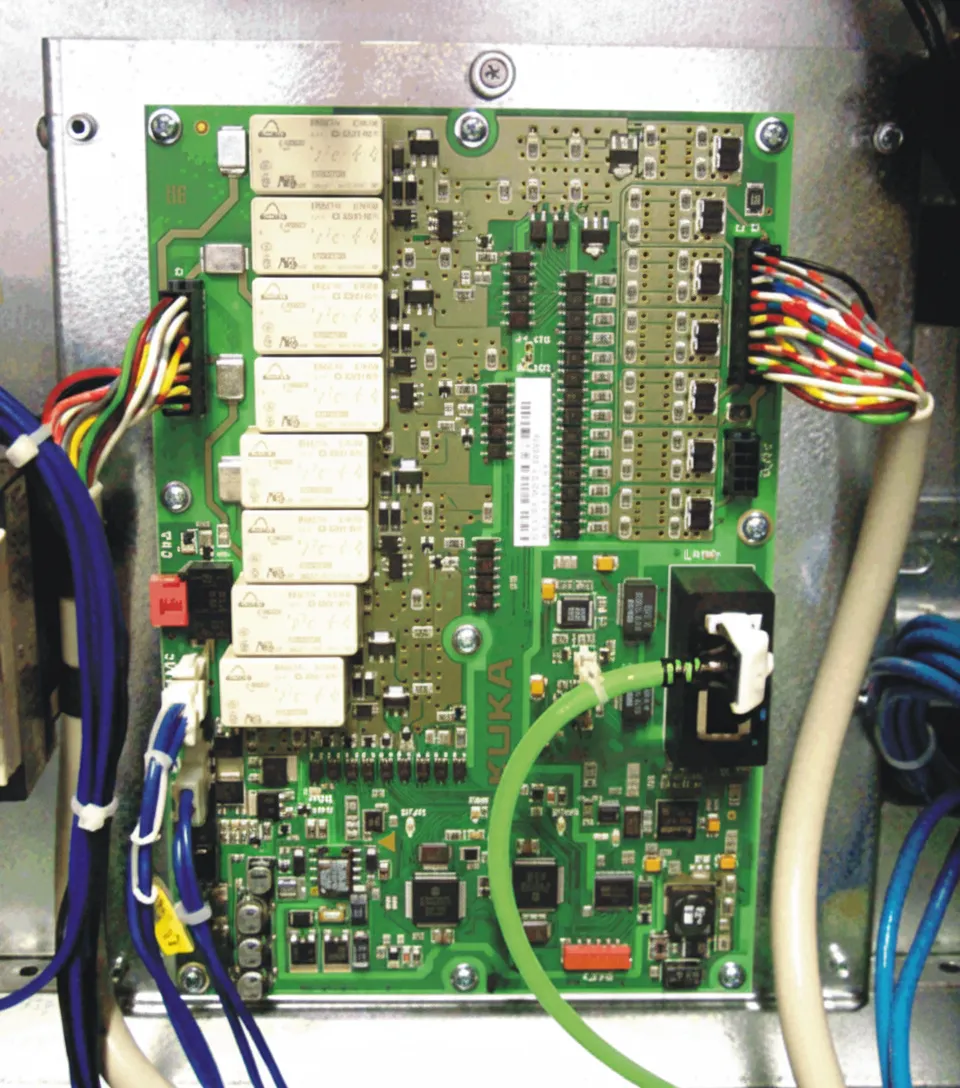
Reliable visual servoing depends on sophisticated embedded electronics:
- High-Performance Vision Processors: Multilayer and HDI PCBs support powerful SoCs, FPGAs, or DSPs for parallel image processing and low-latency control.
- High-Speed Interfaces: Controlled impedance routing for MIPI CSI, LVDS, or GigE Vision camera links with excellent signal integrity.
- Flexible and Rigid-Flex Circuits: Enable eye-in-hand camera mounting and dynamic cabling while maintaining reliability under continuous motion.
- Power Integrity and Thermal Management: Stable power delivery and heat dissipation for processors and cameras in compact robotic arms.
- Sensor Fusion Integration: Support for combining vision data with IMUs, encoders, and force/torque sensors on the same board.
- Real-Time Capabilities: Optimized layouts for deterministic timing, low-jitter clock distribution, and robust EMI shielding in industrial environments.
Electronics manufacturers experienced in robotics deliver the precision PCBs and assembly solutions needed to meet the demanding latency, reliability, and environmental requirements of visual servoing systems.
Research Directions and Industry Outlook
Ongoing advancements focus on AI-enhanced feature extraction, active vision strategies, better sensor fusion, and hardware-accelerated processing. These improvements are expanding visual servoing adoption in collaborative robots, precision assembly, autonomous mobile robots, and medical robotics.
FAQ
Q1: What is the difference between PBVS and IBVS?
A1: PBVS works in 3D Cartesian space using estimated target pose, while IBVS controls directly in 2D image space using feature errors and the image Jacobian matrix.
Q2: What are eye-in-hand and eye-to-hand configurations?
A2: Eye-in-hand mounts the camera on the robot end-effector for high precision; eye-to-hand uses fixed external cameras that are less sensitive to robot motion errors.
Q3: Why are advanced PCBs important for visual servoing?
A3: They enable high-speed image processing, low-latency control, reliable camera interfaces, and robust integration in dynamic robotic environments.