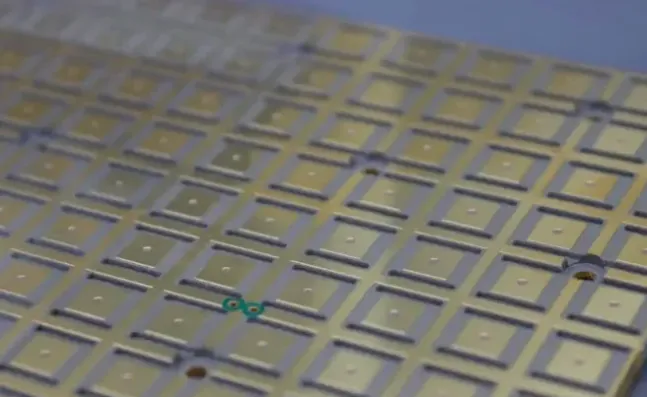
HDI PCB manufacturing enables the production of ultra-compact, high-performance circuit boards that power modern electronics. The HDI PCB manufacturing process combines sequential build-up, laser microvia formation, plating, via filling, and precision layer registration to achieve higher component density and shorter signal paths than conventional PCB fabrication. From smartphones and medical wearables to 5G modules and autonomous vehicles, HDI PCB electronics manufacturing supports increasingly demanding high-density applications.
Highlights:
- HDI is built layer by layer through repeated lamination, laser drilling, plating, and planarization.
- Precise laser microvias, complete desmear, and void-free filling create reliable high-density connections.
- More build-up cycles mean greater alignment and plating challenges, making strict process control essential.
What Is the HDI PCB Manufacturing Process?
HDI PCBs differ fundamentally from conventional multilayer boards. Conventional boards rely primarily on mechanically drilled through-holes and a single or limited number of lamination cycles. HDI boards use laser-drilled microvias, sequential build-up, and thinner dielectrics to achieve far higher interconnection density in a smaller footprint.
Key terminology that appears throughout the process includes:

- Microvia: laser-drilled blind or buried via, usually ≤150 µm diameter.
- Buried via: connects internal layers only.
- Blind via: connects an outer layer to one or more inner layers without passing through the entire PCB.
- Stacked via: microvias aligned directly on top of one another.
- Staggered via: microvias offset from one another.
- Sequential build-up: layer-by-layer addition of dielectric and copper.
- Core: the starting multilayer or double-sided laminate.
- Prepreg/RCC: resin-coated copper or glass-reinforced prepreg used for build-up layers.
HDI PCB Manufacturing Process Flow: Step-by-Step

The HDI manufacturing process is inherently sequential. Each additional dielectric layer requires a full cycle of lamination, laser drilling, cleaning, plating, and planarization. The following flow describes the progression from inner-layer core to finished Any-layer board.
1. Inner-layer core preparation
Thin high-Tg or low-loss cores are selected according to layer count and electrical requirements. Copper is imaged, etched, and inspected by AOI. An oxide or brown-oxide treatment is applied to promote adhesion for the subsequent lamination.

2. Sequential lamination
Vacuum lamination is performed under tightly controlled temperature, pressure, and vacuum to avoid voids and ensure uniform dielectric thickness. Optical or pin registration systems align the layers.

3. Laser drilling of microvias
CO₂ or UV lasers form microvias. Pulse energy and beam focus are controlled to achieve consistent depth and minimize residue or over-drill into the target pad.

4. Desmear and electroless copper
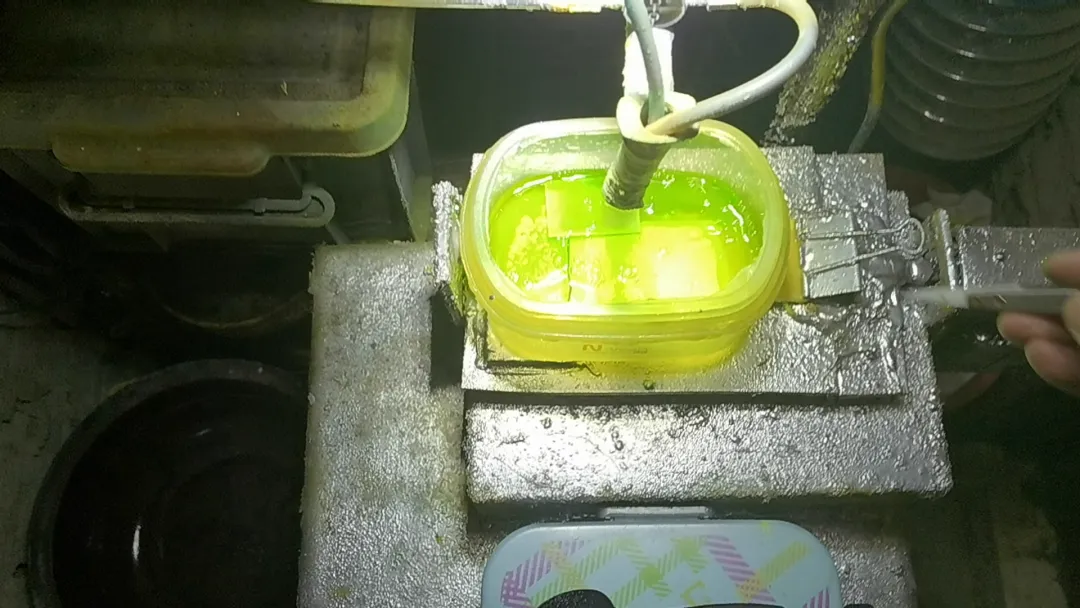
Plasma or wet desmear removes resin smear from via walls. Electroless copper deposits a thin, continuous seed layer that is critical for adhesion and void-free subsequent plating.

5. Microvia filling and planarization
Specialized electrolytic copper chemistry fills the microvias. Mechanical or chemical planarization produces a flat surface ready for the next imaging or lamination step. Dimple depth is tightly controlled.

6. Outer-layer imaging, etching, and strip
Fine-line imaging and etching produce traces and spaces ≤50 µm. Semi-additive or modified semi-additive processes are commonly used for the finest geometries.
7. Repeat sequential build-up cycles
Each additional dielectric layer repeats the sequence: lamination → laser drill → desmear → plate → planarize → pattern. For Any-layer HDI this sequence is executed for every layer in the stack.
8. Final outer-layer processing
Solder mask is applied and imaged, surface finish is deposited, legend is printed, and the board undergoes electrical test and final inspection.

9. Special processes for high-layer-count and Any-layer boards
Multiple registration strategies, precise copper-thickness control, and residual-stress management become essential as the number of sequential cycles increases.
This flow integrates the precision laser drilling, sequential lamination, advanced etching, and rigorous inspection steps that distinguish HDI production from conventional multilayer manufacturing.
How HDI PCB Manufacturing Changes by Structure?
Common constructions are expressed as i+N+i, where N is the core and i is the number of sequential build-up layers on each side:
|
HDI Structure |
Laser Drilling |
Key Characteristics |
|---|---|---|
|
1+N+1 |
One laser-drill and plating cycle per side |
The core still contains mechanical through-holes |
|
2+N+2 |
Two sequential cycles per side |
More build-up layers and greater routing freedom |
|
i+N+i |
Multiple sequential cycles per side |
Additional cycles support higher interconnection density |
|
Any-Layer HDI |
Microvias can be formed in every dielectric layer |
Interlayer connections are primarily formed using laser microvias, reducing or eliminating the need for conventional through-holes |
The industry moved beyond pure mechanical drilling because aspect-ratio limits, minimum pad sizes, and routing-density requirements could no longer be met. Laser microvias allow far smaller capture pads and support the dense BGA and CSP packages now common in smartphones, automotive radar, and AI accelerator modules.
Choosing the Right HDI Manufacturing Process
Engineers should apply a clear decision framework:
- Choose 1+N+1 when component pitch is moderate and routing density can be satisfied with outer-layer microvias.
- Move to 2+N+2 or higher when additional build-up layers are needed for signal integrity or thermal vias.
- Specify Any-layer only when true any-to-any interconnect, ultra-fine pitch, or minimum thickness is mandatory.
Key HDI Manufacturing Processes That Affect Yield and Reliability
Several process nodes carry the highest risk of scrap or latent field failure:
- Laser drilling accuracy and via geometry: Taper, residue, and depth uniformity directly affect plating reliability. Measured by cross-section and AOI; typical process window keeps diameter variation within a few micrometers.

- Desmear completeness and electroless copper coverage: Incomplete cleaning produces voids on via walls. Verified by cross-section and adhesion testing.
- Via-fill plating quality: Via-fill quality, copper thickness, and void control are verified against the applicable IPC Class 3 requirements and customer specifications. Controlled by plating chemistry, current density, and planarization.
- Layer-to-layer registration: Cumulative error becomes fatal in Any-layer constructions. Optical and X-ray systems, combined with process-capability data, keep misregistration within acceptable limits.
- Lamination voids and dielectric thickness uniformity: Voids or thickness variation cause impedance drift and reliability risk. Vacuum lamination parameters and material selection are critical.
- Fine-line etching undercut control: Advanced PCB etching techniques for high-density interconnect HDI boards are essential for achieving the fine-line resolution required in modern HDI production. The semi-additive process combined with laser direct imaging and plasma reactive ion etching delivers trace widths and spaces under 50 µm with excellent edge definition. Excessive undercut reduces trace integrity. Etch-factor monitoring and advanced resists keep lines within specification.
- Surface-finish adhesion on high-density pads: Poor adhesion leads to solder-joint or wire-bond failures. Controlled by surface preparation and finish chemistry.
Each node is monitored with AOI, X-ray, cross-section analysis, and electrical testing. Advanced fabricators maintain statistical process control on these parameters and feed capability data back into Class 2 vs. Class 3 HDI PCB requirements to keep quality and process capability aligned with the applicable standards.
AIVON'S HDI Manufacturing Case Study: 2+N+2 DFM Optimization
A representative case from high-density production illustrates how early process intervention prevents common defects in 2nd-order HDI (2+N+2) boards. In one typical project, the design was a second-order HDI construction.
During DFM review the following process risks were identified:
The original material selection carried higher risk of dimensional instability and plating inconsistency under multiple sequential lamination cycles.
The customer specified resin-plugged vias, yet the Gerber data contained no via-in-pad structures.
HDI solder mask openings were drawn the same diameter as the drilled holes. With openings of this size, solder-mask ink would inevitably flow into the holes during printing, contaminating the resin-plugged surface and creating unreliable solder-mask coverage or residual ink inside the vias.
The production solution implemented was straightforward and effective:
1. Material was changed to FR-4 S1000-2M, a high-Tg, low-CTE laminate better suited to sequential build-up and multiple thermal cycles, improving both dimensional stability and via reliability.
2. Because no vias landed on pads, the resin-plugging requirement was re-evaluated and executed with a controlled non-conductive fill process optimized for non-VIP holes, followed by planarization.
3. Solder-mask design rules were adjusted. Oenings were reduced or properly tented so that ink could not enter the plugged vias, eliminating the contamination risk while still meeting the customer's surface-finish requirements.
The revised process stack and design adjustments delivered stable first-article yield and eliminated the predicted ink-intrusion and material-related failures. This type of early DFM intervention is a routine part of high-density HDI production and directly contributes to consistent volume yields on 2nd-order and higher sequential constructions.
Conclusion
HDI manufacturing is built around sequential buildup, laser microvia formation, via filling, and precise layer registration. As the number of buildup cycles increases, process control becomes increasingly important for yield and reliability. Selecting the right HDI structure and manufacturer therefore depends not only on routing density, but also on laser drilling, plating, registration, and lamination capabilities.
FAQs
Q1: What Is the HDI PCB Manufacturing Process?
A1: The HDI PCB manufacturing process is a specialized PCB fabrication method that uses sequential build-up, laser-drilled microvias, fine-line routing, and advanced plating technologies to achieve high interconnection density. The process typically includes inner-layer preparation, lamination, laser drilling, desmear, copper plating, via filling, imaging, etching, and final inspection to produce compact, reliable PCBs for high-density electronic applications.
Q2: What is the difference between 1+N+1 and Any-layer HDI manufacturing process?
A2: 1+N+1 uses one sequential build-up cycle on each side of a conventional core that still contains mechanical through-holes. Any-layer HDI builds every layer sequentially with laser microvias, allowing interconnection between any layers and eliminating traditional through-holes for signal interconnects.
Q3: How many sequential build-up cycles are typically required for Any-layer HDI?
A3: Any-layer HDI requires a sequential build-up cycle for essentially every dielectric layer. An 8-layer Any-layer board may involve approximately 6–7 full build-up cycles after the initial core, with the number of cycles increasing as the layer count rises.
Q4: What are the most common failure modes in microvia plating during HDI production?
A4: Common microvia plating failures include incomplete fill, poor wall adhesion caused by residual smear, and plating-thickness variation that creates localized stress. These issues are controlled through thorough desmear, optimized copper-fill chemistry, stable process conditions, and effective post-plating planarization.
Q5: What process controls are essential to ensure reliable via filling in Any-layer boards?
A5: Critical controls include complete desmear, consistent electroless copper seed-layer coverage, optimized electrolytic copper-fill chemistry, precise current-density control, and post-plating planarization to minimize dimple depth. Cross-section inspection on each production lot helps verify via-fill quality and process stability.
Q6: How does the HDI manufacturing process impact overall board cost and lead time compared with conventional multilayer?
A6: Each sequential build-up cycle adds lamination, laser drilling, plating, and inspection steps, increasing both manufacturing time and cost. Moving from a conventional multilayer board to 1+N+1 HDI typically increases cost moderately, while Any-layer HDI can significantly increase cost and lead time because it requires more sequential cycles and tighter process controls.