The digital cockpit represents the central nervous system of the modern vehicle, delivering immersive displays, intelligent human-machine interaction, and advanced driver monitoring. These sophisticated systems rely on powerful cockpit-domain controllers and high-speed interconnects that place stringent demands on printed circuit board (PCB) technology. At Aivon, we specialize in designing and manufacturing the advanced PCBs that power next-generation digital cockpits, ensuring exceptional signal integrity, thermal performance, EMI/EMC compliance, and long-term reliability in demanding automotive environments.
High-Performance SoC Integration for Smart Cockpit Compute
Modern digital cockpits are driven by high-performance System-on-Chips (SoCs) capable of running multiple operating systems, AI algorithms for voice recognition, and real-time graphics rendering. China's in-car cockpit SoC trends show rapid advancement toward 7nm and finer processes with integrated NPUs and high-core-count CPUs.
PCB design challenges include:
- High-Speed Memory and I/O Interfaces: Support for LPDDR4/5, PCIe Gen4/Gen5, and multi-channel display links requires tight impedance control (+/- 5%), length matching, and back-drilled vias to maintain signal integrity at multi-gigabit rates.
- Heterogeneous Multi-Domain Processing: Integration of application processors, graphics engines, and safety islands demands sophisticated multilayer stack-ups with dedicated power and ground planes to minimize crosstalk and ensure functional safety isolation.
- Power Delivery Networks (PDN): Complex voltage domains with heavy copper layers and extensive decoupling to prevent voltage droops during peak graphics and AI workloads.
These requirements drive the adoption of HDI and hybrid material constructions to balance high-speed performance with cost and thermal constraints.
Multi-Display and High-Speed Video Interfaces
Digital cockpits typically feature multiple high-resolution displays (instrument cluster, central infotainment, passenger screens, and HUD). This demands robust high-speed video transmission on the PCB.

Key considerations:
- LVDS, FPD-Link, or DisplayPort Routing: Precision differential pair design with low-loss laminates to preserve video quality over longer distances within the dashboard.
- EMI/EMC Optimization: Strategic ground stitching, guard traces, and via fencing to suppress radiated emissions that could interfere with in-cabin wireless systems or ADAS sensors.
- Signal Integrity Validation: Rigorous testing to eliminate jitter and skew that would cause display artifacts or reduced user experience.
In-Cabin Camera Integration and Sensing Systems
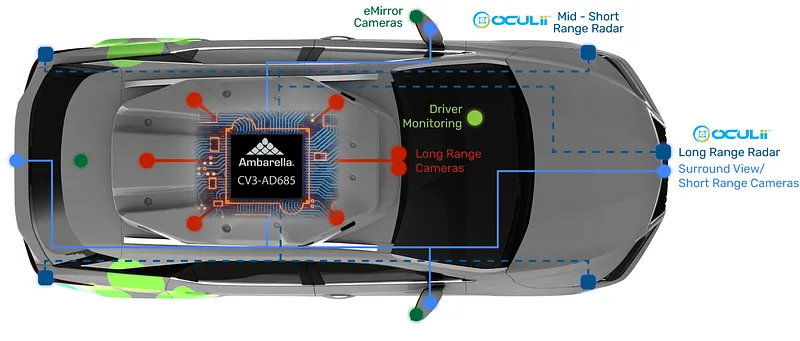
In-cabin cameras for driver monitoring (DMS), occupant monitoring, and gesture recognition are core to smart cockpit functionality. Multiple high-resolution cameras require dedicated high-speed interfaces on the cockpit PCB.

PCB engineering solutions include:
- MIPI CSI-2 / C-PHY Routing: Low-noise, impedance-controlled traces with excellent channel isolation to support simultaneous multi-camera streams.
- AI Processing Proximity: Placing camera deserializers close to the main SoC minimizes trace length and signal degradation while optimizing thermal distribution.
- Thermal and Reliability Design: In-cabin environments experience wide temperature swings and direct sunlight exposure, necessitating high-Tg materials, thermal vias, and robust component attachment methods.
Smart Cockpit Testing and Functional Requirements Translated to PCB Level
Comprehensive testing of digital cockpits covers display performance, camera accuracy, voice interaction, and system responsiveness. These requirements translate directly into PCB design and manufacturing standards:
- Signal Integrity and Timing Analysis: Ensuring clean clocks and data lines for real-time response.
- Power Integrity Under Dynamic Loads: Maintaining stable voltages during simultaneous high-resolution graphics and AI inference.
- EMI/EMC Compliance: Full vehicle-level compatibility achieved through careful board-level shielding and grounding strategies.
- Functional Safety Features: Redundant power domains, watchdog circuits, and design-for-testability structures to support ASIL-rated cockpit functions.
Manufacturing and Reliability Solutions for Automotive Digital Cockpits
Producing reliable cockpit PCBs requires automotive-grade processes:
- Hybrid material stack-ups combining low-loss dielectrics for high-speed interfaces with cost-effective cores for general routing.
- Advanced HDI PCBs with stacked microvias for high-density SoC and connector integration.
- Enhanced thermal management using copper coins or metal-core substrates to handle concentrated heat from powerful SoCs.
- Rigorous validation including thermal cycling, vibration testing, and signal integrity analysis to ensure performance across the vehicle's lifetime.
Common failure mechanisms - such as via fatigue under vibration, dielectric degradation from thermal stress, or signal degradation due to manufacturing variations - are mitigated through precise process control and material selection.
The digital cockpit is a cornerstone of the software-defined vehicle experience. Its immersive displays, intelligent sensing, and seamless interaction are only possible through excellence in underlying PCB design and manufacturing. From high-speed SoC integration and multi-camera interfaces to thermal reliability and EMI control, every layer and via contributes to overall system performance and user satisfaction.
Aivon delivers specialized PCB solutions for digital cockpit domain controllers and intelligent cabin systems. Our deep expertise in high-speed design, power integrity, thermal management, and automotive reliability enables OEMs and Tier 1 suppliers to create differentiated, future-proof cockpit experiences with superior quality and long-term durability.