Medical electronics demand exceptionally high standards of accuracy, reliability, and miniaturization. From wearable heart-rate monitors and continuous glucose monitors (CGM) to multi-parameter patient systems, the printed circuit board (PCB) serves as the critical foundation that integrates sensitive analog sensors, high-resolution analog front-ends (AFEs), wireless modules, and power management circuitry. Proper PCB design directly determines signal integrity, electromagnetic compatibility (EMC), thermal performance, and long-term reliability in environments where device failure can have serious clinical consequences.
For PCB manufacturers and design engineers, medical applications introduce strict constraints on layout, material selection, isolation, and manufacturing processes that exceed those of consumer electronics. Addressing these challenges at the board level enables compact, low-power, and regulatory-compliant devices that improve patient outcomes and drive market adoption.
Key Sensors in Medical Electronics and PCB Integration Challenges
Medical devices rely on a range of sensors to capture physiological data. Ingestible sensors, pressure transducers, non-contact temperature sensors, biosensors, and implantable devices each present unique PCB requirements.
Pressure sensors, for example, convert mechanical force into electrical signals for infusion pumps, oxygen concentrators, and blood-pressure cuffs. These signals are often in the millivolt range and highly susceptible to noise. PCB designers must route sensitive analog traces away from digital clocks and switching regulators, employ star grounding or dedicated ground planes, and use low-noise amplifiers with proper shielding.
Implantable and wearable sensors require biocompatible materials, ultra-low power consumption, and long-term stability. Flexible or rigid-flex PCBs enable conformal mounting on the body while withstanding repeated flexing, moisture, and sterilization cycles. High-Tg laminates and specialized coatings protect against humidity and temperature extremes, while controlled-impedance routing preserves signal fidelity from the sensor to the AFE.
Non-contact infrared temperature sensors and biosensors further demand precise analog signal conditioning. Copper thickness optimization, thermal vias, and strategic component placement help manage heat in compact housings without raising skin temperature in wearable applications.
Heart Rate Monitoring: Optical PPG versus Biopotential ECG Approaches
Two primary methods dominate heart-rate measurement: optical photoplethysmography (PPG) and biopotential ECG.
PPG uses LEDs and photodiodes to detect blood-volume changes. Chips such as the MAX86140/MAX86141 integrate programmable LED drivers, ambient-light cancellation, and low-noise AFEs with 19-bit ADCs. On the PCB, tight coupling between the optical components and the AFE minimizes parasitic capacitance and noise pickup. Controlled-impedance traces, proper decoupling, and separation of analog and digital domains are essential. Proximity detection and dynamic power-down modes reduce average current draw, extending battery life in wrist-worn or finger-clip devices.

ECG measures cardiac electrical activity directly. Devices like the MAX30003 provide clinical-grade AFEs with high input impedance, EMI filtering, and CMRR up to 115 dB. PCB layout must prioritize lead-off detection, motion-artifact suppression, and ultra-low power operation (as low as 85 µW). Short, guarded traces, high-quality grounding, and optional lead-bias resistors improve performance during dry-start or motion conditions. FIFO buffering on-chip reduces microcontroller wake-ups, further conserving energy.
Single-chip solutions such as Cypress PSoC BLE combine programmable analog blocks, SAR ADCs, and Bluetooth Low Energy, simplifying board-level integration while supporting capacitive touch and low-power modes.

Pulse Oximetry and Blood-Oxygen Monitoring: Analog Front-End Optimization
Pulse oximeters measure SpO2 using red and infrared LEDs paired with photodiodes. The TS9514 series exemplifies highly integrated solutions that combine current-to-frequency conversion, H-bridge LED drive, constant-current dimming, and hardware ambient-light cancellation. These chips reduce external component count, lowering BOM cost and improving reliability.

On the PCB, careful placement of the photodiode and LED drive circuitry is critical. PVDD should be decoupled separately from the main supply, and inverse-parallel LED connections require precise trace matching. Digital dimming variants (TS9517) add SPI control for intensity adjustment, demanding clean digital signal routing to avoid coupling into the sensitive analog front end. Achieving weak-perfusion performance below 0.4 % (or even 0.1 % in optimized designs) depends on low-noise layout, proper grounding, and minimal parasitic inductance.

ECG Signal Acquisition, Filtering, and Classification
Advanced ECG systems combine hardware acquisition with software classification. Chips such as the BMD101 integrate analog front-ends and DSP for microvolt-level signals. PCB design focuses on high common-mode rejection, low-pass and high-pass filtering to attenuate motion artifacts and power-line interference, and wireless transmission via Bluetooth or Wi-Fi.
Classification algorithms—whether feature-based (wavelet transforms, SVM) or deep-learning approaches (Faster R-CNN on heartbeat images)—require clean, high-resolution data. PCB-level decisions such as multilayer stack-ups with controlled impedance, shielding, and isolation barriers ensure that downstream digital processing receives accurate waveforms. Wireless modules must be placed to minimize interference with analog sections while maintaining reliable data links to smartphones or servers.

Blood Pressure Monitoring: Oscillometric Designs and Sensor Conditioning
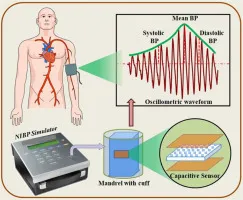
Electronic blood-pressure monitors typically use the oscillometric method with piezoresistive pressure sensors (e.g., MPS20N0040D). The sensor output contains both a slowly varying DC cuff-pressure component and a small oscillatory pulse waveform. Signal-conditioning circuitry amplifies and filters these signals before microcontroller processing.
PCB considerations include low-noise millivolt amplifiers, precise pump and valve driver circuits (often using STM32-class MCUs), and Bluetooth 4.0/5.0 modules for data transfer to companion apps. Airtight manifold connections and vibration isolation from the pump motor are critical mechanical-PCB co-design elements. Accuracy validation against mercury standards (AAMI compliance) ultimately depends on stable power rails, clean analog grounds, and robust firmware running on a well-laid-out board.
Multi-Parameter Patient Monitors and Compact System Design
Multi-parameter monitors integrate ECG, SpO2, blood pressure, respiration, and temperature. Compact reference designs using chips such as AFE4900 combine multiple AFEs on a single board. PCB engineers must manage power sequencing, thermal dissipation across dense layouts, and isolation between patient-connected and non-patient-connected circuits.
HDI and multilayer stack-ups enable the high component density required for portable or bedside units. Thermal management, EMI shielding, and rigorous design-for-manufacturability (DFM) reviews ensure consistent performance across temperature and humidity ranges encountered in clinical settings.

Continuous Glucose Monitoring and Battery Management
CGM systems feature a sensor unit (typically coin-cell powered for 8–10 days) and a handheld aggregator. Accurate battery fuel gauges (e.g., TI Impedance Track devices such as BQ27426 or BQ27Z561) provide state-of-charge, remaining capacity, and health estimates with >99 % accuracy.

PCB placement of the fuel gauge—either system-side or pack-side—requires careful sense-resistor routing, minimal current paths, and protection circuitry. Low quiescent current and adaptive shutdown thresholds extend runtime while preventing premature low-battery warnings under pulsed loads. Proper PCB layout ensures the gauge accurately models battery impedance changes over temperature and aging cycles.
Manufacturing for Reliability and Regulatory Compliance in Medical Devices
Medical PCBs demand controlled impedance, precise etching, advanced lamination, and often ENIG or other biocompatible surface finishes. Isolation barriers, creepage and clearance distances, and conformal coatings address safety standards. Failure analysis frequently points to issues such as insufficient thermal relief, delamination in flex sections, or EMI coupling—problems mitigated through early DFM collaboration with experienced PCB partners.
As medical devices incorporate more wireless connectivity, higher sensor density, and longer battery life, demand grows for HDI, rigid-flex, and low-power multilayer solutions that meet ISO 13485 and IEC 60601 requirements.
Conclusion
Successful medical electronics ultimately rest on the quality and sophistication of the underlying PCBs. By prioritizing optimized analog layouts, robust grounding and shielding, advanced material selections, precise thermal and power management, and rigorous manufacturing processes, PCB engineers directly enable higher measurement accuracy, extended device reliability, and improved patient safety. Collaboration between device developers and specialized medical PCB manufacturers remains essential for transforming sensor data into clinically actionable information across heart-rate monitors, pulse oximeters, ECG systems, blood-pressure devices, multi-parameter monitors, and continuous glucose monitors. As the industry advances toward smaller, smarter, and more connected solutions, PCB expertise will continue to be the cornerstone of innovation in medical electronics.