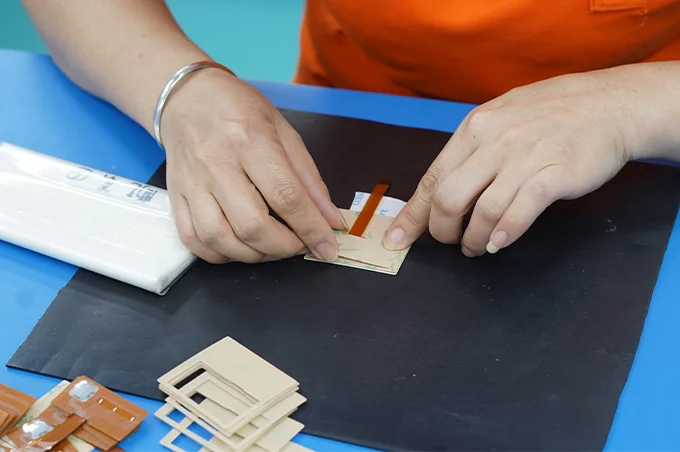
In production, we handle FPC glue paper pull tab design by extending a dedicated pull tab area beyond the final board outline, typically 3-5mm wide with a rounded or finger-friendly contour, connected through controlled perforations or thinned release lines that allow clean separation without tearing into the active circuit area. CAM engineers usually add alignment markers and ensure the tab sits within the panel rail or waste area so the main FPC body remains untouched during lamination and routing. This approach keeps adhesive handling consistent across the panel while giving assemblers a reliable grip point.
What we typically see on the CAM side is that without a proper pull tab, operators end up using tools or fingernails to lift the edge, which risks scratching coverlay or lifting copper at the perimeter. For flex PCB adhesive handling, we prioritize tabs that survive the full production flow including vacuum lamination and AOI inspection.
Where pull tab geometry starts affecting panel stability during lamination
This issue appears mainly because FPC panels use thin polyimide materials that shift slightly under heat and pressure in the lamination press. Glue paper, or release liner, is applied to protect adhesive surfaces or stiffener areas, but the material has its own thermal expansion behavior that differs from the base film. When the tab is too narrow or positioned directly on the board edge, registration tolerances stack up and the paper can wrinkle or misalign, pulling stress into the flex layers.
Factory equipment tolerances for vacuum fixturing and panel handling also play a role. Panels move through multiple stations where operators or automated arms grip the edges — without a dedicated pull feature, the entire release paper tends to stick unevenly, especially on larger arrays or boards with multiple stiffeners.
How adhesive liner positioning impacts coverlay alignment and final outline accuracy
On the outline side, poor pull tab placement directly affects how cleanly the paper releases after lamination or before SMT. If the tab interferes with the routing path, we see micro-tears that propagate into the board margin, causing dimensional drift beyond the usual ±0.1mm tolerance for flex outlines. During coverlay lamination, trapped air or uneven pressure around a badly designed tab leads to bubbles or incomplete bonding near the perimeter.
Production consequences when glue paper removal becomes inconsistent
If not controlled, we observe higher scrap rates during final inspection because residual adhesive or torn paper fragments contaminate pads or coverlay openings. Assembly lines slow down significantly when operators struggle with stuck liners, leading to manual scraping that introduces scratches or static damage on sensitive flex circuits. In worst cases, this causes delamination at stiffener interfaces or misalignment in ZIF connector areas, pushing yield drops of 5-15% on tight-tolerance jobs. Shipment delays follow when panels require rework or extra cleaning steps.
From the fab standpoint, inconsistent handling also affects downstream processes like electroless plating or surface finish uniformity if paper debris affects chemistry baths indirectly through panel contamination.
Factory CAM adjustments and panelization strategies for reliable pull-out
We solve this primarily through panel design where the glue paper pull tab is integrated into the breakaway rail or waste zone. CAM engineers typically offset the tab 2-4mm from the final board contour and add a series of small perforations or score lines spaced at 0.5-1mm intervals. This allows the paper to tear cleanly along the intended path without stressing the polyimide.
For flex PCB adhesive handling, we recommend tab widths of at least 5mm for manual grip and up to 8-10mm on high-volume panels for easier robotic handling. The tab shape is usually trapezoidal or with a flared end to prevent slipping. During panelization, we ensure at least two tabs per board side when possible, positioned away from critical features like vias or bends. Copper clearance around the tab area stays at minimum 0.3mm to avoid any shorting risk during processing.

Process parameters get tightened around lamination — lower initial pressure ramps help the release liner settle evenly before full cure. Post-lamination, AOI stations include checks for tab integrity. In routing, we program the cutter to leave the tab attached until final depanelization, reducing premature lifting during handling.
Assembly line efficiency gains from well-designed pull tabs
Proper FPC glue paper pull tab design cuts removal time per board from 10-15 seconds of fiddly work down to 2-3 seconds of clean pull. This compounds across large panels and high-mix production, improving throughput at SMT lines where operators handle dozens of pieces per shift. Cleaner removal also means fewer defects passed to assembly, reducing first-pass yield issues at placement and reflow.
We see particular benefits on boards with PSA stiffeners or coverlay where the adhesive liner protects until the last possible moment. Consistent tabs reduce training time for new operators and lower the risk of ESD events from excessive handling friction.
Factory processing workflow for glue paper on FPC panels
In our lines, the workflow starts with material prep where release paper is laminated under controlled tension. After circuit patterning and coverlay application, panels go through inspection with the tabs serving as handling points. Routing leaves the tabs intact, and final packaging keeps the paper in place until customer receipt or in-house assembly. Any custom tab geometry gets reviewed in DFM to confirm it fits within standard panel sizes like 250x500mm without wasting material.
When we can relax tab requirements without major risk
Exceptions are allowed on very small prototype runs or boards under 20x20mm where manual handling is minimal and the entire panel is processed as one unit. In low-volume cases with adhesive-less constructions, simpler edge-lift designs sometimes suffice if the release force is low. Trade-offs include slightly higher labor time and potential for minor edge imperfections that may need touch-up before assembly. For high-reliability or automotive-grade flex, we rarely approve deviations.
Overall, investing early in good FPC glue paper pull tab design pays back through smoother production flow and higher customer satisfaction with the delivered panels. When in doubt on dimensions, sharing the gerber with notes on intended assembly method lets our CAM team propose the optimal layout. (Word count: 1187)