How to Read SMD Resistor Codes: 3-Digit, 4-Digit, and R Marks
What This Video Covers
The number printed on an SMD chip resistor is a compact value code, not a random lot mark. This short walks through the three systems you will see on most PCB assembly lots: three-digit codes (significant figures + multiplier), four-digit codes used on tighter-tolerance parts, and R-codes where "R" stands in for the decimal point.
Examples in the video are the ones production and field engineers actually meet: 103 = 10 kΩ, 472 = 4.7 kΩ, 1002 = 10 kΩ, 4R7 = 4.7 Ω, and R10 = 0.10 Ω. Those values drive current limits, pull-ups, analog gain, and current-sense networks on consumer electronics PCB builds as well as industrial control PCB and automotive PCB assemblies.
The page is written so you can decode a marking at incoming inspection, during AOI escape review, or on a rework bench, even if you never play the clip. Use it with your BOM and an SMT assembly quote so the part on the reel matches the value the circuit expects.
Key Highlights
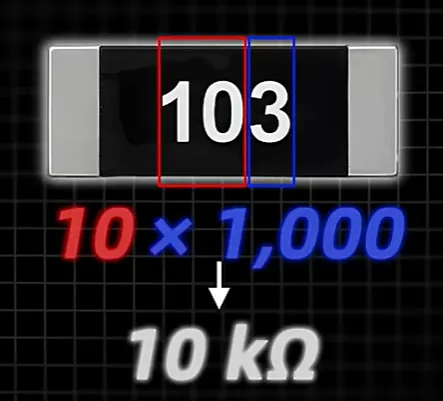
- 3-digit code: first two digits are significant figures; last digit is the power-of-ten multiplier (103 → 10 × 10³ = 10 kΩ; 472 → 47 × 10² = 4.7 kΩ).
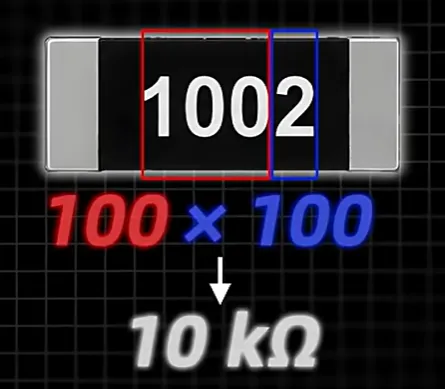
- 4-digit code: first three digits are significant figures; last digit is the multiplier (1002 → 100 × 10² = 10 kΩ), typical on 1% parts.
- R-code: "R" replaces the decimal point on low-ohm and sense resistors (4R7 = 4.7 Ω; R10 = 0.10 Ω).
How 3-Digit SMD Resistor Codes Work
Most general-purpose thick-film chip resistors in 0603, 0805, and 1206 use a three-character numeric mark. The first two characters are the significant figures. The third is the multiplier: how many times you multiply those figures by ten.
That is why 103 is not "one hundred three ohms." It is 10 × 1,000 = 10 kΩ. 472 is 47 × 100 = 4.7 kΩ. 560 is 56 × 10⁰ = 56 Ω. The same logic as through-hole color bands, compressed onto a ceramic body that has no room for four color rings.
On the line, three-digit marks usually map to E24 / ±5% parts. Do not treat the printed code as a substitute for the manufacturer part number in the BOM. Two vendors can print "103" on bodies with different TCR, power rating, and pulse capability. The code only tells you the nominal resistance class.
Factory risk: operators and even some AOI recipes confuse 100 (10 Ω) with 101 (100 Ω) or 102 (1 kΩ). One digit shift is a decade error. On a pull-up that is survivable; on a current-limit or divider it is a field failure. Incoming inspection should sample-read values with a meter, not only scan the reel label.
How 4-Digit Precision Codes Differ
Four-digit marks add one significant figure. The first three digits are the value; the fourth is the multiplier. 1002 is 100 × 10² = 10 kΩ, the same nominal as 103, but written for a 1% (often E96) part that needs the extra digit.
Other common examples: 1001 = 1.00 kΩ, 4992 = 49.9 kΩ, 2201 = 2.20 kΩ, 7500 = 750 Ω. Zero-ohm jumpers are often marked 000 or 0000; treat them as shorts in the netlist, not as "zero times a multiplier."
Four-digit printing needs a larger body or a finer print process. Many 0402 and most 0201 / 01005 parts carry no value mark at all. Value then lives only on the tape, reel, and BOM. If your design uses unmarked packages, the pick-and-place program and incoming lot control are the only protection against a wrong reel.
R-Codes for Sub-10 Ω and Current-Sense Parts
When the value is below about 10 Ω, a trailing multiplier of "0" is easy to misread. Manufacturers insert R where the decimal point belongs. 4R7 = 4.7 Ω. R10 = 0.10 Ω. 1R0 = 1.0 Ω. Four-digit variants follow the same rule: 15R0 = 15.0 Ω, 2R20 = 2.20 Ω.
These marks show up on current-sense, snubber, and power-path resistors in power supply PCB and new energy PCB designs. A misread of R10 as "10 Ω" is two orders of magnitude off and will either starve a sense amp or overheat a shunt.
Milli-ohm shunts sometimes use other letter conventions (M, L, m). Those are vendor-specific. Always confirm against the datasheet before you program a first article.
Why Misread Codes Break BOM, AOI, and Rework
A wrong decode does not stay on the workbench. It contaminates three manufacturing files:
- BOM: value and MPN must agree. A 103 on silk and a 1002 in the AVL can both be "10 kΩ" but they are not interchangeable for TCR or tolerance.
- AOI / AXI: many recipes check body mark against expected string. Teaching "103" when the approved part prints "1002" creates false fails or, worse, false passes if the recipe is disabled.
- Rework: technicians replace by the printed code. If the original was an unmarked 0402, the only safe source is the reel ID and the approved MPN.
DFM practice: keep reference designators (R12, R13) on silkscreen readable, and keep value marks on the component body. Do not reprint the resistor value as board silk unless you also control revision when the BOM changes. Silk-on-pad and undersized legend still fail CAM the same way they do on any other marking job.
For first builds, pair the decoded values with an instant PCB quote and a matched SMT stencil so pad geometry and paste volume match the package you actually purchased.
SMD Resistor Code Quick Reference
| Code | System | Decode | Nominal value | Typical use |
|---|---|---|---|---|
| 103 | 3-digit | 10 × 10³ | 10 kΩ | Pull-up, general E24 |
| 472 | 3-digit | 47 × 10² | 4.7 kΩ | Divider, LED bias |
| 560 | 3-digit | 56 × 10⁰ | 56 Ω | Series / damping |
| 1002 | 4-digit | 100 × 10² | 10 kΩ | 1% analog / reference |
| 1001 | 4-digit | 100 × 10¹ | 1.00 kΩ | Precision E96 |
| 4R7 | R-code | 4.7 | 4.7 Ω | Low-ohm / snubber |
| R10 | R-code | 0.10 | 0.10 Ω | Current sense |
| 000 / 0000 | jumper | — | 0 Ω | Net strap |
Package vs. Marking Reality
| Package | Mark usually present? | What incoming inspection should trust |
|---|---|---|
| 1206 / 0805 | 3- or 4-digit or R-code | Body mark + reel + MPN |
| 0603 | Often marked | Body mark + reel; verify print quality |
| 0402 | Sometimes unmarked | Reel / MPN only; meter sample |
| 0201 / 01005 | Almost never marked | Reel / MPN + process control only |
FAQ
Q1: Why do 103 and 1002 both read 10 kΩ, and can I substitute them on a PCBA order?
A1: Both decode to 10 kΩ, but 103 is the 3-digit (typically ±5% E24) form and 1002 is the 4-digit (typically ±1% E96) form. Substitution changes tolerance, often TCR, and the AOI expected mark. Only swap if the AVL and the circuit tolerance allow it.
Q2: How should a contract manufacturer treat unmarked 0402 resistors on the BOM?
A2: Value is not on the body. Incoming control must lock reel ID to MPN, and first-article measurement should sample a few parts from the pocket tape. Do not program AOI to "read the code" on unmarked packages.
Q3: What happens if a current-sense R10 is loaded as a 10 Ω part?
A3: The shunt is 100× high. Sense voltage collapses or the power path overheats. Catch it with a first-article resistance check on the populated net, not only with a visual of the mark.
Q4: Should resistor values also be printed on the PCB silkscreen?
A4: Only if you will revise silk when the BOM value changes. Most production boards print reference designators only and keep the value on the component and in the BOM, to avoid silk/BOM mismatch after an ECO.
Q5: Does EIA-96 (two digits + letter, e.g. 01B) appear in this video?
A5: No. This short covers 3-digit, 4-digit, and R-codes. EIA-96 is a separate 1% compact system used on small bodies; decode it from the E96 index table plus letter multiplier, not from the last-digit-as-zeros rule.
That number on an SMD resistor isn't random.
Take this one: 103.
The first two digits are the significant figures.
The last digit is the multiplier.
So, 10 × 1,000 gives you 10 kΩ.
Now look at 472.
That's 47 × 100,or 4.7 kΩ.
But what about four digits?
Take 1002.
The first three digits are the significant figures,and the last digit is the multiplier.
So, 100 × 100 equals 10 kΩ.
You'll also see R codes.
Here, R replaces the decimal point.
So 4R7 means 4.7 Ω,while R10 means 0.10 Ω.
Now, your turn.
Can you decode this one?