PCB Surface Finish Explained: HASL, ENIG, and OSP Comparison
What this Video Covers
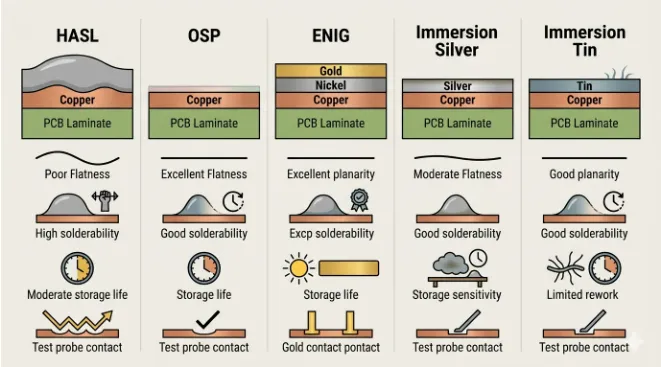
The video breaks down the most common PCB surface finishes used in modern fabrication. HASL remains the lowest-cost option for general-purpose boards but struggles with fine-pitch BGAs and coplanarity. ENIG delivers a smooth, oxidation-resistant gold surface ideal for high-density interconnect designs and long shelf-life storage. OSP offers a flat, RoHS-compliant alternative at lower cost, though it oxidizes rapidly once exposed.
Immersion silver and tin finishes are also covered for RF and budget-sensitive applications where handling sensitivity must be managed. The content helps engineers match finish type to component pitch, assembly process, and environmental requirements before sending files for PCB prototype or PCB assembly.
Key Highlights
- HASL is inexpensive but often unsuitable for fine-pitch BGAs due to uneven surface
- ENIG provides superior flatness and long-term oxidation resistance for precision SMT assembly
- OSP is cost-effective and flat yet requires strict storage control because of rapid oxidation
Core Differences Between HASL, ENIG, and OSP Surface Finishes
HASL (Hot Air Solder Leveling) applies molten solder to the copper pads and then levels it with hot air, creating a tin-lead or lead-free coating. It provides excellent solderability but results in uneven topography, making it challenging for fine-pitch components. ENIG (Electroless Nickel Immersion Gold) deposits a nickel barrier layer followed by a thin gold topcoat, delivering exceptional flatness and corrosion resistance. OSP (Organic Solderability Preservative) applies a thin organic film directly over copper for protection.
In production, HASL is favored for its low cost and robustness in through-hole applications, while ENIG excels in high-density designs due to its coplanar surface. OSP balances cost and flatness but demands careful process control to prevent degradation.
Manufacturing Performance and DFM Considerations for Each Finish
From a CAM engineering perspective, surface finish selection directly impacts DFM outcomes. HASL can cause issues with solder mask registration and via filling due to its thickness variation, potentially leading to bridging or insufficient annular rings in dense layouts. ENIG offers reliable wire bonding and BGA performance but introduces risks like black pad syndrome if plating chemistry is not tightly controlled, resulting in brittle solder joints. OSP maintains excellent flatness for SMT but is sensitive to multiple reflow cycles and environmental exposure.
Practical recommendations include specifying finish type early in the stackup and reviewing pad geometries during DFM analysis. For high-layer count boards, ENIG helps maintain impedance control, while HASL may require compensation for uneven plating in high-volume runs. Always verify shelf life against production scheduling to minimize oxidation-related defects.
When to Choose HASL, ENIG, or OSP for Your PCB Project
Selection depends on component density, reliability needs, and budget. Use HASL for cost-sensitive consumer electronics with larger pitches where coplanarity is not critical. Choose ENIG for fine-pitch BGAs, medical devices, or aerospace applications requiring long shelf life and multiple reflows. OSP suits prototypes and medium-volume runs with quick turnaround, provided storage and handling protocols are followed.
Engineers should evaluate assembly process compatibility—lead-free HASL performs well in standard SMT but may show reduced wetting on very small pads compared to ENIG.
Surface Finish Comparison Table
| Property | HASL | ENIG | OSP |
|---|---|---|---|
| Cost | Lowest | Highest | Low |
| Flatness | Poor (uneven) | Excellent | Excellent |
| Shelf Life | Good (6-12 months) | Excellent (12+ months) | Poor (3-6 months) |
| Fine-Pitch BGA Suitability | Low | High | Medium |
| Corrosion Resistance | Medium | High | Low |
| Typical Applications | Consumer, Through-hole | High-density, High-rel | Prototypes, Quick-turn |
Common Surface Finish Defects and Prevention Strategies
Uneven HASL coating can lead to solder bridging or poor joint formation on fine features. ENIG black pad manifests as weak interfaces after nickel corrosion, often traced to improper gold deposition. OSP oxidation appears as discoloration, causing soldering failures if boards are stored improperly.
Prevention involves strict process controls: monitor bath chemistry for ENIG, ensure proper air knife settings for HASL, and use nitrogen packaging for OSP. During DFM review, flag dense BGA areas and request surface finish compatibility checks. Real-world cases show that mismatched finishes contribute significantly to assembly yield loss.
Additional Surface Finishes: Immersion Silver and Tin Overview
Immersion Silver provides good RF performance and flatness at moderate cost but is sensitive to sulfur and tarnishing. Immersion Tin offers excellent solderability for press-fit connectors but can grow whiskers over time. Both require careful handling and are selected when specific electrical or mechanical properties outweigh general-purpose needs.
FAQ
Q1: Which surface finish works best for fine-pitch BGA components?
A1: ENIG is preferred because it provides a flat, coplanar surface that supports reliable solder joint formation on small-pitch packages.
Q2: How does OSP compare to ENIG in terms of shelf life?
A2: OSP offers shorter shelf life than ENIG because the organic coating oxidizes quickly once exposed to air, limiting storage time before assembly.
Q3: Is HASL still acceptable for high-volume consumer electronics?
A3: Yes, HASL remains cost-effective for non-fine-pitch boards in high-volume runs where coplanarity and long shelf life are not critical.
Q4: What causes black pad in ENIG finishes and how to prevent it?
A4: Black pad results from excessive phosphorus in the nickel layer or plating process imbalances, leading to poor solderability. Prevention includes qualified vendors with tight process controls, regular bath analysis, and post-plating inspections during CAM review.
Q5: Can OSP be used for multiple reflow cycles?
A5: OSP is generally limited to 1-2 reflow cycles before degradation. For applications requiring multiple thermal exposures, ENIG is recommended to maintain solderability and avoid open joints or weak connections.
Why do some PCBs shine like gold while others look plain? The secret lies in the surface finish.
For low-cost projects, HASL is like fast food — cheap and common, but not ideal for fine-pitch BGAs.
Need precision and long shelf life? ENIG is the premium choice — smooth, gold-plated, oxidation-resistant, but more expensive.
OSP is the eco-friendly option — flat and affordable, but it oxidizes quickly once exposed to air, making storage tricky.
There's also immersion silver and tin, often used in RF or budget boards, but both are sensitive to handling and shelf life.
So, which finish is "the best"? It depends on your design, components, and budget.
This is aivon, making PCB learning easier, comment below — and follow for more PCB tips!