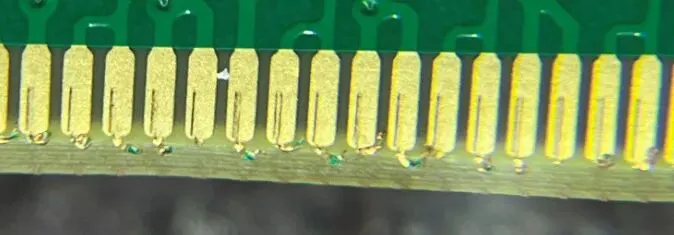
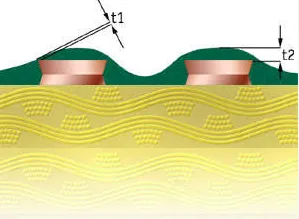
In production we select FR4 prepreg by calculating the resin volume needed to fill the copper topography on each layer pair and then matching that volume to the available resin content and glass style. CAM engineers start with the measured copper thickness and remaining copper percentage, compute the required fill, and choose a prepreg whose resin content delivers a 10–20 % excess after wetting. Thickness is locked next so the finished dielectric stays inside the impedance and overall board-thickness window. Most factories reject a stack-up that relies on marginal resin content before the panel ever reaches the press.

How Resin Content Sets the Real Fill Limit on the Press
Resin content is the percentage of uncured resin by weight in the B-stage prepreg. It determines how much melt is available once the press temperature softens the material. Low-resin styles such as 1080 or 106 leave little excess after the glass is wet; high-resin styles such as 2116 or 7628 with elevated RC provide the extra volume needed for dense copper or thick foil. From a fabrication standpoint the resin-content number is not a material specification alone—it is a production fill budget. When the calculated copper displacement exceeds the available resin, voids form under planes or between fine traces. That is the core constraint behind FR4 prepreg resin content decisions on the manufacturing floor.
Glass style further limits flow path length. Tight weaves restrict resin movement more than open weaves, so the same resin content can behave differently depending on the fabric. CAM therefore pairs resin content with glass style rather than treating them as independent variables.
Where Copper Pattern Forces a Higher Resin Content Choice
Copper thickness and remaining copper percentage directly dictate how much resin is consumed. A 2 oz plane with 80 % copper coverage displaces far more volume than a 1 oz signal layer with 30 % coverage. Narrow spaces between conductors also demand longer flow distances, increasing the risk that the resin gels before the gap is filled. In production we therefore raise the resin content or add an extra thin prepreg whenever the copper topography exceeds the fill capacity of the baseline material. Ignoring this relationship is the most common source of resin voids and thickness variation after lamination.

What Thickness Selection Actually Controls After Lamination
Prepreg thickness is chosen to hit the target dielectric spacing once the resin has flowed and cured. Nominal thickness listed on the material data sheet is the starting point; actual pressed thickness depends on resin flow, copper topography, and press pressure. Excessive resin content can produce a thicker dielectric than planned if flow is restricted; insufficient resin can collapse the thickness and create shorts or impedance shifts. Factories therefore verify the pressed thickness on coupons from every new stack-up and adjust the prepreg construction if the result drifts outside the design window. Thickness selection is never made in isolation—it is always balanced against the resin-content requirement for fill.
In multilayer stack-ups the choice becomes more constrained. Thin cores combined with multiple prepreg plies improve flow but increase the number of interfaces that must wet properly. Thick single prepregs simplify the stack but reduce fill capability on high-copper layers. CAM resolves this by running a fill calculation for each dielectric and selecting the combination that satisfies both thickness and resin volume at the same time.

When the Factory Relaxes Prepreg Selection Rules
Not every design requires the tightest fill and thickness control. Low-layer-count boards with 1 oz copper and open patterns can run standard resin-content prepregs without extra calculation, reducing material cost and lead time. Prototype lots that will not see controlled impedance or high-reliability testing are often allowed a wider thickness tolerance provided the customer accepts the residual risk of minor voids. The trade-off is lower process complexity against a small increase in the probability of thickness or fill variation. Once the same design enters volume production with tight impedance or thermal-reliability requirements, the full resin-content calculation and coupon verification are restored.