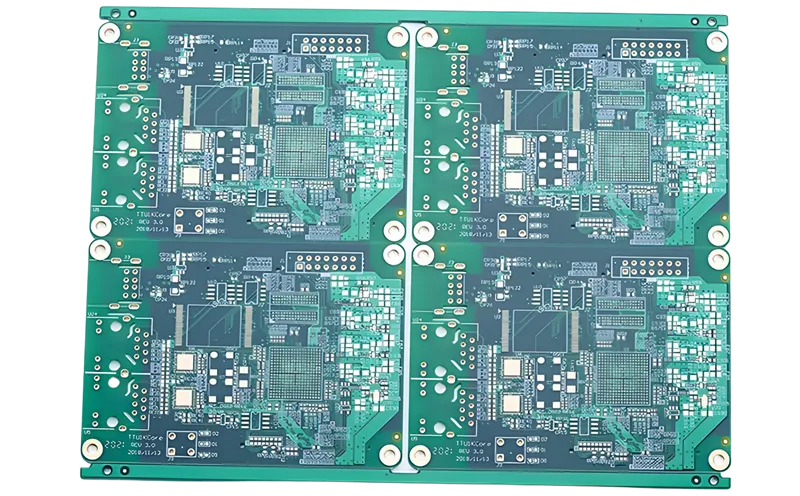
Discover how AIVON manufactures 4 Layer HDI PCBs, including microvia structures, fine-line routing requirements, sequential lamination processes, manufacturing challenges, and real production experience from customer orders.
| Parameter | Typical Range |
|---|---|
| Layer count | 4 layers |
| Material type | FR-4, High Tg FR-4 |
| Surface finish | ENIG, OSP, Immersion Tin |
| Thickness | 0.4mm to 3.2mm |
| Solder mask | Green, black, red, white, yellow, blue, purple |
| Copper thickness | 0.5oz to 2oz |
| Special features | Blind microvias, stacked vias, fine pitch lines |
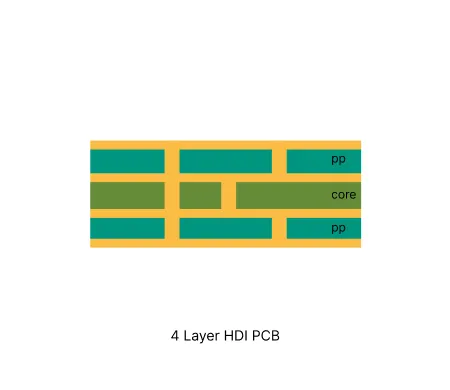
Sequential Lamination: Inner core is laminated first. Outer layers add through controlled press cycles with prepreg.
Laser Drilling: UV and CO2 lasers create microvias. Plasma desmear follows to clean via walls.
Plating Logic: Direct metallization and electrolytic copper fill microvias uniformly. Current density is tightly controlled.
Surface Finish: ENIG is preferred for fine pitch assembly reliability.
Registration control and via inspection mitigate risks throughout the process.
| Order Quantity | Order Proportion | Estimated Price Level | Typical Lead Time |
|---|---|---|---|
| Prototype (<=30 pcs) | 69% | From $180 | From 7 days |
| Small volume (30-200 pcs) | 22% | From $220 | From 8 days |
| Mass production (>200 pcs) | 9% | From $330 | From 8 days |
| Order ID | PCB Type | Layers | Dimensions | Solder Mask | Surface Finish | Quantity | Action |
|---|---|---|---|---|---|---|---|
| Loading... | |||||||
AIVON engineers rugged PCBs for industrial control systems demanding unwavering reliability in harsh environments. Featuring high-Tg materials, heavy copper, and conformal coatings, our solutions withstand extreme heat and vibration. We ensure superior signal integrity and long-term stability for PLCs, robotics, and drives, maximizing your operational uptime.
AIVON automotive electronics PCBs are designed for demanding vehicle environments. They withstand extreme temperatures, vibration, and harsh conditions, supporting ECUs, ADAS, infotainment, and EV modules. Featuring multilayer, rigid-flex, and high-frequency designs, AIVON PCBs meet IATF 16949 standards for safe and reliable automotive performance.
Ensure uncompromising safety with our automotive-grade PCBs, compliant with stringent industry standards. Engineered for EVs, ECUs, and railway signaling, our boards withstand extreme vibration and thermal shock. We deliver the rugged reliability and precision required for mission-critical transportation electronics.
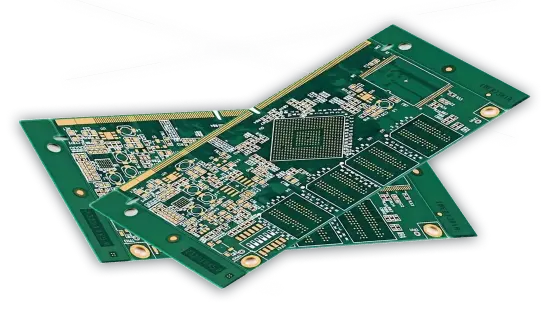
AIVON manufactures 4 Layer HDI PCB with laser microvia drilling, sequential lamination, and fine line imaging capability, ensuring high interconnect density, precise via alignment, and stable electrical performance in high-reliability production.
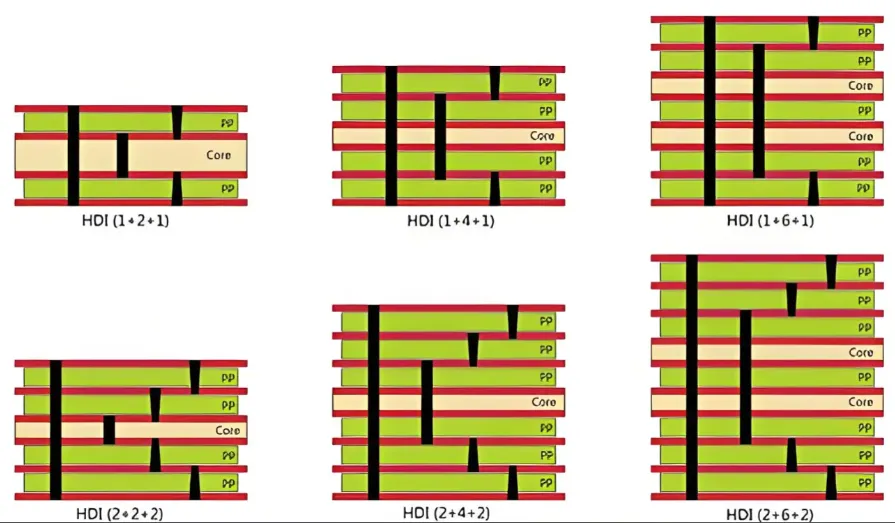
Grasp microvia design rules, boost microvia reliability, stacked microvias setups, laser drilling microvias methods, and microvia impedance control for HDI PCB design. Engineering-focused guide covers best practices, testing, and configurations to ensure high-density board performance and fabrication success.
Read More
Learn advanced HDI PCB design techniques for multilayer boards. Gain insights on microvias, signal integrity, and layer stackup optimization to create compact, high performance electronics with reliable results.
Read More










.webp)