Discover how AIVON manufactures 4 Layer FR4 PCBs, including multilayer stackup design, layer alignment control, fabrication processes, manufacturing challenges, and real production experience from customer orders.
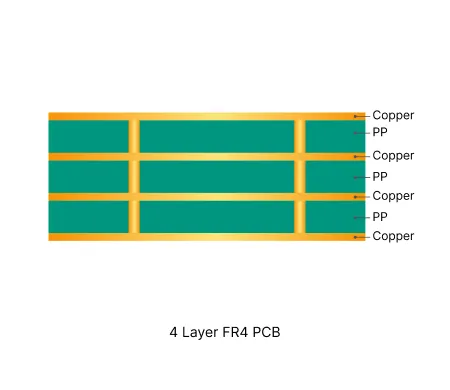
| Parameter | Typical Range |
|---|---|
| Layer count | 4 layers |
| Material type | FR4 TG130 to TG170 |
| Surface finish | HASL, ENIG, OSP |
| Thickness | 0.8mm - 1.6mm |
| Solder mask | Green, black, red, white, yellow, blue, purple, matte black, matte black |
| Copper thickness | 1oz - 8oz |
| Special features | Impedance control, via plugging, heavy copper, gold fingers |
Inner Layer Imaging & Etching Inner cores are imaged and etched first. Precise registration and etch-factor control are essential to maintain annular rings and impedance on signal layers.
Lamination & Stackup Control Cores and prepregs are stacked and laminated under heat and pressure. Copper balance and dielectric thickness uniformity are critical to control warpage and registration on 4-layer boards, especially thin (1.0–1.2 mm) constructions.
Precision Drilling CNC drilling creates through-holes (and any blind vias). Parameters are optimized for layer-to-layer registration and hole-wall quality, particularly on high-aspect-ratio or mixed-copper designs.
Desmear & Electroless Copper Resin smear is removed and electroless copper deposited. Uniform coverage ensures reliable plating of through-holes and any controlled-depth features.
Pattern Plating & Outer Layer Etching Outer layers are imaged, plated and etched. Tight registration to inner layers and controlled etch compensation prevent undercut and maintain fine-line integrity.
Solder Mask Application Liquid photoimageable mask is applied and developed. Via tenting/plugging decisions and mask openings on gold fingers or dense areas are finalized here to avoid ink intrusion and exposed copper.
Surface Finish HASL, ENIG or OSP is applied according to assembly needs. Process control ensures uniform coverage on both outer pads and plated through-holes while preserving dimensional stability.
Routing, V-Scoring & Depanelization Boards are separated by routing, V-scoring or both. Tab strength, stamp-hole design, copper-to-edge clearance and fiducial protection are verified to prevent edge defects on multilayer panels.
Electrical Test & Final Inspection 100% flying-probe or fixture testing confirms continuity and isolation across all layers. Final inspection against IPC criteria (edge condition, registration, solder-mask quality) ensures only compliant boards are shipped.
| Order Quantity | Order Proportion | Estimated Price Level | Typical Lead Time |
|---|---|---|---|
| Prototype (<=30 pcs) | 55% | From $1 | From 2 days |
| Small volume (30-200 pcs) | 30% | From $70 | From 2 days |
| Mass production (>200 pcs) | 15% | From $140 | From 3 days |
| Order ID | PCB Type | Layers | Dimensions | Solder Mask | Surface Finish | Quantity | Action |
|---|---|---|---|---|---|---|---|
| Loading... | |||||||
AIVON medical device PCBs are high-reliability boards designed for healthcare applications. Built with strict quality control, biocompatible materials, and precise manufacturing, they ensure safety and accuracy. Suitable for diagnostic equipment, patient monitoring, and wearable medical devices, AIVON PCBs meet ISO and IPC medical standards.
AIVON automotive electronics PCBs are designed for demanding vehicle environments. They withstand extreme temperatures, vibration, and harsh conditions, supporting ECUs, ADAS, infotainment, and EV modules. Featuring multilayer, rigid-flex, and high-frequency designs, AIVON PCBs meet IATF 16949 standards for safe and reliable automotive performance.
AIVON's consumer electronics PCBs are precision-engineered for smartphones, tablets, laptops, and smart home devices. Using HDI design, fine-line etching, and multilayer fabrication, they deliver compact layouts, high-speed signal transmission, and strong reliability while meeting international quality and environmental standards.
AIVON specializes in 4 Layer FR4 PCB manufacturing with precise multilayer alignment, controlled lamination pressure, and strict impedance control, ensuring consistent electrical performance, high via reliability, and stable mass production yield.
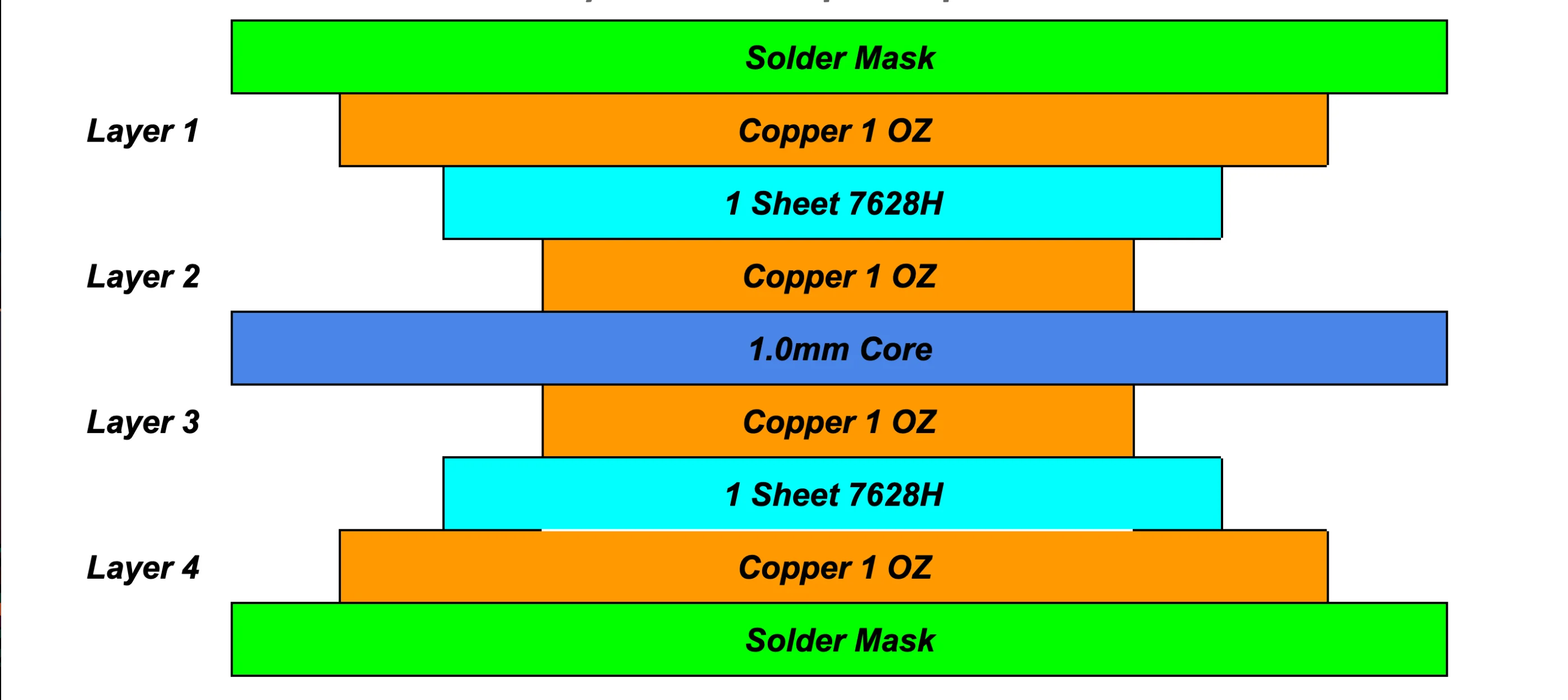
This tutorial covers 4-layer PCB stackup basics for simple hobby designs, including layer arrangements, ground and power planes, symmetry to avoid warpage, signal integrity tips, and troubleshooting. Follow best practices for reliable prototypes with standards like IPC-2221C.
Read More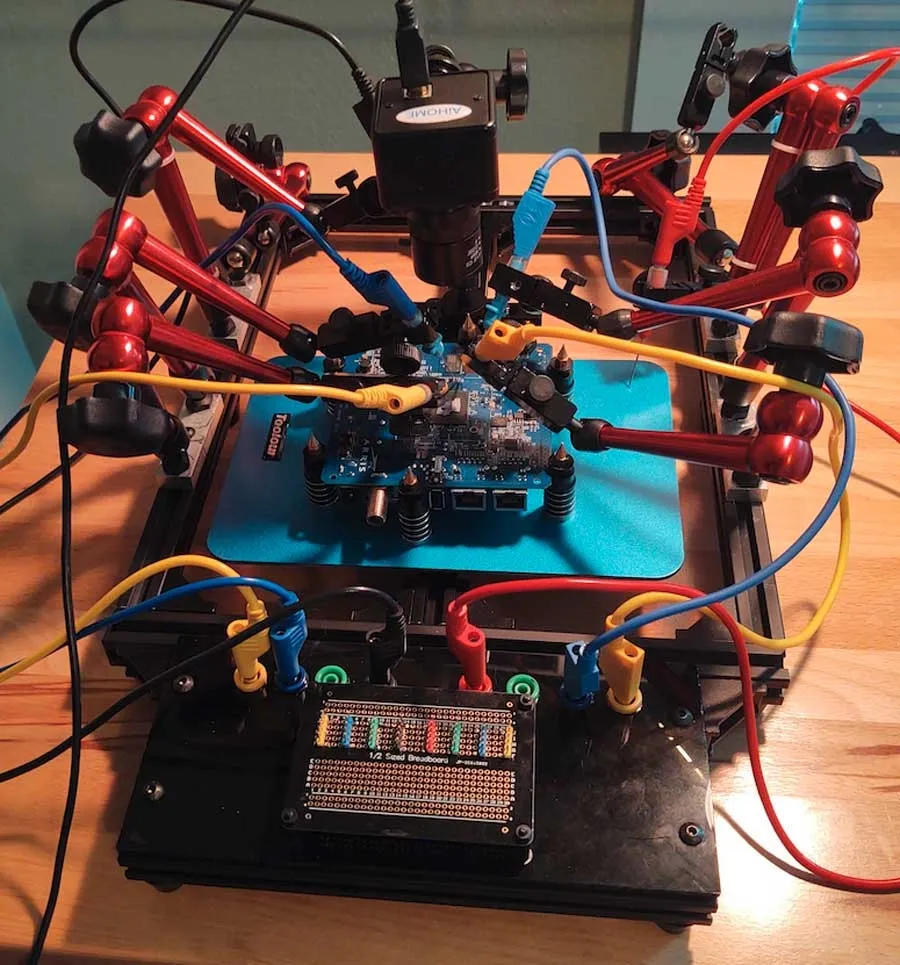
Learn how to build a DIY PCB test setup with pogo pins, Arduino automation, and step-by-step jig instructions. Perfect for hobbyists and engineers—create a professional-grade homemade tester under $100 and diagnose faults fast.
Read More










.webp)