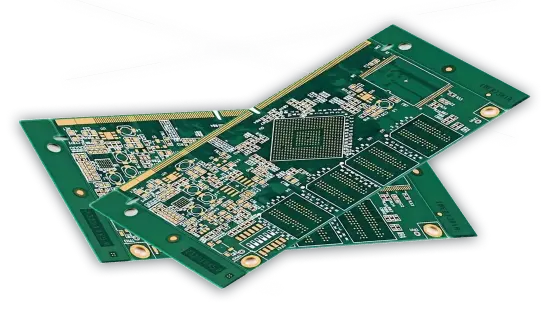
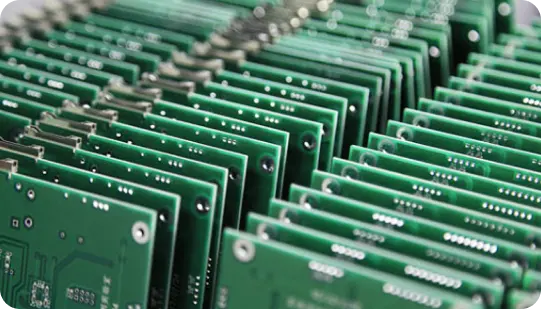
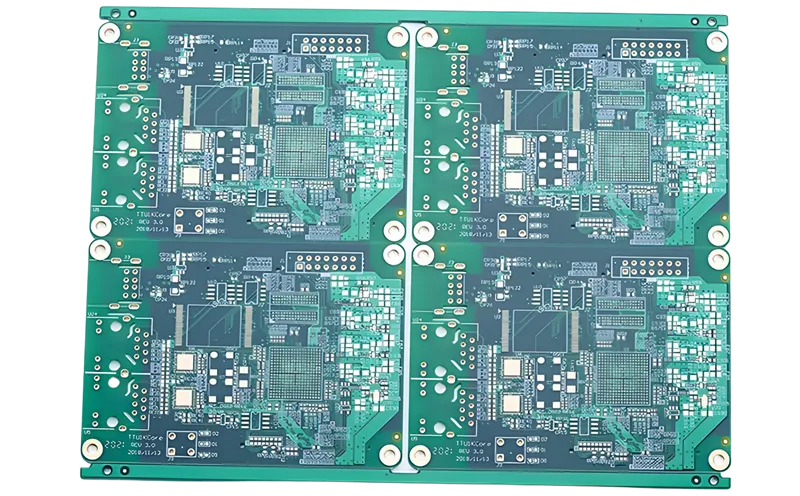
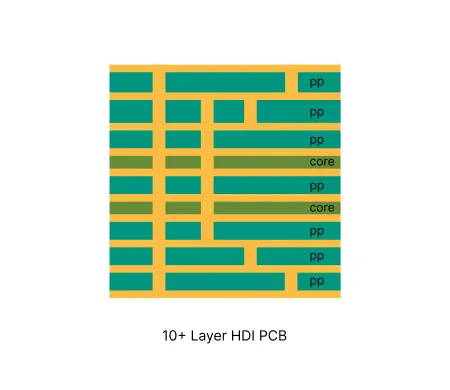
10+ layer HDI PCBs use sequential lamination and microvia technology to achieve high interconnect density in compact multilayer boards. Supports stacked or staggered microvias with laser-drilled structures. Compatible with high-Tg FR-4 and high-speed laminates.
| Parameter | Typical Range |
|---|---|
| Layer count | 10 to 20+ layers |
| Material type | High Tg FR-4, mid-loss or low Dk laminates |
| Surface finish | ENIG, ENEPIG, Immersion Silver, OSP |
| Thickness | 0.8-2.5 mm |
| Solder mask | Green, black, red, white, yellow, purple, matte black |
| Copper thickness | 0.5-2 oz |
| Special features | Blind microvias, buried vias, stacked vias, fine line routing |
Sequential Lamination: Cores are first fabricated and patterned. Build-up layers are added in sequential cycles with precise registration control.
Drilling Technology: UV or CO2 lasers create microvias. Plasma desmear prepares surfaces for plating.
Plating and Surface Finish: Copper electroplating fills vias. ENIG finish protects pads and ensures assembly compatibility.
Surface Finish Application: ENIG is preferred for flatness and wire-bond compatibility. Process parameters are controlled to avoid nickel corrosion.
Key Process Risks: Registration drift and plating voids are monitored through coupon testing and cross-section analysis after each lamination cycle.
| Order Quantity | Order Proportion | Estimated Price Level | Typical Lead Time |
|---|---|---|---|
| Prototype (<=30 pcs) | 44% | From $328 | From 8 days |
| Small volume (30-200 pcs) | 35% | From $368 | From 10 days |
| Mass production (>200 pcs) | 21% | From $504 | From 10 days |
| Order ID | PCB Type | Layers | Dimensions | Solder Mask | Surface Finish | Quantity | Action |
|---|---|---|---|---|---|---|---|
| Loading... | |||||||
AIVON telecommunication PCBs are high-performance boards designed for fast and stable signal transmission. Used in base stations, routers, satellite systems, and 5G infrastructure, they feature advanced materials and precision manufacturing to ensure low signal loss, accurate impedance control, and reliable high-frequency performance.
AIVON medical device PCBs are high-reliability boards designed for healthcare applications. Built with strict quality control, biocompatible materials, and precise manufacturing, they ensure safety and accuracy. Suitable for diagnostic equipment, patient monitoring, and wearable medical devices, AIVON PCBs meet ISO and IPC medical standards.
AIVON's consumer electronics PCBs are precision-engineered for smartphones, tablets, laptops, and smart home devices. Using HDI design, fine-line etching, and multilayer fabrication, they deliver compact layouts, high-speed signal transmission, and strong reliability while meeting international quality and environmental standards.
AIVON manufactures 10+ Layer HDI PCBs with advanced microvia technology and precise laser drilling for high-density interconnects. Strict multilayer lamination, accurate registration control, and reliable copper plating ensure excellent interlayer alignment, tight impedance control, and superior reliability in compact, high-performance applications.
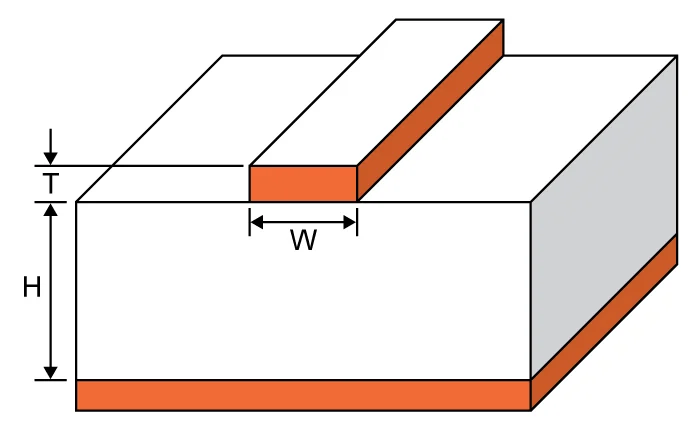
Learn advanced RF PCB routing techniques for microstrip and stripline designs. Gain practical insights on impedance control and signal integrity to improve high frequency performance in your PCB layouts.
Read More
Learn practical solutions with this HDI PCB troubleshooting guide. Identify and fix common defects like microvia failures and signal issues. Perfect for electrical engineers seeking reliable failure analysis tips.
Read More