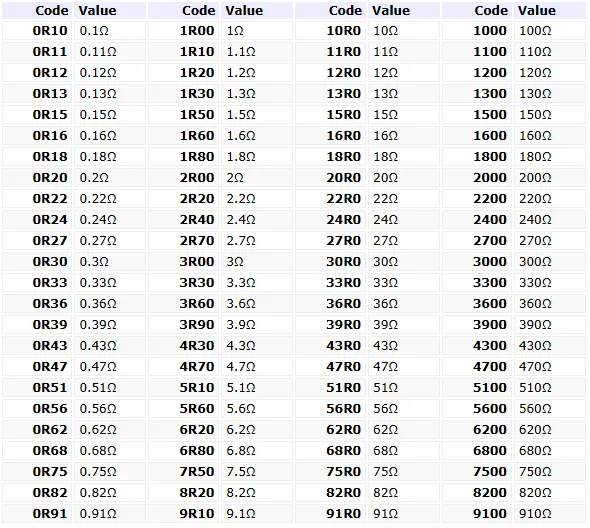
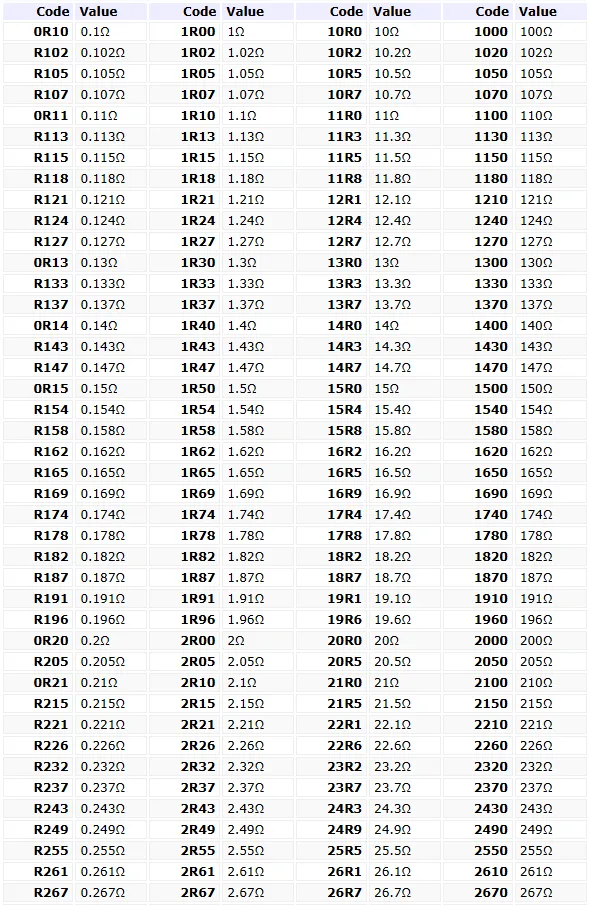
Unlike through-hole resistors that use color bands, SMD resistors use SMD resistor markings to indicate resistance. The most common encoding methods are three-digit, four-digit, and the EIA-96 two-digit-plus-letter scheme.
If you prefer not to memorize code rules, there are simple utilities that can compute resistor values from SMD codes and provide practice examples.
Three-digit code
The three-digit SMD resistor code is the most common format. Rules:
- First two digits: significant figures of the resistance.
- Third digit: power of ten multiplier (10^n).
- Calculation: value = (first two digits) × 10^(third digit).
Examples:
- Code 102: 10 × 10^2 = 1000 Ω = 1 kΩ
- Code 473: 47 × 10^3 = 4700 Ω = 4.7 kΩ (commonly written as 4.7 kΩ or 4.7kΩ)
Four-digit code
Four-digit codes are used when more precision is required.
- First three digits: significant figures of the resistance.
- Fourth digit: power of ten multiplier (10^n).
- Calculation: value = (first three digits) × 10^(fourth digit).
Examples:
- Code 1001: 100 × 10^1 = 1000 Ω = 1 kΩ
- Code 4702: 470 × 10^2 = 47,000 Ω = 47 kΩ
Special case: 'R' denotes the decimal point
For resistances below 10 Ω, SMD codes may use the letter "R" to indicate the decimal point.
- Code 3R3 = 3.3 Ω
- Code R100 = 0.1 Ω
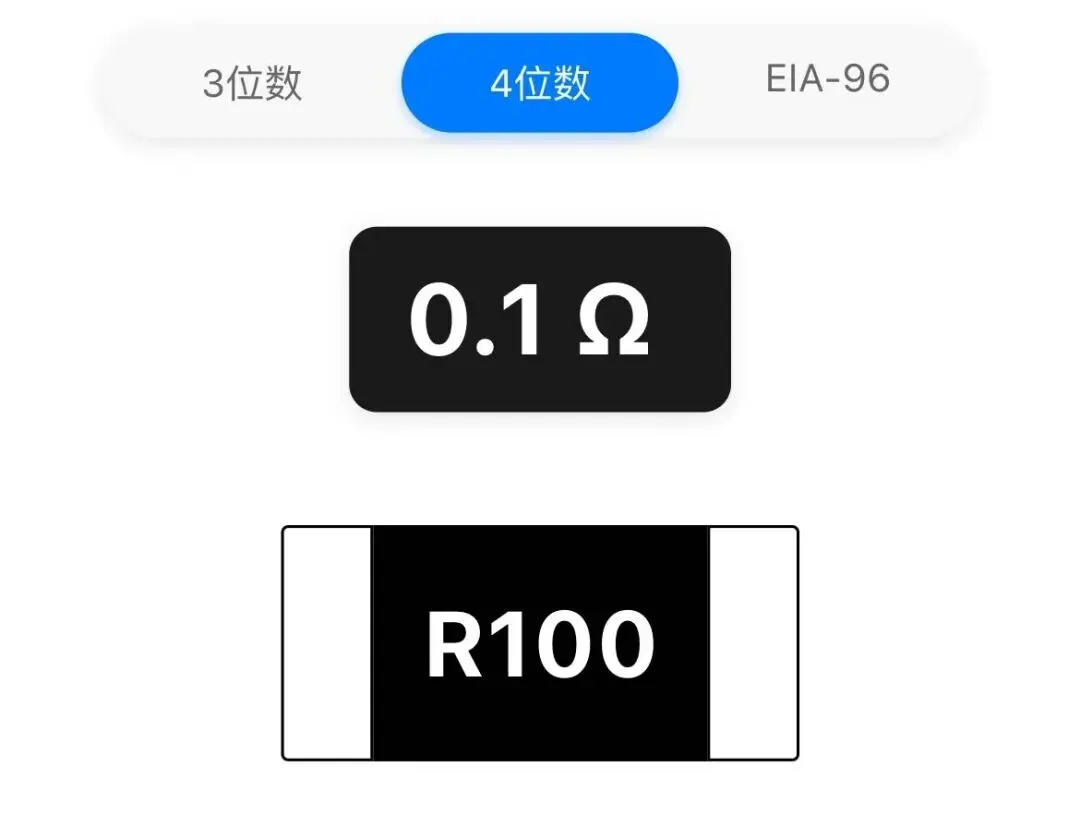
Figure | 'R' used as a decimal point in SMD resistor codes
EIA-96 code (high-precision resistors)
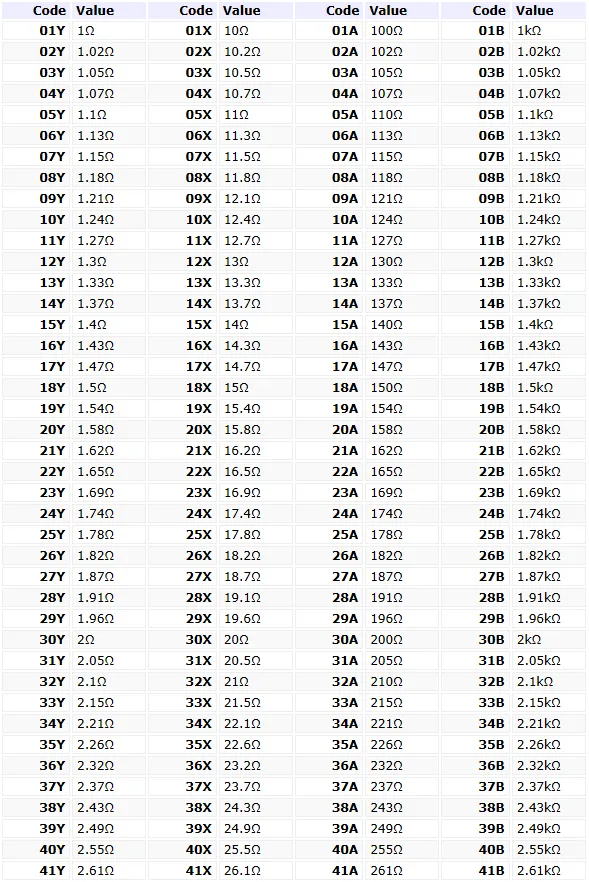
The EIA-96 scheme is used for high-precision (1% tolerance) SMD resistors. Format and rules:
- First two characters: a two-digit code that maps to a nominal resistance value via the EIA-96 table.
- Third character: a letter that indicates the multiplier (power of ten).
Examples:
- Code 01A corresponds to 100 Ω
- Code 24C corresponds to 17.4 kΩ
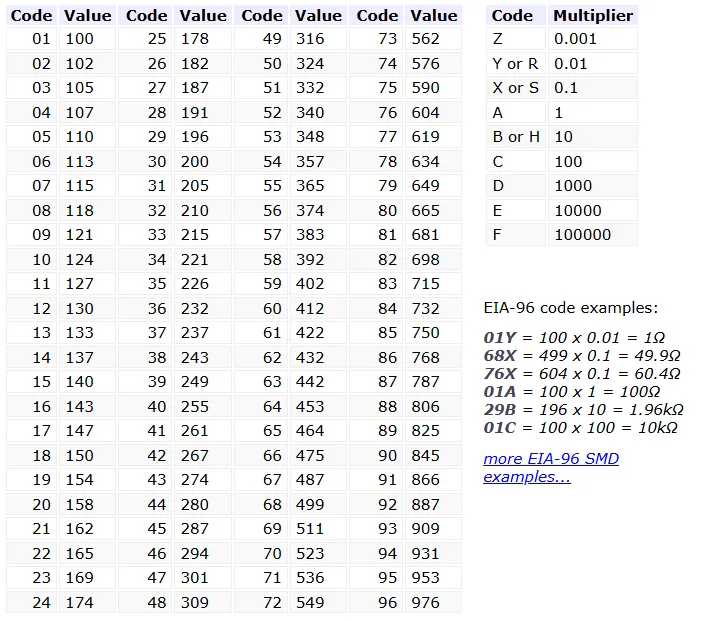
Figure | EIA-96 code lookup (two-digit code maps to base value; letter gives multiplier)
The EIA-96 two-digit code table defines the base values; the letter provides the decade multiplier. Common EIA-96 mappings are shown in the tables and charts below.
Lookup tables and common value charts
If you prefer to look up codes rather than calculate them, standard tables list common SMD resistor values for three-digit codes, four-digit codes (E24 series), and E96 series values. The images below show commonly used charts and E96/E24 value lists.
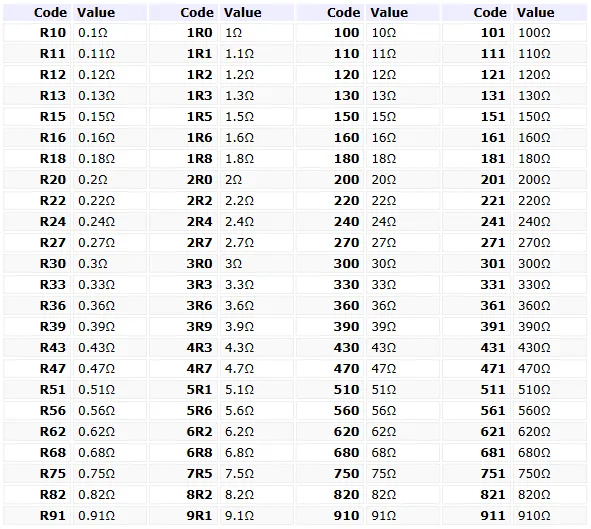
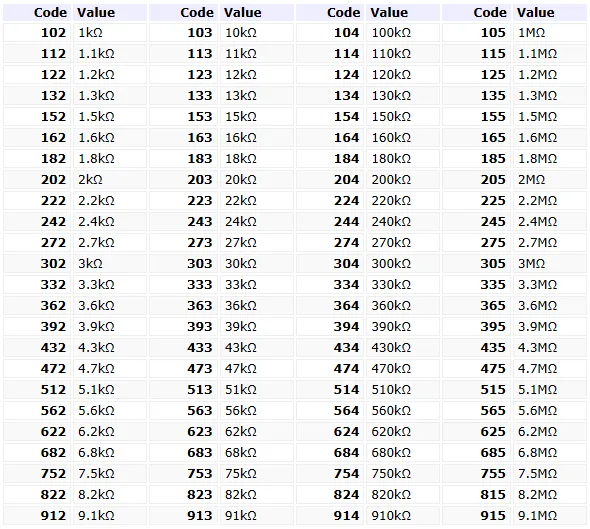
Four-digit common values (E24 series) and higher-resolution lists (E96 series) are shown in the images below.