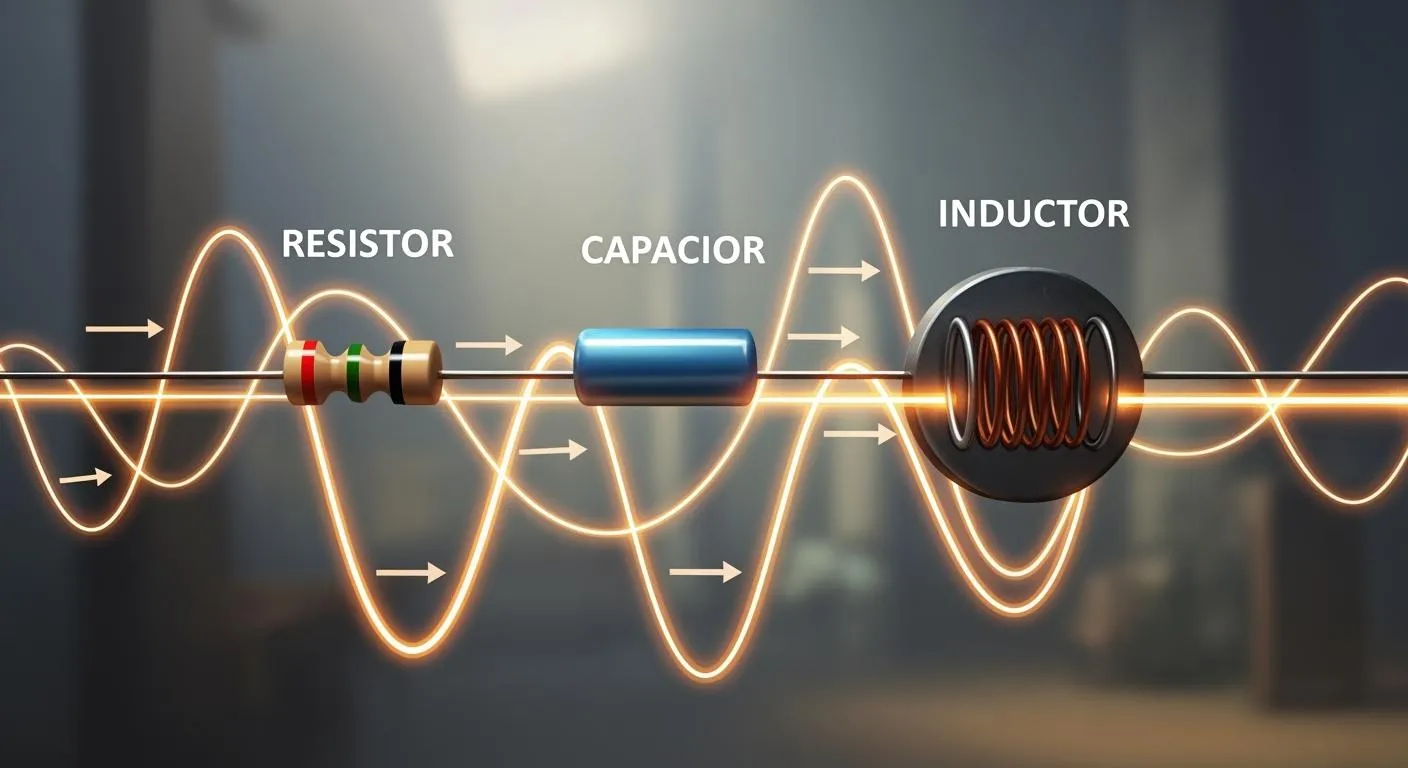
Capacitors and inductors are common circuit elements, and each is tied to a time-domain variable: voltage on the capacitor and current in the inductor. In ordinary circuits, a sudden jump in capacitor voltage or inductor current is rarely observed. That raises a direct question: why can capacitor voltage and inductor current not change instantaneously?
The following sections look at the physical basis of that continuity and at how capacitor voltage and inductor current evolve toward a new steady state.
1. Evolution of Capacitor Voltage
1.1 Basic Capacitor Relationship
A capacitor stores charge. Its voltage and the stored charge are directly related. By definition, capacitance C and voltage V are linked by the relationship shown below:
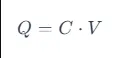
Q is the charge stored on the capacitor. The stored charge is set by the capacitor voltage and the capacitance value.
1.2 Continuity of Voltage
Consider a simple circuit that contains a capacitor. When the input voltage changes, the capacitor voltage changes as well. That change is not a jump. It is continuous.
The reason is that charge flow and charge accumulation are smooth processes. Charge does not move from zero to a finite value in an instant. It builds up or is released over time. The capacitor voltage therefore follows a smooth curve rather than a step.
1.3 Energy Conservation
The same continuity can be viewed through energy conservation. The energy stored in a capacitor depends on its voltage and charge. When capacitor voltage changes, energy does not appear or vanish suddenly. It is transferred between states. That transfer requires a smooth transition in capacitor voltage so that energy conservation is satisfied.
2. Evolution of Inductor Current
2.1 Basic Inductor Relationship
An inductor stores magnetic-field energy. Its current and magnetic flux are directly related. By definition, inductance L and current I are linked by the relationship shown below:
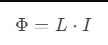
Φ is the magnetic flux in the inductor. As with capacitor voltage, the current and the flux in an inductor change smoothly.
2.2 Continuity of Magnetic Flux
Consider a circuit that contains an inductor. When the input current changes, the magnetic flux in the inductor changes. Like capacitor voltage, that flux change is continuous, not a jump.
The continuity follows from the fact that a magnetic field also changes smoothly. Building or collapsing the field in an inductor takes time, so the current also changes gradually. Faraday's law relates the induced voltage to the rate of change of flux and is consistent with this continuous flux change.
2.3 Energy Conservation
Inductor current follows the same energy argument. The energy stored in an inductor is tied to current and flux. While inductor current changes, energy must transfer smoothly if the energy of the system is to be conserved.
Conclusion
Capacitor voltage and inductor current cannot jump because they are tied to the continuous evolution of charge and magnetic flux. Both variables change through a smooth transition set by charge flow and field change. Energy conservation also requires that transition to be continuous. Understanding this behavior is what allows circuits that use capacitors and inductors to be designed and analyzed as stable electronic systems.