Overview of Software-Defined Vehicle (SDV) PCB Technology
The transition to Software-Defined Vehicles (SDVs) fundamentally changes automotive electrical and electronic (EE) architectures. Centralized computing, service-oriented architectures (SOA), and high-bandwidth in-vehicle networks place unprecedented demands on printed circuit board design and manufacturing. At Aivon, we engineer advanced PCBs that support the high data rates, processing power, thermal management, and functional safety requirements essential for next-generation software-defined automotive systems.

Evolution of Automotive EE Architectures Toward SDV
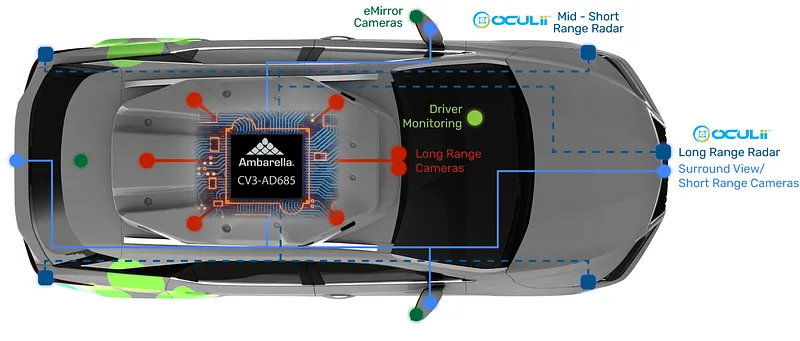
Traditional distributed architectures are giving way to zonal and centralized designs. In zonal architectures, domain controllers are replaced by zone ECUs that aggregate sensors and actuators within physical vehicle zones, communicating with powerful central compute units.
PCB-level implications include:
- Higher Routing Density: Zonal controllers require complex multilayer HDI boards with microvias to handle numerous sensor interfaces and high-speed links.
- Mixed-Signal Integration: Separation of high-speed digital, power, and analog sections demands careful stack-up planning with dedicated ground planes and via shielding.
- Thermal Management: Centralized high-performance computing (HPC) modules generate significant heat, necessitating heavy copper layers, thermal vias, and metal-core substrates.
Service-Oriented Architecture (SOA) and Its Impact on PCB Design
SOA treats vehicle functions as software services accessible through standardized interfaces, enabling continuous updates and feature scalability.

For PCBs, SOA implementation drives:
- High-Bandwidth Communication: Support for Ethernet-based service communication requires tight impedance control (100 ohms differential pairs) and low-loss materials to maintain signal integrity over longer distances.
- Deterministic Performance: Time-Sensitive Networking (TSN) features demand low-jitter clock distribution and minimal crosstalk in multilayer PCB designs.
- Scalability: Modular PCB architectures that allow future expansion of compute and networking capabilities without full redesign.
In-Vehicle Ethernet: The Backbone of Software-Defined Vehicles
Automotive Ethernet (100BASE-T1, 1000BASE-T1, and Multi-Gig) has become the dominant networking technology for SDVs, replacing legacy CAN, LIN, and MOST buses.
PCB design considerations for Ethernet include:
- Controlled Impedance Routing: Precise differential pair layout with tight length matching and minimal vias to achieve low insertion loss and return loss.
- Electromagnetic Compatibility: Advanced shielding techniques, guard traces, and ground stitching to suppress EMI in dense automotive environments.
- Power over Data Line (PoDL): Integration of power delivery with data lines requires careful PDN design to prevent voltage droops and noise coupling.
- Material Selection: Low-loss dielectrics and smooth copper foils are critical for maintaining performance at 2.5Gbps, 5Gbps, and higher speeds.
Levels of Automotive Software Integration
The industry is progressing through five levels of software integration, from basic ECU-level software to fully virtualized, cloud-connected SDV platforms.
PCB requirements evolve with each level:
- Early Levels: Focus on reliable CAN/FlexRay interfaces with standard multilayer boards.
- Advanced Levels: Demand powerful SoC integration, high-speed SerDes links, and robust power integrity for virtualization and AI workloads.
- Highest Levels: Require boards capable of supporting over-the-air (OTA) updates with secure boot, redundant power domains, and high-reliability materials for ASIL-D compliance.
Key Technologies in the CAEdge Framework and PCB Implementation
The CAEdge framework (Continental's automotive edge computing solution) exemplifies modern SDV platforms by combining high-performance computing with real-time control.
PCB engineering challenges include:
- Heterogeneous Integration: Combining high-performance processors, GPUs, and real-time MCUs on the same board requires sophisticated power sequencing and thermal co-design.
- High-Speed Interfaces: Multiple Ethernet ports, PCIe, and MIPI interfaces demand back-drilled vias and hybrid stack-ups.
- Functional Safety: Redundant circuits, watchdog monitoring, and extensive testing for latent fault detection.
Manufacturing and Reliability Solutions for SDV PCBs
To meet automotive-grade requirements (AEC-Q100, IATF 16949), Aivon applies:
- High-Tg and low-CTE materials for thermal cycling resilience
- Enhanced via filling and copper plating for vibration resistance
- Tight impedance and registration tolerances for high-speed performance
- Comprehensive signal integrity, power integrity, and thermal simulation/validation
- Environmental stress screening and functional safety validation
Software-defined vehicles represent a paradigm shift that heavily depends on underlying hardware capability. The performance, reliability, and upgradability of SDVs are ultimately limited by the quality of the PCBs that support high-bandwidth networking, centralized computing, and zonal architectures.
Aivon delivers specialized PCB solutions tailored for software-defined automotive platforms, combining advanced manufacturing processes with deep expertise in high-speed design, thermal management, and functional safety. Our boards enable OEMs and Tier 1 suppliers to accelerate SDV development while maintaining the highest standards of reliability and performance.