An LED, or light-emitting diode, is a semiconductor device that produces light. The name is derived from the initial letters of "Light Emitting Diode." In 1993, the commercialization of high-brightness blue LEDs based on gallium nitride enabled the subsequent development of white LEDs. White LEDs attracted considerable attention as a potential fourth-generation lighting source.
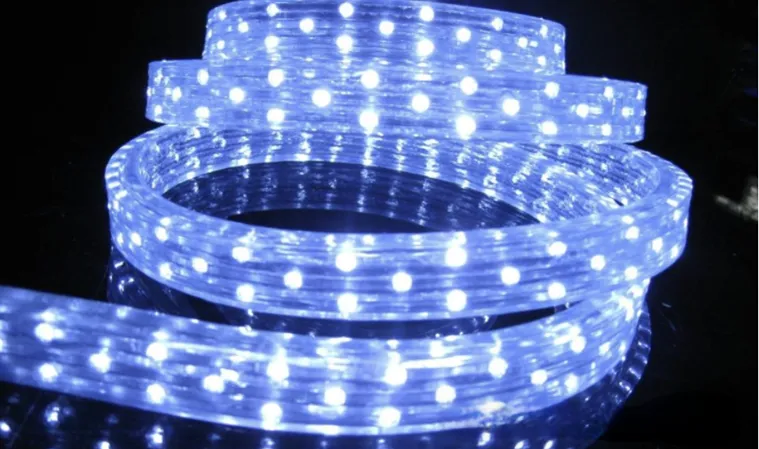
A light-emitting diode is a semiconductor light source that emits light when current flows through it. It is an electroluminescent semiconductor device in which electrons recombine with holes and release energy in the form of photons. A typical flexible PCB LED strip contains multiple light-emitting diodes.
The core of an LED is its PN junction. The surrounding package commonly uses epoxy resin or another transparent material to seal and protect the leads, frame, and semiconductor die. When the PN junction is forward-biased, it can emit visible or non-visible radiation. The emitted wavelength depends on the semiconductor materials and the intentionally introduced dopants used to form the junction.
Like an ordinary diode, an LED primarily conducts current in one direction. Under forward bias, electrons and holes are injected into the junction region. When they recombine, an electron transitions to a lower energy state and releases energy as a photon. This process is known as electroluminescence. The wavelength, and therefore the color, depends on the semiconductor composition and its bandgap.
LEDs offer several advantages over traditional light sources, including high efficiency, long service life, high switching speed, good reliability, and resistance to mechanical damage.
How LEDs Were Invented
The invention of the LED was a multistage process involving contributions from many scientists. Several milestones were particularly important.
Early Theory and Experiments
- 1907: British scientist H. J. Round observed that silicon carbide (SiC) emitted light when electrically energized. This was the first documented observation of electroluminescence in a semiconductor material.
- 1920s: Russian scientist Oleg Losev investigated the phenomenon further and published a paper on the operating principle of LEDs in 1927. His work did not attract widespread attention at the time.
Development of Practical LEDs
- 1962: Nick Holonyak Jr., an engineer working at General Electric, developed the first practical visible-light LED, a red LED. He is widely known as the "father of the LED."
- 1972: M. George Craford, a student of Holonyak, developed the first yellow LED and significantly increased the brightness of red and orange LEDs. By improving gallium arsenide phosphide (GaAsP) technology, he increased LED brightness by approximately ten times.
- 1970s and 1980s: Continuing advances in semiconductor technology led to LEDs in additional colors, including green, yellow, and orange.
The Breakthrough in Blue LEDs
- 1990s: Scientists at Hitachi and Nichia, including Shuji Nakamura, developed high-brightness blue LEDs. This breakthrough was based on gallium nitride (GaN) materials and made full-color displays and white LEDs practical.
- 2014: Shuji Nakamura, Isamu Akasaki, and Hiroshi Amano received the Nobel Prize in Physics for their contributions to the development of blue LEDs.
Development of White LEDs
White LEDs are commonly produced by combining a blue LED with a phosphor. The blue light excites the phosphor, which emits yellow light. The combination of the blue and yellow components is perceived as white light.
LED technology has expanded beyond the visible spectrum into the ultraviolet and infrared ranges. Today, LEDs are widely used in displays, lighting, indicators, optical communication, and other electronic systems.
Why Can an LED Emit Light?
- Semiconductor material: Ordinary diodes commonly use silicon or germanium. When electrons and holes recombine in these materials, the energy is released primarily as heat rather than visible light. LEDs use compound semiconductors such as gallium arsenide and gallium nitride, whose carrier recombination can release energy as photons.
- Band structure: Silicon and germanium are indirect-bandgap materials. Their carrier recombination generally requires momentum assistance and is therefore dominated by non-radiative processes. LED materials are selected for bandgap and band-structure characteristics that support efficient radiative recombination at the desired wavelength.
- Design objective: An ordinary diode is designed primarily for functions such as one-way conduction, rectification, switching, or voltage regulation. An LED is specifically engineered to generate photons and extract them from the semiconductor structure.
An LED is a specialized type of diode. Like other diodes, it is built from semiconductor material processed through doping or related techniques to form P-type and N-type regions. Current can readily flow from the P-side anode to the N-side cathode under forward bias, while reverse current is strongly restricted.
Electrons and holes move from their respective regions toward the PN junction under the applied electric field. When they meet and recombine, an electron transitions to a lower energy state. The released energy appears as a photon, which is the physical basis of light emission.
The wavelength, or color, of the emitted light is determined by the bandgap energy of the semiconductor forming the P-N structure. Silicon and germanium are indirect-bandgap materials. At normal temperatures, electron-hole recombination in these materials is predominantly non-radiative, so the energy is converted into heat instead of being released efficiently as photons. Under special low-temperature conditions, weak emission may be detectable, but ordinary silicon and germanium diodes are not practical light sources.
LEDs use direct-bandgap materials so that carrier recombination can release energy efficiently as photons. Depending on the bandgap, the emitted radiation can fall in the near-infrared, visible, or near-ultraviolet range.
Early LEDs based on gallium arsenide (GaAs) emitted infrared or red light. As semiconductor materials developed, LEDs capable of producing shorter-wavelength radiation became available. Modern devices can generate many different colors by selecting suitable semiconductor compositions and controlling the bandgap.
An LED is often formed by depositing a P-type semiconductor layer on an N-type substrate and connecting the semiconductor layers with electrodes. P-type substrates are also used in some structures. Many commercial LEDs, particularly GaN and indium gallium nitride (InGaN) devices, use sapphire substrates.
Most LED materials have a relatively high refractive index. As a result, a substantial portion of the generated light can be reflected back into the semiconductor at the semiconductor-air interface rather than escaping. Improving light extraction is therefore an important part of LED research and device development.
Key Differences Between LEDs and Ordinary Diodes
1. Different Materials
LEDs use III-V compound semiconductors such as gallium arsenide (GaAs), gallium phosphide (GaP), and gallium nitride (GaN). These materials can support direct radiative transitions, allowing electrons and holes to recombine and release photons. Ordinary diodes generally use silicon or germanium, in which carrier recombination is mainly non-radiative and the energy is released as heat.
2. Different Structures
LED structures are designed to improve both photon generation and light extraction. The PN junction may include carefully selected dopants and layered semiconductor regions that promote carrier recombination in the active region. The package and optical structure are also designed to direct light outward.
By contrast, the structure of an ordinary diode is optimized for electrical performance, such as rectification, switching, or voltage regulation. Light generation and extraction are not primary design objectives.
3. Bandgap Energy
The bandgap determines the energy released when an electron recombines with a hole. In an LED, the semiconductor composition is selected so that the transition energy corresponds to the desired infrared, visible, or ultraviolet wavelength. In ordinary silicon or germanium diodes, the indirect band structure makes photon emission inefficient, and most of the energy becomes heat through non-radiative recombination.
4. Emission Mechanism
When an LED is forward-biased, electrons move from the N region toward the P region and recombine with holes. In a suitable direct-bandgap material, this recombination releases photons and produces light. In an ordinary diode, electron-hole recombination occurs mainly through non-radiative mechanisms, so the energy is converted primarily into heat.
These differences in material system, band structure, device architecture, and optical design explain why an LED can emit useful light while an ordinary diode normally cannot.
How to Improve LED Luminous Efficiency
Improving LED efficiency involves material selection, semiconductor structure, packaging, manufacturing quality, thermal management, and drive conditions. The main approaches include the following.
Optimize Material Selection
- Use efficient emitting materials: Direct-bandgap semiconductors such as GaN, GaAs, and GaP can support efficient electron-hole recombination without requiring phonon-assisted energy transfer. Their different bandgaps also enable red, yellow, blue, and other emission colors.
- Apply controlled doping: Introducing selected elements, such as aluminum, gallium, or nitrogen, can adjust the electrical and optical properties of the semiconductor and improve emission efficiency.
Improve Device and Optical Structure
- Optimize the PN junction: Improving the junction structure can increase the efficiency with which electrons and holes are confined and recombine in the active region.
- Improve light extraction: Optical lenses, cavities, surface structures, and other optical features can reduce internal light loss and increase the amount of light emitted from the package.
Improve Packaging Technology
- Use optically transparent encapsulants: Materials such as silicone or epoxy resin with high optical transmittance can reduce absorption and scattering during light extraction.
- Add reflective layers: A reflective layer can redirect light that would otherwise remain inside the package, increasing total optical output.
Improve Manufacturing Quality
- Reduce defect density: Optimizing the manufacturing process and reducing crystal defects and material impurities can improve both luminous efficiency and operating stability.
- Increase quantum efficiency: Improving the LED chip's quantum efficiency increases the proportion of electrical energy converted into light and reduces non-radiative recombination.
Strengthen Thermal Management
Effective thermal management reduces the operating temperature of the LED and helps prevent thermal droop and long-term light degradation. High-thermal-conductivity materials and suitable heat-dissipation structures, such as heat sinks and cooling fans, may be used where required by the application.
Control Current and Optimize the Driver
- Regulate the operating current: Excessive current can reduce efficiency and increase device temperature. Constant-current driving helps maintain a controlled operating condition.
- Optimize the driver circuit: A well-designed LED driver can improve electrical conversion efficiency and reduce power losses in the drive path.
Use Quantum-Dot and Phosphor Technologies
- Quantum-dot technology: Quantum dots can be incorporated into LED systems to improve color purity and luminous performance.
- Phosphor coatings: For white LEDs, optimizing the phosphor formulation and coating process can improve luminous efficiency and color quality.