CPU, SoC, and MCU appear constantly in computing and electronics. They are all important building blocks, but they are not the same device. This article separates the definitions, functions, and typical applications of the central processing unit (CPU), the system on chip (SoC), and the microcontroller (MCU).
Central Processing Unit (CPU)
The central processing unit, or CPU, is a core component of a computer system. It executes program instructions and controls and coordinates operations inside the computer. A CPU is designed for general-purpose computing: arithmetic, logic, and data movement. A high-performance CPU often has multiple cores to raise parallel processing capacity. CPUs are widely used in personal computers, servers, and workstations.
System on Chip (SoC)
A system on chip, or SoC, integrates several functional blocks on one chip. Those blocks typically include a CPU, a GPU (graphics processing unit), a memory controller, input/output interfaces, and network interfaces. The SoC is designed for high integration so that physical size, power, and cost of the product can be reduced. Smartphones, tablets, and IoT devices use SoCs widely. A defining trait is that multiple cores and functions sit on one chip to cover complex compute and communication needs.
Microcontroller (MCU)
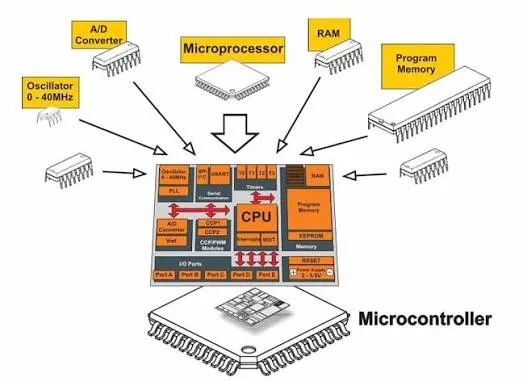
A microcontroller, or MCU, is a small computer system that integrates a central processor, memory, input/output ports, timers, and related functions. Compared with a general-purpose CPU or an SoC, an MCU is usually aimed at a specific embedded task such as appliance control, automotive electronics, or sensor control. Because it is small, low-power, and cost-effective, the MCU is widely used in embedded systems.
Summary of Differences
Function range:
- A CPU is focused on general-purpose computing.
- An SoC integrates multiple functional blocks to cover complex compute and communication needs.
- An MCU is focused on specific embedded applications such as control systems and sensors.
Application areas:
- CPUs are widely used in general-purpose computers such as PCs and servers.
- SoCs are common in portable products such as smartphones and tablets.
- MCUs are used mainly in embedded systems such as home appliances and automotive electronics.
Level of integration:
- A CPU is usually the compute core of a computer system and still needs support from other chips.
- An SoC integrates multiple functional blocks on one chip.
- An MCU is a complete embedded system that integrates the necessary components on the device.
Choosing a compute platform depends on these differences. Different applications need different hardware architectures, and the split among CPU, SoC, and MCU is how those different needs are met.