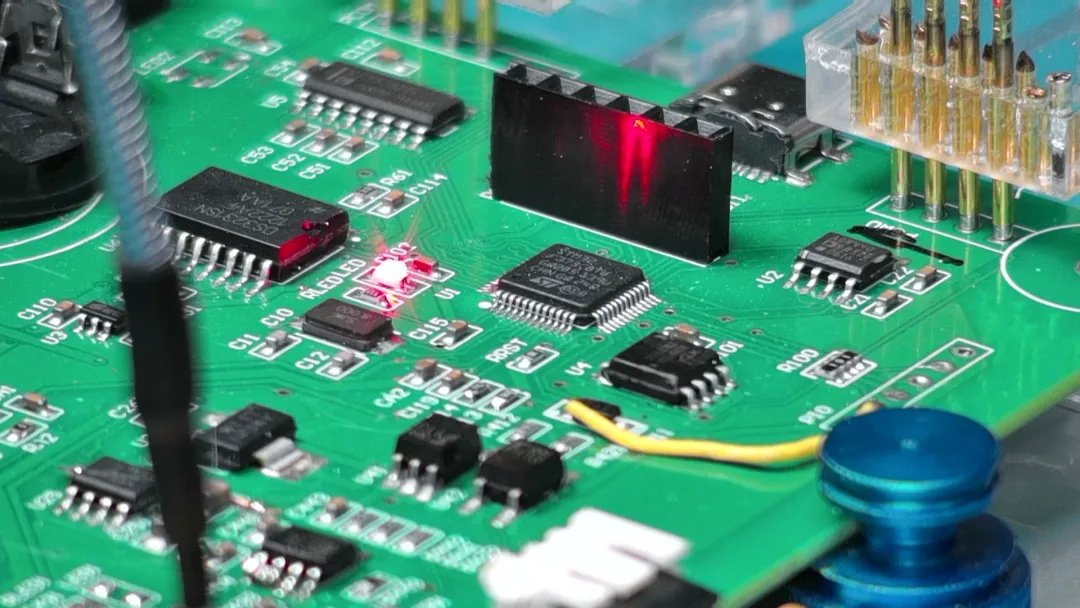
Four-corner testing evaluates the operating margin of a circuit board, device, or system when key electrical and environmental parameters are shifted toward their limits. It is particularly useful during hardware maintenance and reliability improvement, because it can expose weak points that may not appear under nominal operating conditions.
How Four-Corner Testing Works
The test begins by identifying the operating range of the product or system. Relevant parameters may include temperature, pressure, humidity, supply voltage, power, and load. Four representative corner conditions are then selected from the boundaries of those ranges. In a typical electrical and thermal test, the four corners combine low and high temperature with low and high supply voltage.
Each corner is tested using the required functional, performance, and stability workloads. The results are then analyzed to determine whether the system continues to operate correctly and whether any errors or performance degradation occur under the selected conditions.
- Determine the possible operating range of each relevant product or system parameter.
- Select four representative limit conditions from that range.
- Run the required tests at each selected corner, including functional, performance, and stability testing where applicable.
- Analyze the results and correct or optimize any identified weaknesses.
DDR3 Reliability Test Example
In a DDR3 reliability test, four-corner testing is used to verify whether memory devices from different vendors can operate correctly under extreme voltage and environmental conditions. Particular attention is paid to single-bit and multi-bit ECC errors, as these events may indicate insufficient operating margin or a weakness in the memory subsystem.
The test requires an environmental chamber capable of adjusting the temperature between the low- and high-temperature conditions, as well as the board under test. Each test point is operated for 6 hours. Before the environmental test begins, the board is configured with the required stress-test workload and allowed to run for 1 hour to confirm that the system operates normally under the initial conditions.
Test Procedure
- Use the voltage adjustment circuit to set the memory Vdd to Vdd-5%VDD.
- Configure the stress-test workload on the board, run it for 1 hour, and verify that the system operates normally.
- Place the board in the environmental chamber, set the chamber to the high-temperature condition, and begin the configuration A test. Continue the test for 6 hours.
- Review the system logs on the board, check for data errors, and perform ECC verification.
- Reset the board and repeat Steps 1 through 4. Power-cycle the board and repeat Steps 1 through 4 again.
- After completing configuration A, inspect the test results and record the data. Continue with the remaining three configurations.
The four configurations are executed according to the predefined temperature and memory-supply-voltage matrix shown below.
| Test Point | Temperature | Memory Vdd | Run Time (h) |
|---|---|---|---|
| A | High temperature | Vdd-5%VDD | 6 |
| B | Low temperature | Vdd-5%VDD | 6 |
| C | Low temperature | Vdd+5%VDD | 6 |
| D | High temperature | Vdd+5%VDD | 6 |
Expected Results
Under normal operation, the different memory devices should not generate system errors during the four-corner test. System logs should show no single-bit or multi-bit error events, and the ECC verification results should remain consistent with correct data operation.
If the test triggers an error, the result indicates that the system has a weak point under the corresponding combination of temperature and supply voltage. The failure should then be reproduced, verified, and localized before corrective action is taken. The corner condition identifies where the margin is insufficient, but it does not by itself determine whether the root cause is the memory device, the power-delivery network, the PCB layout, the controller configuration, or another part of the system.
Advantages of Four-Corner Testing
Broad Coverage of Operating Conditions
Testing both high and low values of the selected parameters provides a broader view of system behavior than testing only at nominal conditions. A board may pass a normal-temperature, nominal-voltage test while becoming unstable when temperature or supply voltage moves toward an operating boundary. Four-corner testing deliberately examines these boundary combinations.
Strong Focus on Potential Weaknesses
The method concentrates test resources on the conditions most likely to reduce margin. For a memory subsystem, the combination of temperature and Vdd can reveal problems that remain hidden during a short functional check. The same principle can be applied to other products by selecting the parameters most closely related to their reliability risks.
Improved Reliability and Stability
When a failure is found, the design team can investigate the cause and improve the relevant hardware, firmware, configuration, or manufacturing process. Verifying the correction at the same corner conditions provides evidence that the system has improved tolerance to environmental and electrical variation.
Limitations of Four-Corner Testing
High Test Cost
Corner testing can require environmental chambers, programmable power equipment, monitoring instruments, test boards, and long-duration workloads. In the DDR3 example, each of the four configurations runs for 6 hours, in addition to setup, initialization, reset, and power-cycle operations. Consequently, a complete test consumes significant time and engineering resources.
It Does Not Fully Represent Every Field Condition
Four-corner testing covers selected extreme combinations, but real products may experience continuously changing temperature, voltage transients, humidity, vibration, electromagnetic interference, and workload patterns. A system that passes four static corners is not automatically qualified for every possible field condition. Additional tests may be required when these factors are relevant to the product.
Key Elements of Reliability-Oriented Four-Corner Testing
Four-corner testing is a reliability-verification method based on deliberately applying extreme conditions to the system or product. Its central objective is to cover the minimum and maximum values, as well as important boundary regions, of the parameters that influence operation.
Extreme-Condition Coverage
- Temperature: The highest and lowest specified operating temperatures.
- Voltage and power: Supply-voltage variation or unstable power conditions.
- Load: High-concurrency operation or operation with limited resources such as memory and CPU capacity.
- Environmental factors: Humidity, vibration, electromagnetic interference, and other conditions relevant to the product.
Test Dimensions
- Functional reliability: Confirm that required functions remain available under extreme conditions.
- Performance stability: Check whether response time, throughput, and other performance indicators remain within the acceptable range.
- Fault recovery: Evaluate the system's ability to recover after an abnormal event.
- Long-duration operation: Check stability during sustained operation, including issues such as memory leaks where applicable.
Typical Application Scenarios
- Hardware products: Electronic equipment may require high-temperature, low-temperature, high-humidity, and vibration testing. Automotive electronics, for example, may be evaluated against requirements associated with MIL-STD-810 when that standard is applicable to the product.
- Software systems: The test may cover high-concurrency access, low network bandwidth, abnormal input, and limited system resources.
- Industrial equipment: Extreme loads and extended operation can be applied to verify durability and operating stability.
Automotive Controller Example
An automotive controller may be evaluated during development under high and low temperatures, voltage variation, vibration, and sustained full-load operation. The example conditions include functional testing at 85 °C and -40 °C, stable operation during a 12 V±5 V voltage variation, vibration that simulates rough road conditions, and long-duration full-load operation to identify performance degradation.
These conditions represent different stress mechanisms. Temperature variation can affect component characteristics and timing margins. Supply-voltage variation can reduce electrical margin or increase stress on the power-delivery path. Vibration can expose mechanical or interconnect weaknesses, while sustained full-load operation can reveal thermal accumulation and long-term stability problems.
Conclusion
Four-corner testing is a structured method for verifying reliability across combinations of extreme electrical, thermal, environmental, and workload conditions. In PCB and system-level hardware development, it helps expose marginal behavior that may not appear during nominal testing. For DDR3 systems, monitoring system logs, ECC results, data integrity, reset behavior, and power-cycle behavior makes it possible to identify weaknesses in the memory subsystem and related hardware.
The exact corner conditions must be selected according to the product's characteristics, operating limits, and applicable industry requirements. Because different fields may define four-corner testing differently, the common principle is the same: verify system stability, fault tolerance, and performance while key parameters are driven toward their specified boundaries. Properly planned testing can improve robustness and reduce the risk of failures in real operating environments.