




In surface-mount technology (SMT), ensuring the ionic cleanliness of printed circuit boards and electronic assemblies is critical. Ionic residues can cause leakage, corrosion, dendritic growth, and reduced electrical performance, which in turn compromise reliability and service life. To accurately evaluate ionic cleanliness in SMT products, three methods are commonly used: Resistivity of Solvent Extract (ROSE), Ion Chromatography (IC), and the C3 test. This article explains the principles, procedures, strengths, and limitations of these methods, and outlines how to select an appropriate approach for production and quality control.

ROSE testing estimates overall ionic contamination by measuring the resistivity of a solvent extract. Ion chromatography separates and quantifies specific ions to provide a detailed contamination profile. The C3 test focuses on flux residues by evaluating conductivity changes under controlled environmental and electrical conditions. Each method has a role depending on the production stage, required sensitivity, and analytical depth.

ROSE Testing
ROSE is a widely used ionic cleanliness test method. It indirectly evaluates ionic contamination by measuring the resistivity of a solvent extract that has dissolved residues from the board surface. Lower resistivity indicates higher levels of dissolved ionic contaminants.
Test Procedure
- Sample preparation: Cut the SMT board or assembly into appropriately sized samples to ensure the tested surface is representative of the product.
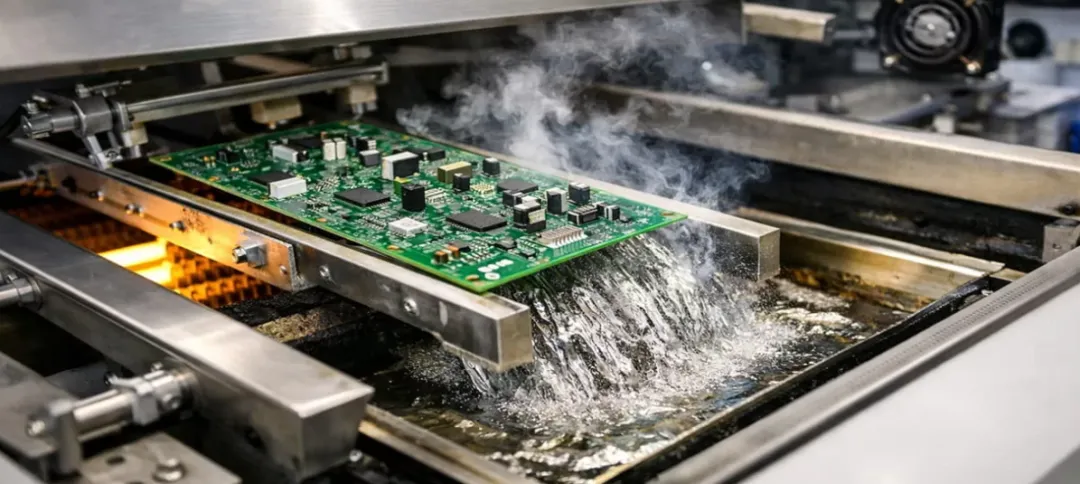
- Solvent extraction: Place samples into a container with a specified solvent, typically isopropanol, and perform ultrasonic extraction under controlled temperature and time to dissolve ionic contaminants into the solvent.
- Resistivity measurement: Use a resistivity meter to measure the extract's resistivity. The lower the resistivity, the higher the ionic contamination.
Advantages
- Relatively simple operation and fast testing, suitable for high-volume production screening and process monitoring.
- Good detection capability for common ionic species such as chlorides, sulfates, and nitrates in aggregate.
Limitations
- Cannot distinguish among different ion species; only provides a total ionic contamination level.
- Sensitivity is relatively low for very low ion concentrations compared to analytical methods like IC.
- Results can be affected by factors such as solvent purity and extraction conditions, requiring consistent procedures to ensure comparability.
Ion Chromatography (IC)

Ion chromatography is a high-efficiency, high-sensitivity analytical technique that accurately quantifies specific ionic species and their concentrations. It provides detailed insight into the composition of ionic residues, supporting root-cause analysis and targeted process improvements.
Principle
Based on ion-exchange separation, the mixed ionic extract passes through an ion-exchange column where different ions are separated according to their affinity for the stationary phase. A detector, such as a conductivity detector, measures each ion as it elutes, enabling identification and quantification.
Test Procedure
- Sample preparation: Similar to ROSE, prepare samples and perform solvent extraction to obtain the analyte solution.
- Injection and separation: Inject the extract into the IC system. Under the mobile phase flow, different ions separate as they traverse the column.
- Detection and quantification: The separated ions pass through the detector, producing signals proportional to concentration. Compare signal response to calibration curves to determine species and levels.
Advantages
- Simultaneously measures multiple ions, including anions (e.g., chloride, fluoride, phosphate) and cations (e.g., sodium, potassium, calcium), providing a comprehensive contamination profile.
- High sensitivity that supports accurate determination of low-level contaminants.
- High accuracy and repeatability for detailed quality control and failure analysis.
Limitations
- Instrumentation is more expensive and requires trained personnel for operation and maintenance.
- Longer test time than screening methods, making it less suited to rapid in-line checks in mass production.
C3 Testing

The C3 test is designed to evaluate ionic cleanliness with a focus on flux residues introduced during SMT assembly. By monitoring conductivity changes under specific environmental and electrical conditions, the method assesses the propensity of flux residues to contribute to ionic contamination.
Principle
Under controlled temperature and humidity, a defined voltage and current are applied to a test structure or specimen. The resulting conductivity changes reflect the presence and activity of conductive residues associated with flux, allowing evaluation of contamination severity.
Test Procedure
- Sample preparation: Place the SMT board or assembly into a dedicated test fixture designed for the C3 procedure.
- Apply test conditions: Set specified temperature and humidity, then apply defined electrical stress (voltage and current) to the sample according to the procedure.
- Measure conductivity: Monitor conductivity changes during the test. Higher conductivity indicates more severe ionic contamination related to flux residues.
Advantages
- Directly targets flux-related residues, making it closely aligned with SMT process control.
- Enables quick assessment of the impact of flux residues on ionic cleanliness.
Limitations
- Primarily detects flux-associated ionic contamination; sensitivity to other contamination sources is limited.
- Results depend on test conditions such as temperature, humidity, voltage, and time, requiring strict control to ensure measurement consistency and accuracy.
Comparison and Method Selection
Comparison
- Analytical capability: IC provides the most detailed information on ion species and concentrations. ROSE offers a total ionic level, while C3 is more specific to flux residues.
- Sensitivity: IC has the highest sensitivity; ROSE and C3 are comparatively less sensitive for very low levels.
- Test speed: ROSE and C3 are faster and suitable for production-floor screening. IC is slower due to separation and analysis steps.
- Cost: ROSE has the lowest cost, C3 is moderate, and IC involves higher instrumentation and operation costs.
Application Selection
- For rapid screening and preliminary assessment in high-volume production, ROSE and C3 are practical options. For detailed analysis, high precision, and root-cause investigation in R&D or quality control, choose IC.
- When flux residue impacts are a primary concern, C3 is appropriate and directly relevant to process evaluation.
- A combined approach can provide comprehensive coverage: use ROSE or C3 for routine monitoring, and IC for periodic in-depth characterization or when issues arise.
Each approach delivers different insights into ionic contamination. ROSE quickly indicates aggregate cleanliness levels for process control. IC quantifies specific contaminants to guide material selection and process optimization. C3 connects directly to flux behavior under environmental and electrical stress conditions, complementing both ROSE and IC for a process-centric perspective.
Conclusion
ROSE, ion chromatography, and C3 each serve distinct roles in assessing ionic cleanliness for SMT assemblies. Method selection should be based on the required analytical detail, sensitivity, throughput, and cost. Using the right technique—or a combination of methods—helps ensure product reliability by identifying contamination sources, guiding process improvements, and maintaining consistent cleanliness levels. As industry requirements for cleanliness continue to rise, testing methodologies are evolving toward greater efficiency, accuracy, and practicality, supporting the long-term reliability of SMT products.