




Why do PCBA assemblies still suffer from catastrophic blowouts, plated-through-hole (PTH) wall cracking, or internal delamination during reflow even when manufacturing follows the process to the letter? The root cause is often not the soldering process itself but insufficient control of moisture uptake. Moisture control across the entire printed board lifecycle is one of the least glamorous yet most consequential aspects of electronics manufacturing.
This article provides a practical, engineering-focused interpretation of IPC-1602-2020 Standard for Printed Board Handling and Storage. Beyond explaining what the standard requires, it translates those requirements into actionable practices that protect yield and reliability while reducing customer returns.
Why IPC-1602 Matters
Before IPC-1602, many organizations relied on legacy military specifications or ad hoc rules developed in-house. Those approaches struggle under today's realities: lead-free soldering with higher peak reflow temperatures (typically 245–260 °C), evolving laminate chemistries, and diverse surface finishes. IPC-1602-2020 was released in April 2020 to address these gaps, superseding IPC-1601A (2016). Importantly, it elevates guidance into enforceable requirements, using shall to define mandatory practices. In other words, it is no longer just a set of best practices—it is a standard meant to be actively implemented.
In scope, the standard governs the full lifecycle of bare printed boards: from factory shipment, transportation, receiving, and storage, through loading into assembly lines and soldering. Its objectives are to prevent physical damage, surface oxidation and solderability loss, electrostatic discharge (ESD) events, and—most critically for lead-free processes—moisture absorption and the resulting expansion during reflow.
Two Invisible Killers: Moisture and ESD
IPC-1602's opening rationale is clear: handling and storage must protect printed boards from contamination, mechanical damage, solderability degradation, ESD, and moisture uptake. Surface scratches and ESD are acute hazards that often leave immediate evidence. Moisture, by contrast, accumulates quietly and reveals itself violently at reflow.
Moisture: The Time Bomb Inside FR-4
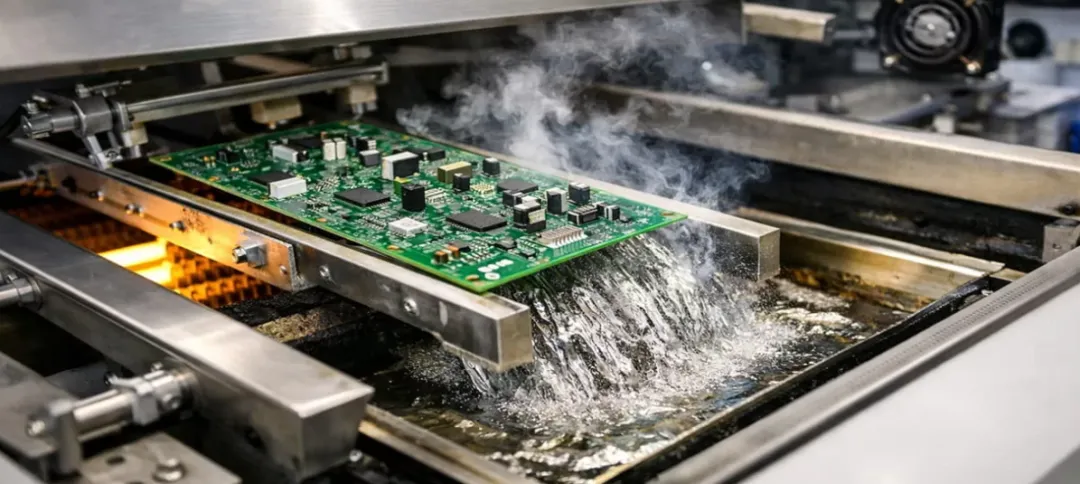
Laminate systems such as FR-4 are polymeric and hygroscopic. Exposed to ambient air, water molecules ingress via edges, micro-voids, and plated-through holes through capillary action. If a moisture-laden board enters a reflow oven, elevated temperatures rapidly vaporize the absorbed water. The resulting vapor pressure can exceed the interlaminar bond strength (peel strength), causing layer separation (delamination or "popcorning"). If stress concentrates within PTH barrel walls, it can lead to plated-hole wall cracking and intermittent opens that may only be detected during functional test or field operation.
ESD: The Unseen Device Killer
For assemblies carrying ESD-sensitive components, robust ESD control is non-negotiable. IPC-1602 calls for compliance with comprehensive ESD control frameworks such as ANSI/ESD S20.20 when handling ESD-sensitive items, from receiving to line-side operations.
How to Implement Moisture and Damage Control Across the Lifecycle
IPC-1602-2020 organizes requirements into three practical stages. The following breakdown explains what to do and why it matters.
Stage 1: PCB Fabrication and Packaging (Section 3) — Establish the First Line of Defense
Moisture control does not start at the assembly line; it starts at the PCB fabricator. If boards are built and packaged without moisture discipline, downstream operations inherit latent risk.
-
Protect moisture-sensitive raw materials: Prepreg and resin-coated foil are sensitive to temperature, humidity, and UV exposure. Unused prepreg should be immediately re-sealed with clips or heat-sealed (as illustrated in the standard) and stored in cool, dry conditions (typical control targets include below 23 °C and below 50% RH). Poor storage compromises resin flow, bond strength, and ultimately reliability.
-
Dry after innerlayer etch: Innerlayer etch exposes base material previously shielded by copper, elevating moisture uptake risk. If moisture is not driven out before lamination, it becomes trapped—a "sealed-in moisture" problem. Once sealed within multilayer stacks, moisture is difficult to remove and can drive delamination at reflow.
-
Get baking profiles right: Baking removes moisture, but excessive baking introduces new risks. Overbaking can embrittle the laminate, darken resin, and degrade surface finishes such as OSP. Establish controlled baking profiles and validate ovens for effective forced convection—uniform airflow is critical. As a general example, high-Tg materials may be baked at approximately 105–120 °C for several hours to de-moisturize, but profiles should be tailored and qualified per laminate type, thickness, and finish. Baking is a tool, not a blanket fix.
Stage 2: Dry Packaging, Storage, and Transportation (Section 4) — Build a Moisture Barrier
Once bare boards leave the fabricator, they face long transit times and multiple handoffs. Without robust dry packaging, earlier process discipline can be undone. IPC-1602 prescribes specific dry-pack requirements:
-
Use proper moisture barrier bags (MBBs): Ordinary plastic bags do not block water vapor. MBBs used for printed boards shall have very low water vapor transmission rate (WVTR) and include an opaque aluminum foil layer to create a true barrier.
-
Quantify desiccant and include HICs: Dry packs must include adequate desiccant and a humidity indicator card (HIC). If HIC dots change color (e.g., blue to pink or brown to blue depending on card type), internal humidity has exceeded target levels and moisture risk is present.
-
Enforce sulfur- and chlorine-free packaging materials: As immersion silver and other sensitive finishes have proliferated, corrosion phenomena such as blackening or white residues have become more common. IPC-1602 explicitly requires auxiliary packaging materials (cartons, foams, desiccants, etc.) to be sulfur-free and chlorine-free to avoid corrosive attack on finishes.
-
Label external cartons clearly: Outer cartons should display clear markings for Pb-free/RoHS compliance, the ESD protective symbol, and the moisture sensitivity caution symbol. These markings communicate downstream handling requirements and reduce accidental mishandling.

Figure 1 | ESD protective symbol commonly required on external cartons
Figure 2 | Moisture sensitivity caution symbol indicating dry-pack handling requirements
Stage 3: Receiving, Storage, and Assembly (Section 5) — The Last Mile on the Shop Floor
For EMS and OEM assembly operations, Section 5 is particularly actionable.
-
Acclimate before opening: Do not open MBBs immediately after cold-chain transit or cool storage. Let sealed packages equilibrate at room temperature—often two hours or more—so internal boards and the ambient environment reach thermal parity. This prevents condensation on cold board surfaces, which would otherwise jump-start corrosion and moisture uptake.
-
Manage floor life with MAMC: Once a dry pack is opened, floor life begins. The standard introduces Maximum Acceptable Moisture Content (MAMC) for bare boards. Allowable exposure time depends on board thickness and stackup. If exposure exceeds limits or moisture uptake is suspected, boards must be re-baked before soldering. Treat floor life as an engineering control linked to moisture content, not a generic "open bag" stopwatch.
-
Measure moisture content when necessary: Traditional gravimetric methods (drying and weighing) remain useful. IPC-1602 also cites advanced, non-destructive techniques such as confocal micro-Raman spectroscopy for localized moisture detection near vias or PTHs. Diagnostic measurement is especially valuable when failure analysis points to latent moisture or when process audits uncover dry-pack or storage deviations.
Reading Between the Lines: Key Insights from the Appendices
Experienced engineers know that appendices often contain the most practical tools. IPC-1602 is no exception.
-
Appendix A: Provides a template for flowing handling and packaging requirements to upstream and downstream suppliers. Integrating this into purchasing documents aligns expectations and reduces disputes—requirements become contractual, measurable, and auditable.
-
Appendix B: Offers a sizing table that links MBB dimensions to required desiccant quantity. This removes guesswork, ensures repeatable packaging quality, and avoids both under- and over-packaging.
-
Appendix C: Discusses diffusion and the concept of bound water in polymers. Moisture can form hydrogen bonds with resin, creating "bound water" that is difficult to remove at low temperatures. This explains why some boards still delaminate after long low-temperature bakes: the moisture never truly left. Effective removal requires appropriate temperatures and strong forced convection to break hydrogen bonding and drive diffusion out of the laminate.
Practical Recommendations for Deployment
Based on common practices observed across assembly operations, the following recommendations help translate the standard into daily discipline:
-
Replace rule-of-thumb habits with documented controls: A dry cabinet is not a panacea. Verify cabinet humidity uniformity, log setpoints and actuals, and account for door-open frequency and duration, which can create local microclimates. Implement formal temperature and humidity recordkeeping aligned with IPC-1602.
-
Audit packaging materials for sulfur and chlorine: Where immersion silver or other corrosion-sensitive finishes are used, require material declarations and verification testing of cartons, foams, and desiccants for sulfur- and chlorine-free content. This addresses a frequent root cause of tarnish and corrosion artifacts.
-
Re-evaluate baking profiles with your laminate supplier: Avoid one-size-fits-all prescriptions such as "bake everything at 120 °C for 4 hours." Collaborate with laminate suppliers to tailor de-moisturizing and cool-down profiles by Tg, thickness, and finish. Document profiles as process control plans and verify with measurement when risk or variability is observed.
Conclusion: Small Details, Big Reliability
IPC-1602-2020 spans a few dozen pages, but it distills decades of hard-won experience from leading aerospace, defense, and electronics manufacturers, as well as major PCB fabricators. Success in high-reliability electronics often depends on quiet disciplines executed consistently: proper drying, dry packaging, humidity logging, acclimation, and ESD compliance.
When PCBA failures appear mysterious, revisit the basics: handling, storage, moisture exposure, and floor life. Latent moisture in bare boards remains a leading cause of delamination, PTH cracking, and solderability issues under lead-free reflow. Preventing these problems upstream is the most effective and economical way to protect yield and field reliability.
Proactive control of moisture and handling is not overhead—it is an engineering control that pays for itself in reduced scrap, fewer reworks, and fewer customer returns.
SEO Title: IPC-1602-2020: Preventing PCBA Delamination and PTH Cracking with Proper PCB Handling and Storage Meta Description: Technical guide to IPC-1602-2020 for printed board handling and storage. Covers moisture absorption, ESD control, dry packaging (MBB, WVTR, desiccants, HIC), baking profiles, MAMC, and shop-floor practices to prevent delamination and plated-through-hole cracking during lead-free reflow.