










-
 28:04
28:04
Custom PCB for PS5 NAND Recycling: Turning Dead Consoles into Reliable Portable SSDs
This video documents the complete process of converting recovered dual BGA132 Toshiba/Kioxia NAND packages from a failed PS5 motherboard into a compact USB 3.x portable drive. It covers NAND desoldering and cleaning, precision reballing, placement onto a custom SM2259XT + AS2235 carrier PCB, firmware programming, capacity detection, and performance testing with CrystalDiskMark. The project also examines real-world file-transfer performance under thermal load and highlights how PCB design parameters influence BGA reflow quality, high-speed signal integrity, and stable operation inside a compact metal enclosure. The case study provides practical insights into NAND recovery, storage hardware development, BGA assembly, and custom PCB engineering.
-
 08:00
08:00
PCB Power Integrity Fixes Enable Sony Frame Reverse Engineering
This video investigates power delivery and component aging issues in a Sony digital picture frame, focusing on the relationship between its backlight circuit and overall system stability. It demonstrates how reconnecting the fluorescent-style backlight can trigger brown-outs, extended boot times, or complete startup failure, followed by hands-on troubleshooting of the backlight circuit, including its coils, diode, and capacitors. The video also highlights practical diagnostic methods such as measuring power rails under load, checking the power supply, testing aged capacitors for high ESR, and evaluating backlight inrush current. By combining real-world repair challenges with the MultiBoi diagnostic platform, the episode offers useful insights into power integrity, component aging, and reliable hardware troubleshooting.
-
 18:16
18:16
PCB Prototyping Turns Xbox One eMMC into Reliable Dual-Channel USB Drive
This video documents the complete process of transforming eMMC memory packages into a working 10 GB dual-channel drive, from chip removal to real-world hardware testing. It covers hot-air extraction, cleaning, programming verification, iterative reballing, Norelsys NS1081 firmware initialization, and performance benchmarking with CrystalDiskMark. Viewers also see the drive tested across multiple platforms, including a Raspberry Pi cyberdeck, modified Xbox 360, PS3, PS4, and Xbox One. By showing both failed attempts and successful recovery—including reflow issues, residual solder balls, and careful rework—the video provides practical insights into eMMC rework, storage hardware development, and the challenges of turning experimental hardware into a functional, reliable product.
-
 13:20
13:20
AIVON PCB Enables Reliable BadWDSD PS3 Firmware Time Travel
This video documents the troubleshooting and successful modification of a CECH-3000 PlayStation 3, beginning with a console that powers on briefly before shutting down due to compromised CMD and CLK connections. It demonstrates how loose wiring caused by handling and vibration can lead to XDR initialization failures, and shows the repair process using properly gauged magnet wire, fresh flux, magnified soldering, and UV-curable solder mask for mechanical reinforcement. After restoring hardware integrity and correcting the NOR flash, the project achieves an unusual firmware transition before enabling qCFW capabilities and optional DEBUG UART diagnostics. The video also highlights critical hardware details—including wire gauge and length, resistance checks, power and ground distribution, solder quality, and mechanical retention—that determine whether a modification remains reliable beyond the initial prototype.
-
 08:23
08:23
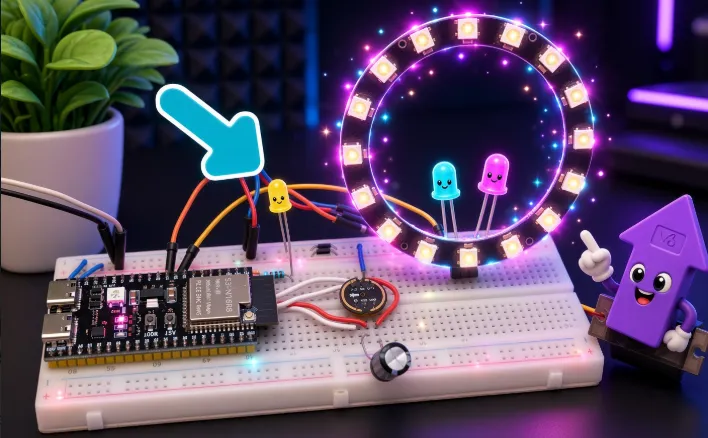
Offline Voice ESP32 PCB: From Demo to Production-Ready Board with AIVON
This video demonstrates the complete TT Voice Studio experience, showcasing how a voice-controlled system can operate entirely offline without cloud services or API integrations. Viewers see the full workflow, from wake-word activation and voice command recognition to controlling LEDs, RGB lighting, servos, and relays through spoken instructions. The video highlights the simplicity of the zero-code setup process, including browser-based firmware flashing, configuration, microphone integration with the INMP441 module, and practical power connection considerations. By combining easy deployment with real-time local processing, TT Voice Studio provides an accessible solution for embedded voice control applications, smart devices, and custom hardware projects.


