Where Each Material Actually Wins on the Shop Floor
In real CNC production, ABS is the default when cost and speed dominate, POM is the safer choice for tight-tolerance functional parts, and Nylon only earns its place when toughness and impact load outweigh moisture risk. Most shops reach for POM first on precision mechanical components because it machines cleanly and holds size. ABS stays in the mix for enclosures and prototypes where a few tenths of a millimeter do not matter. Nylon gets selected only after the moisture environment is confirmed controllable.
The decision is never about which plastic is "better." It is about which set of trade-offs your part can actually live with once it leaves the spindle.
Side-by-Side Engineering Snapshot
| Property | ABS | POM (Delrin/Acetal) | Nylon (PA6/PA66) |
|---|---|---|---|
| Tensile Strength | 35–55 MPa | 60–70 MPa | 70–90 MPa (dry) |
| Wear / Friction | Low–medium | Excellent (μ ≈ 0.15–0.25) | Excellent |
| Chemical Resistance | Moderate (weak to solvents) | Good (avoid strong acids) | Good |
| Water Absorption (24 h) | 0.2–0.3 % | 0.2 % | 1.5–2.5 % |
| Dimensional Stability | Good | Excellent | Poor once moisture is present |
| CNC Machinability | Excellent – fast, low tool wear | Excellent – clean chips, tight tol. | Good – stringy chips, moisture control needed |
| Material Cost | Lowest | Medium | Medium |
| Typical CNC Tolerance | ±0.05 mm | ±0.02 mm | ±0.08 mm (dry) |
| Best Fit | Prototypes, housings | Gears, precision slides | Impact-loaded wear parts |
Decision Matrix for Real Production Priorities
| If your priority is… | Better Choice | Why |
|---|---|---|
| Lowest piece cost & fastest turnaround | ABS | Cheapest stock, highest material removal rate, minimal tool wear |
| Tightest dimensional control after machining | POM | Near-zero moisture uptake and excellent chip control keep size stable |
| Highest mechanical strength under impact | Nylon | Superior toughness when kept dry; POM can be more brittle under shock |
| Low-friction sliding or continuous wear | POM | Self-lubricating surface and lowest friction coefficient of the three |
| Humid or outdoor service with tight fits | POM | Nylon swells 0.5–1 %; ABS softens under heat; POM stays put |
| Mass-production prototypes or cosmetic housings | ABS | Lowest cost and easiest secondary finishing (paint, plate) |
Mechanical Strength and Wear Behavior Under Real Loads
Tensile numbers alone mislead. ABS sits at the bottom of the strength range and is rarely chosen for load-bearing features. POM and Nylon both deliver useful strength, but they fail differently. POM is stiffer and maintains modulus better under continuous load; Nylon absorbs impact energy better but loses stiffness once it takes on moisture. In production we see POM gears run quieter and last longer in dry sliding contact, while Nylon bushings survive shock loads that crack POM if the moisture content is controlled.
Wear resistance follows the same pattern. POM's low coefficient of friction and hard surface give the longest life on unlubricated slides and cams. Nylon is close behind when the contact is under higher pressure, but any humidity swing changes the clearance and can accelerate wear. ABS simply does not belong in continuous sliding applications; the surface wears quickly and generates abrasive debris.
Chemical Resistance and Water Absorption Reality
None of the three materials is a chemical tank liner, but the ranking is clear. POM resists most oils, fuels and weak bases better than ABS; strong acids attack it. Nylon handles similar chemistry but is more sensitive to prolonged moisture. ABS is the weakest of the three against solvents and will stress-crack in contact with many common cleaners.
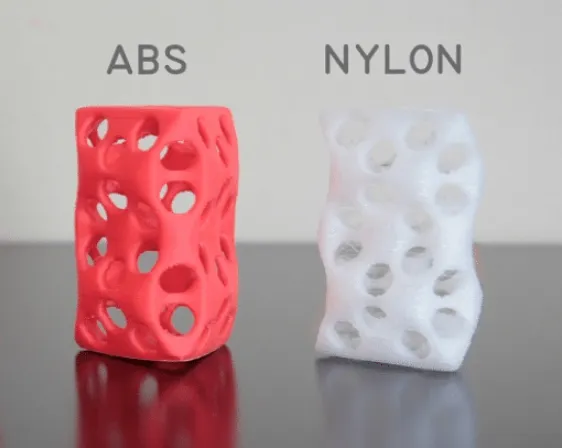
Water absorption is the single largest differentiator in CNC practice. POM and ABS stay within 0.3 %. Nylon can pick up 1.5–2.5 % in 24 hours and continue to saturation. That moisture causes measurable swelling—often 0.3–0.8 % linear—and drops modulus. From a fabrication standpoint we dry Nylon stock before machining and store finished parts in sealed bags when the drawing calls for tight fits. Skipping that step is the most common reason Nylon jobs come back for rework.
Dimensional Stability and Achievable Tolerance
POM routinely holds ±0.02 mm on critical diameters with standard carbide tooling and air blast. ABS is limited to about ±0.05 mm by its lower stiffness and higher thermal expansion. Nylon can match POM only when the stock is fully dry and the shop environment is controlled; once the part leaves the machine the clock starts on moisture-driven growth.
In CAM we treat POM like a free-machining material—aggressive feeds, sharp tools, excellent chip evacuation. Nylon needs lower spindle speeds and chip-breaker geometry to avoid long stringy chips that wrap the tool. ABS is the most forgiving but also the most likely to leave burrs that require secondary deburring.
Machining Difficulty, Tool Life and Process Yield
From the spindle's point of view ABS is the easiest: low cutting forces, minimal heat, long tool life. POM is almost as easy and produces short, clean chips that clear well. Nylon is the most process-sensitive of the three. Dull tools or insufficient cooling cause melting and gumming; stringy chips demand frequent operator attention or high-pressure air. Scrap rates climb when operators treat Nylon like POM.
Panel utilization and nesting are similar for all three because they are available in rod and plate form. The real difference appears in secondary operations. ABS accepts paint and plating readily. POM is difficult to bond or coat without special surface preparation. Nylon can be dyed but also absorbs process chemicals that later affect dimensions.
Cost Comparison That Actually Hits the Quote
Raw material cost ranks ABS lowest, Nylon and POM roughly 1.5–2× higher depending on grade and diameter. The bigger cost driver is machining time and yield. ABS cuts fastest and needs the least inspection. POM machines almost as fast and produces the highest first-pass yield on precision features. Nylon often requires drying cycles, slower feeds, extra inspection for moisture-related drift, and occasional rework—pushing total piece price above POM even when the stock is cheaper.
For low-volume prototypes the difference is minor. Once quantities move into hundreds or thousands, the process cost of Nylon becomes visible and most shops steer the customer toward POM if the application allows.
How CNC Shops Actually Evaluate These Three Materials
During DFM review the first questions are tolerance stack-up, moisture exposure, and whether the part sees continuous sliding or impact. If the drawing shows ±0.03 mm or tighter on a functional diameter, Nylon is flagged immediately. If the part is a housing or cover with open tolerances, ABS is pushed for cost. POM is the default recommendation for any mechanical interface that must stay in size after machining.
CAM programmers prefer POM because toolpaths can be aggressive without constant tool-life monitoring. Inspection departments prefer POM because CMM results stay consistent from first piece to last. Yield on Nylon jobs drops when ambient humidity swings or when operators forget to dry the stock. Those process risks are why many shops quietly prefer POM even when the customer originally specified Nylon.
Which Material Should You Specify?
Choose ABS if you:
- Need the lowest cost and fastest turnaround for prototypes or non-critical housings
- Can accept ±0.05 mm tolerances and moderate mechanical performance
- Plan secondary finishing such as painting or plating
- Have no continuous sliding or high-load requirements
Choose POM if you:
- Require tight dimensional stability after machining (±0.02 mm class)
- Need low friction and long wear life on gears, bushings or slides
- Operate in environments with humidity variation or moderate chemicals
- Want the highest first-pass yield and simplest process control
Choose Nylon if you:
- Need maximum toughness and impact resistance under dry or controlled-humidity conditions
- Can manage stock drying and post-machining moisture protection
- Are designing structural or wear parts that see shock loads rather than pure sliding
- Accept the extra process steps in exchange for higher strength potential
There is no universal winner in ABS vs POM vs Nylon CNC machining. The correct choice is the one whose limitations you have already designed around.
FAQs
Q1: Can I substitute POM for Nylon on an existing drawing to improve dimensional stability?
A1: Yes in most cases, provided the impact loads are moderate. POM will hold size better and machine cleaner. Confirm the friction and toughness requirements with the customer before making the change.
Q2: Why do some Nylon parts grow after they leave the machine shop?
A2: Nylon absorbs atmospheric moisture. Even after drying, the part will continue to take on water until it reaches equilibrium with the service environment. That growth is why we recommend sealed packaging and moisture-aware tolerances for Nylon.
Q3: Is ABS strong enough for functional prototypes that will be tested under load?
A3: Only for light loads and short-duration tests. For any prototype that must survive repeated mechanical stress, step up to POM. The cost difference is small compared with a failed test.
Q4: Which material gives the best surface finish straight off the CNC?
A4: POM. With sharp carbide tools and proper chip evacuation it routinely produces Ra 0.4–0.8 µm without secondary polishing. ABS is close behind; Nylon tends to show more tool marks unless parameters are carefully tuned.
Q5: Does glass-filled Nylon or POM change the ranking?
A5: Glass fill raises strength and stiffness for both, but increases tool wear and can make the material more abrasive. Unfilled POM remains the easiest and most stable choice for most precision CNC work.
Q6: For high-volume production, should I stay with CNC or move to molding?
A6: Once annual volume exceeds a few thousand pieces and geometry allows, injection molding becomes more economical for all three materials. CNC remains the right process for low-to-medium volume, tight-tolerance, or frequent design-change parts.